
On Jan. 18, at the second weekly Dartmouth Student Government meeting of the winter term, senators listened to two presentations about mental health on campus — the first by faculty members involved in Evergreen.AI, and the second by members of the student Mental Health Union.
During the meeting, MHU co-presidents Mingyue Zha ’27, Chelsea Mills ’26 and policy chair Luna Zhang ’29 shared their takeaways from the Ivy League Mental Health Conference, which was held from Nov. 7 to Nov. 9 at Princeton University
Zha said there was a “student mental health crisis,” with 13% of students reporting seriously considering suicide and 11% of the Dartmouth population experiencing thoughts of suicide, according to the Healthy Minds Study.
“Across speaker sessions, presenters shared updated data showing continued increase in anxiety, depression and suicidality among college students year after year post-COVID,” Zha said.
Center for Technology and Behavioral Health Dartmouth director Lisa Marsch and assistant professor of psychology Michael Heinz began the meeting with a presentation about Evergreen.AI, which is being billed as the world’s first campus wellness AI. At the beginning of the presentation, Marsch said that her goal was to enable a “transparent discussion” that clears “misconceptions” surrounding the project.
“We really wanted to have a conversation, and one of the main things we wanted to do here is give you a clearer sense of what Evergreen.AI is,” Marsch said. “It’s really built by Dartmouth students for Dartmouth students, and we’re supporting students in that effort.”
Marsch said that Evergreen can undertake “personalized measures” designed to support students’ well-being by creating study plans, monitoring personal health changes and finding local activities to support them.
Marsch added that Evergreen is not for students struggling with mental health crises and will not be a replacement for conventional therapy services.
“This is not AI therapy,” Marsch said. “This is not a mental health chatbox. This is a tool, ideally, that any undergraduate who's interested could use once it's out of research and testing.”
Evergreen.AI has hired 130 undergraduate students to help build the service, according to Marsch. Marsch noted that the project uses pre-structured dialogues rather than large-language models.
“It's not generative AI,” Marsch said. “It is a structured chatbot building on dialogues that Dartmouth students have written for this structured chatbot.”
March said that students control how much of their data is shared with Evergreen, and she added that data shared with this platform will not be accessible to Dartmouth administrators.
“Students control everything … in a really granular way,” Marsch said. “It's all privacy first.”
DSG deputy chief of staff Vani Miglani ’28 expressed concerns around AI’s tendency to “hallucinate”—referring to the generation of factually incorrect information—and how that might influence Evergreen’s model.
Heinz explained that the Evergreen team will set “limitations on what the app can do” to ensure user safety.
“If we see that somebody is using it whose severity [of mental health crisis] is higher than what the app can manage or has problems that the app isn’t equipped to manage, then we have off-ramps for that,” Heinz said.
According to Zha, many AI mental health tools, such as Evergreen.AI are emerging as “scalable, stigma-free” mental health solutions, although she added that they may require “human helpers” to make them “as effective as possible.”
“As DSG works with various organizations, like Evergreen.AI, [it] will need insights to reinforce our need for data safeguards and also human oversight of these programs, [their] distribution and [their] automation,” Zha said.
Zha said that aside from AI-based tools, investment in peer-to-peer support programs and counseling services could also improve mental health on campus. She added that stress management at Dartmouth had to be “changed at a foundational level.”
“Acknowledging how to uphold rigorous demands of an elite institution while helping students redefine what productivity looks like … is super important,” Zha said.
Following the presentations, senators convened in a closed-session meeting that was not open to campus.
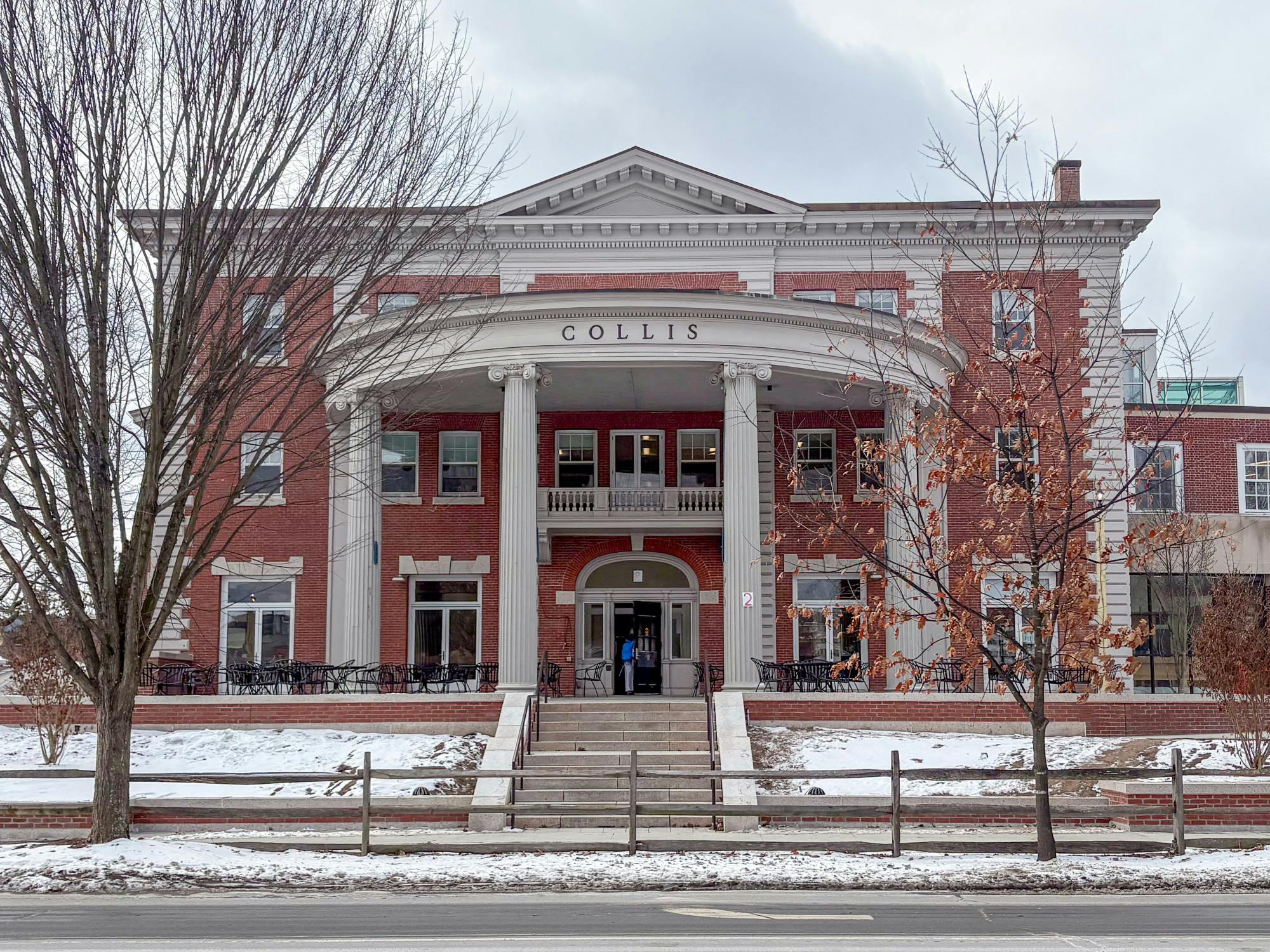
DSG Senate meetings occur weekly on Sundays at 7 p.m. in Collis 101 and are open to all students.
Kailyn Holty ’29 is a news reporter from Redwood City, Calif., and is majoring in economics and quantitative social science.


