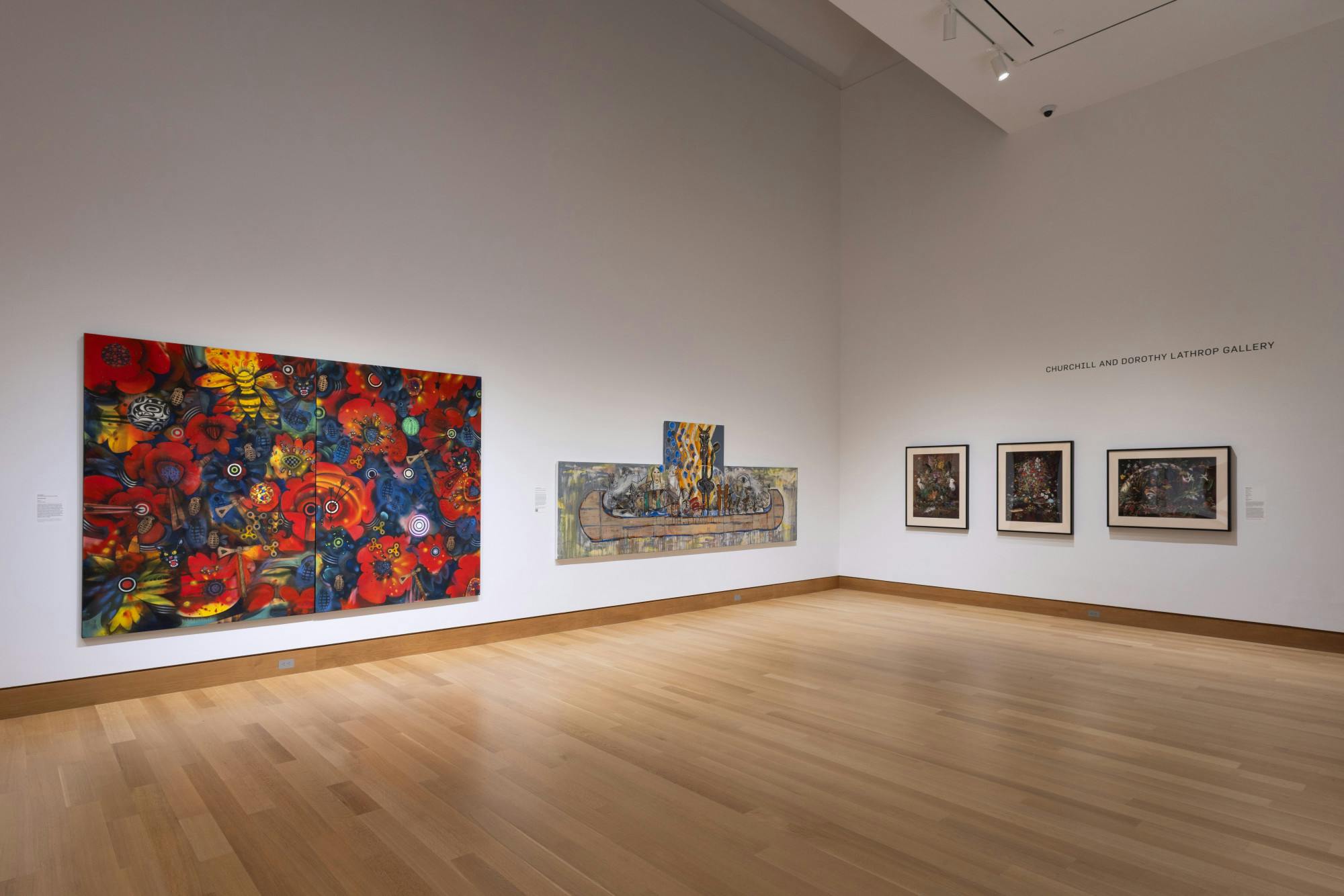
“American Pop,” on view at the Hood Museum of Art from Dec. 13, 2025 through Nov. 7, 2026, reframes Pop Art as an evolving visual language shaped by consumer culture, colonial histories and environmental concerns. The exhibition places canonical works alongside contemporary artists to invite viewers to reconsider how American identity has been constructed and contested.
The Pop Art movement emerged in Britain and the United States in the mid-20th century. It draws on imagery from popular and consumer culture such as advertising, comics and everyday objects. By blurring the boundaries between high and low culture, Pop Art challenged traditional definitions of art while commenting on the rise of consumerism.
Curated by associate director for curatorial affairs and curator of Indigenous Art Jami Powell, as well as the Hood curatorial department’s Mutual Learning Fellows Evonne Fuselier and Beatriz Martinez, the exhibition brings together works from across the Hood’s collection to examine how Pop visual language has been used, adapted and challenged across time.
The exhibition is part of the Hood Museum’s broader 2026 curatorial vision — using the 250th anniversary of the United States as an opportunity to reflect on the creation of our national history, according to senior curator of academic programming Amelia Kahl.
“The history of the United States is intimately tied up with Indigenous histories,” Kahl said. “A lot of objects on view in these exhibitions are by Indigenous artists.”
Working exclusively with the Hood’s permanent collection, the curatorial team approached “American Pop” as a focused exploration of consumerism, colonialism and the environment — themes that emerge when works are placed in dialogue across periods, perspectives and artistic strategies.
Fuselier and Powell noted that visitors often arrive with narrow understandings of Pop Art shaped by familiar figures such as Andy Warhol and Ed Ruscha. They said that the exhibition deliberately uses these canonical artists as points of entry into broader conversations.
“With the idea [that] using the familiar people can have that sort of entry point [to] connect with this resource, [viewers] will be able to engage with this piece in a deeper way,” Fuselier said. “Hopefully that can sort of guide the way that people are engaging with other pieces.”
Powell explained how Pop Art exists outside of its associated timeframe.
“Pop as an art historical moment can be studied on its own as something that really peaked in the 1960s,” Powell said. “But Pop Art as pop culture is something that contemporary artists continue to draw on their work today. And so, it is something that has really influenced the work of artists, and particularly for the show, Native American artists, who are grappling with the complexity of colonization and of dispossession.”
Rather than treating consumer culture as Pop Art’s sole concern, “American Pop” foregrounds how consumerism intersects settler colonial histories and environmental extraction, positioning these themes as interconnected forces within American visual culture.
Powell described how the placement of the works throughout the exhibition was intentional, creating dialogue between the pieces and across time.
“We placed [works] in conversation with other works,” she said. “So thinking about environmental extraction and oil by the inclusion of the Tony Abeyta and Cannupa Hanska Luger, as well as settler colonialism, with the inclusion of George Longfish and discussions of blood quantum.”
By placing canonical Pop Art works, including Ed Ruscha’s “Standard Station, Amarillo, Texas,” alongside contemporary artists such as Jaune Quick-to-See Smith, Tony Abeyta and Cannupa Hanska Luger, the exhibition shows how Pop strategies like appropriation, satire and repetition have been mobilized to critique elements of pop culture.
Fuselier emphasized that these artists are not presented as “just a discrete group of artists.”
“We’re working in this time,” she said. “And that’s the only time that visual imagery is being interrogated by artists. So bringing in these artists that are working more recently, up until last year, we can sort of build that conversation out and have people see how visually and technically these artists are in conversation with each other across the time period.”
Powell explained how placing newer Pop works alongside more canonical ones adds “a more nuanced layer of understanding” to the earlier works and the movement. For example, she claimed that Ruscha’s work is recontextualized through the lens of Lugar’s focus on environmental justice and violence against indigenous people and women.
Several works in the exhibition function as key entry points for these conversations, using visual density, scale or extended interpretation to encourage sustained engagement, including Jaune Quick-to-See Smith’s “Trade Canoe: 40 Days and 40 Nights.”
Fuselier emphasized that American Pop is designed to meet viewers where they are. It invites students and visitors to spend time with the works, return multiple times and leave with a more complex understanding of Pop Art.
“A big thing about Pop Art is just taking a second look at things that are really familiar to you,” Fuselier said. “I think that’s a big desire of these works, and as to what we’re curating, that people can take a look at things upstairs, and after spending some time with them, come out with a different understanding, a different perspective.”