
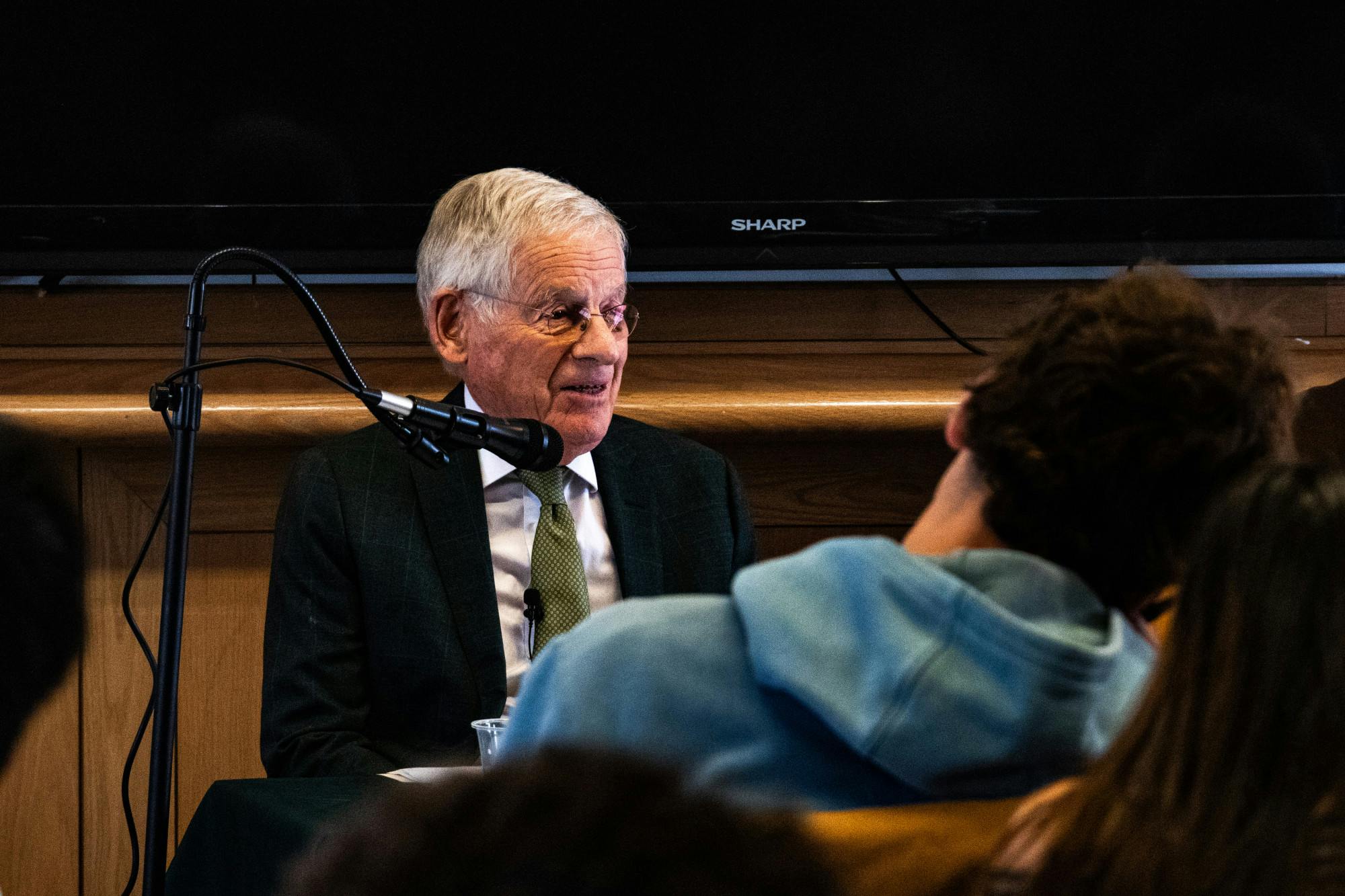
What is liberalism? If you’re asking Harvard government professor emeritus Harvey Mansfield, the question doesn’t have just one answer.
At a Nov. 3 talk at Dartmouth, Mansfield told students that American democracy “depends on the virtue of each generation” and reflected on the evolution of political liberalism in America. The Rockefeller Center for Public Policy and the Political Economy Project sponsored the event, titled “America’s Two Liberalisms.” Approximately 50 people attended.
Mansfield began his talk by distinguishing between 17th-century liberalism and “the liberalism of today.” 17th-century liberalism, according to Mansfield, holds that government “must be limited” to solely protecting the rights of individuals. In modern liberalism, on the other hand, the government’s power is expanded in the name of “liberal diversity,” which Mansfield described as “toleration of any person or principle.”
Mansfield added that 17th-century liberalism “is vulnerable to attack from both right and left,” particularly its concept of liberal self-preservation, which he said allows individuals to “live a life of choice.”
“The right declares that liberal self-preservation is paltry, cowardly, ignoble and base, whereas the left declares that self-preservation ignores the weak and the poor,” Mansfield said.
Mansfield said that there is “value” in America’s modern liberal diversity, using the two American political parties as an example.
“Democrats stand for inclusiveness … Republicans want a variegated whole in which some are held more valuable than others,” Mansfield said. “Each party prefers its own virtue, but will have, when pressed, some appreciation for the other.”
Mansfield also discussed how “no regime is perfect,” including “our liberal regime.”
“Nature permits us the freedom to choose among possible regimes, but limits us to imperfect results,” Mansfield said. “Survival cannot be the goal of politics, because no regime can survive forever.”
Audience member Kaitlin Clark ’28 said that Mansfield’s comment on the impermanence of regimes “really resonated.”
“It made me think, not only about my own mortality, but the fact that even the Roman Empire, which seemed like it might persist forever … even that fell some day,” Clark said.
Mansfield ended by noting that the American Constitution “gives representation to the people” while only giving “equal opportunity to the few.”
“The American Revolution did launch a regime and a great one, yet one that has always struggled to articulate the character of its greatness,” Mansfield said.
After Mansfield’s lecture, the event transitioned into a Q&A moderated by government professor and State Rep. Russell Muirhead, D-Hanover.
When asked by Muirhead about whether he was “sanguine” or “concerned” about the state of American politics, Mansfield said one “should always be concerned.”
The American system “doesn’t work automatically,” Mansfield said. “It’s something that depends on the virtue of each generation, the kinds of leaders that we become and that we elect.”
Audience member Tamia Kelly ’27 noted the “depth” of Mansfield’s career and said Mansfield was “very informed.”
“He did a very good job of breaking down what liberalism looks like for both sides and how we see it happening today, which I think is very necessary,” Kelly said.


