
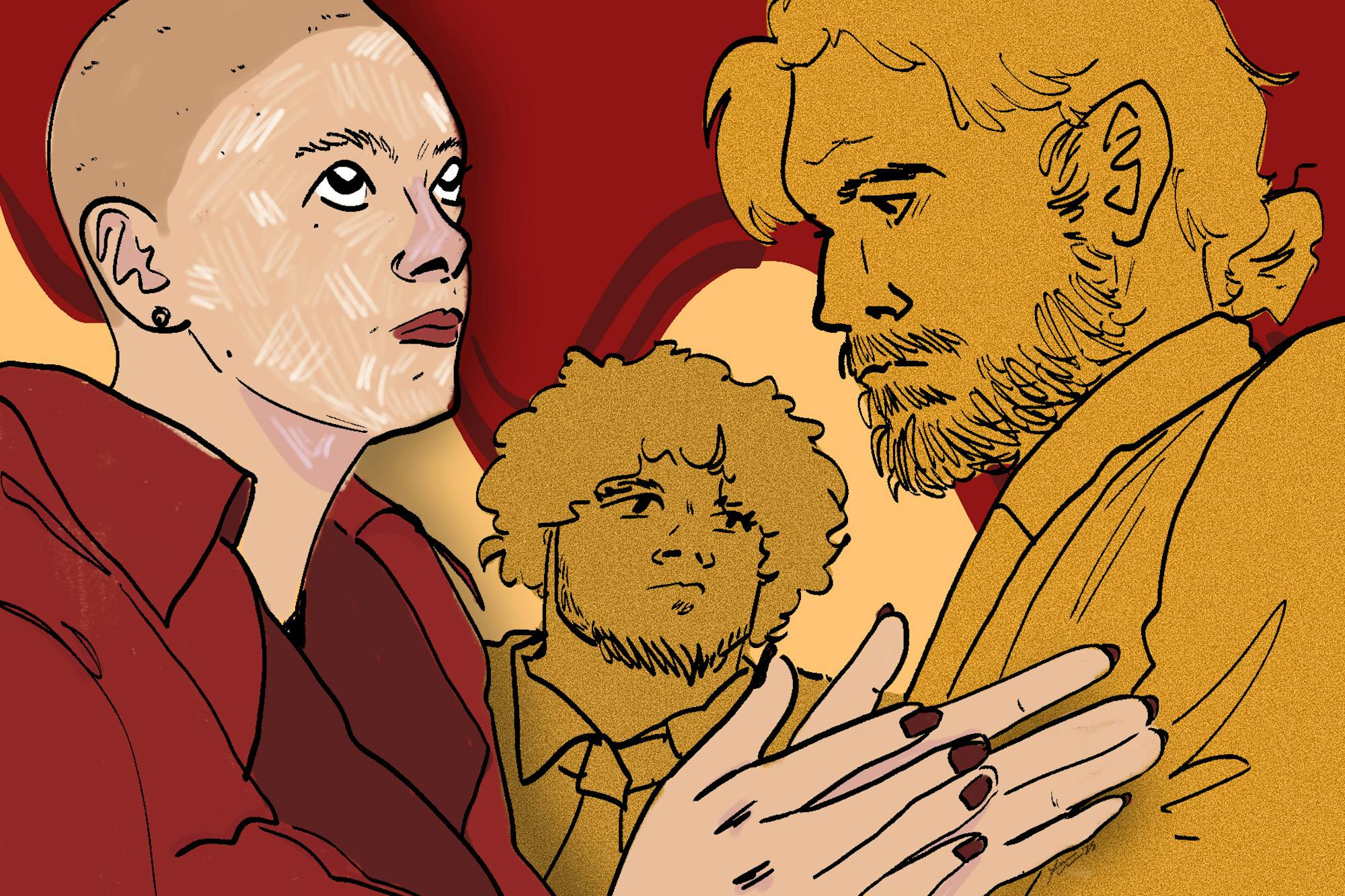
Much of “Bugonia,” Yorgos Lanthimos’ absurdist black comedy thriller, deals with a common modern sentiment: that mysterious forces are quietly pulling strings to manipulate society. From this view, much of the world’s evil and inequality may be attributed to a malevolent cabal that has embedded itself in the highest levels of government and business. In “Bugonia,” the answer is simple: the cabal isn’t human at all, but alien. With its embrace of comedy, nuanced characters and great acting alongside effective imagery and music, “Bugonia” strikes a contemporary nerve.
The film’s central character is the deranged conspiracy theorist Teddy (Jesse Plemons), who believes to have uncovered a vast intergalactic plot against humanity only he can stop. With the help of his intellectually disabled cousin Don (Aidan Delbis), he kidnaps the CEO of a pharmaceutical megacorporation Michelle Fuller (Emma Stone), whom he believes to be an undercover extraterrestrial invader. Most of the film takes place in Teddy’s dilapidated house where Michelle, restrained in the basement, tries to survive by engaging Teddy in a psychological battle, initially attempting to convince him she is human before trying to appease his delusions. Cracking under the emotional pressure, Don starts to doubt that Michelle really is an alien while Teddy continues to reassure him.
“Bugonia” effectively leans into comedy. Known for films like “The Lobster,” “The Favourite,” and “Poor Things,” Lanthimos finds hilarity in the film’s bonkers premise. During the kidnapping sequence, Teddy and Don wear print-outs of Jennifer Aniston’s face as masks while they hide in the bushes outside Michelle’s house. In an outrageously funny moment straight out of “Fargo,” they attempt to grab her yet find themselves soundly outmatched by their victim, who turns out to be proficient in martial arts. Lanthimos shoots the scene from wide, low angles, allowing all the action to unfold in precisely staged long takes and making it look all the more absurd.
The characters and acting are another highlight of “Bugonia.” Teddy and Michelle are both more complex than they initially seem, with new information and nuanced performances by Plemons and Stone shifting our sympathies throughout the film. As a girlboss-coded executive, Michelle is an undeniably modern character. She sings along to Chappel Roan as she drives, speaks in vapid corporate platitudes and tells her assistant to remind the office that employees are free to leave at 5:30 p.m. but that it’s not compulsory — and that they really ought to stay until they finish their work. Once kidnapped, Michelle engages in HR-approved deescalation techniques, asking Teddy to engage in a “dialogue” to find a solution that works for both of them. Although her ice-cold demeanor is recognizably human, Stone manages to make Michelle feel genuinely alien through her utter detachment to her underlings and the world at large.
Meanwhile, Plemons makes Teddy a terrifying but sympathetic antihero. Despite his violent actions and unstable temper, it is clear that he is operating from a deeply held conviction that he is saving the planet. Adding even more nuance to the portrayal is his treatment of Don. He manipulates his cousin into committing awful crimes, but it’s also clear that Teddy genuinely loves him and has long served as his caretaker. There are several flashback sequences, stunningly shot in high-contrast black and white, where Teddy’s family backstory is explored. These surreal, haunting scenes provide a powerful glimpse into the character’s motivations and further complicate the morality of his actions.
The first and final shots of the film focus on bees in Teddy’s backyard, where he tends to an apiary. He is certain that, among other transgressions, the aliens running the world economy are destroying the bee population. The bee imagery functions on several thematic levels. For one, Teddy mentions that bee colonies are based on a system of stratification where the mindless drones exist only to serve the queen bee, a clear analogue for Michelle. Furthermore, Teddy blames Michelle’s company and its pesticides for the rise of colony collapse disorder in beehives worldwide, which causes worker bees to gradually disappear until the community dies; he believes a similar plot is being carried out against humanity, whose social ills are not innate but deliberately manufactured by hostile outsiders. Although the details of Teddy’s conspiracy are faulty, his broader social frustration is easy to understand.
The music in “Bugonia” is also effective. For instance, the use of Green Day’s “Basket Case” during a particularly shocking scene will be seared into many viewers’ minds. The film’s final montage, set to Marlene Dietrich’s rendition of “Where Have All the Flowers Gone?” serves as a disturbing, eerily beautiful conclusion. Meanwhile, the original score by Jerskin Fendrix is bombastic and overwhelming, providing a jolting contrast to Lanthimos’s cold, clinical shot composition. Shots of Teddy riding his bicycle are accompanied by epic musical motifs fit for a hero, perhaps reflecting his own self-image.
The great trick of “Bugonia” lies in how it toys with audience expectations. The film constantly pivots from absurd comedy to disturbing horror and vice-versa — often when the audience least expects it. Different viewers may thus have polar opposite reactions to the same scenes, unsure whether to laugh or recoil. In an era defined by paranoia and conspiracy thinking, “Bugonia” weaponizes that unease into something viciously funny and quietly devastating.


