
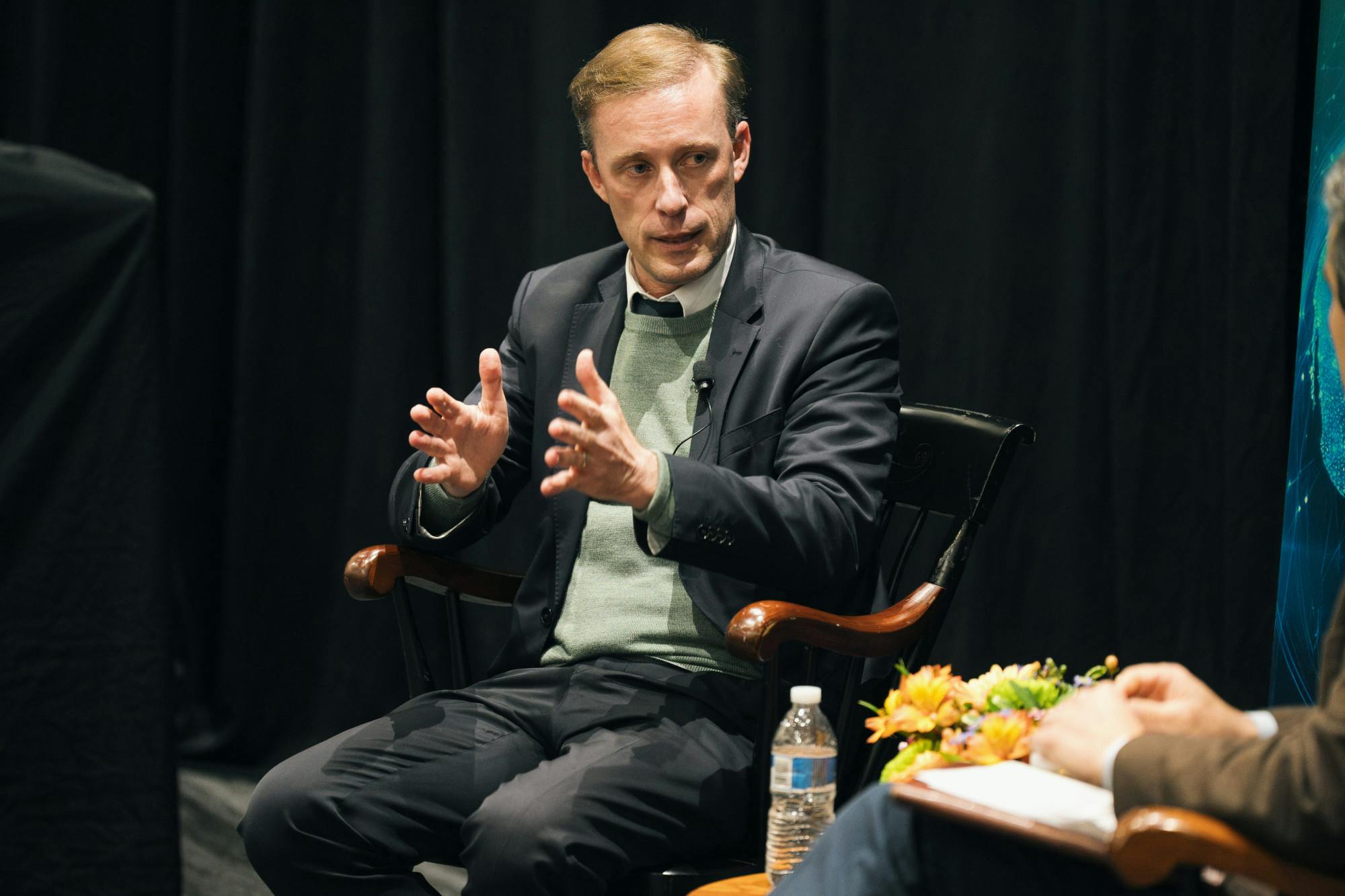
On Nov. 4, the Davidson Institute for Global Security hosted former national security advisor Jake Sullivan for an event about his role in the Biden administration’s foreign policy. Sullivan served as U.S. national security advisor under President Joe Biden, worked as a foreign policy advisor for Hillary Clinton’s 2016 presidential campaign and served as director of policy planning in the state department under President Barack Obama. Sullivan also taught at the College from 2019 to 2020.
The Dartmouth sat down with Sullivan to discuss his career, his views on the Trump administration’s foreign policy and America’s role in addressing global challenges.
Some academics have said in the past that the 21st century may be a “Chinese century” — in which the global system is dominated by China as it was by the United States in the 20th century. In 2025, does the “Chinese century” prediction still hold? And how would you evaluate America’s long-term geopolitical and economic competitiveness?
JS: I do think that a defining feature of the modern international system is the competition between the United States and China. I think that China is seeking to surpass the United States as the world’s leading economic, technological, diplomatic and military power.
I do not believe it is clear yet how this competition will play out. I do feel that when I walked out of the building on Jan. 20 of this year, the United States was in a strong strategic position in the competition with China. We had strong allies, we had strong economic growth and we had advantages in the AI race.
The U.S. and China, whatever happens in this competition, are two big countries that aren’t going anywhere. And so the U.S. and China will have to learn to live alongside one another.
Your first year as national security advisor in 2021 was dominated by headlines about the U.S. military’s withdrawal from Afghanistan and the subsequent takeover of the country by Taliban forces. Looking back at the withdrawal, is there anything that you think the Biden administration should’ve done differently?
JS: When I think about the operational aspects of the withdrawal, which included the tragic loss of 13 brave Americans and a significant number of Afghan civilians, we learned a lot of lessons about how we could have executed the operation in a different way.
When I think about the big strategic question of if the United States is better off in November of 2025, not still being at war in Afghanistan, I think the answer to that question is unequivocally yes. The war would be entering its 26th year next year. I think ending the war was the right strategic call by President Biden. It’s important to underscore that — in terms of America’s strength, capacity and purpose — no longer being tied down in Afghanistan is a good thing. Multiple previous presidents had tried to end the war and had not, and President Biden did.
One of the hallmarks of the Biden administration’s foreign policy was a consistent emphasis on support for Ukraine in its war against Russia. What do you see as the significance of Ukraine in the United States’s broader geopolitical strategy?
JS: There’s a basic American principle that when you see somebody getting attacked by a bully, you stand up for them. In a way that almost transcends strategy and geopolitics. That’s just something about who we are as Americans. It’s why you saw — whether it’s in Hanover, N.H., or in my hometown of Minneapolis or in your hometown — Ukrainian flags popping up on people’s houses, places of work and places of worship.
But I also think it’s deeply in our strategic interest to do so because if the United States had allowed Russia to basically swallow Ukraine whole, I think it would’ve increased the possibility of conflict between Russia and NATO, which in turn would’ve increased the prospect of American service members back in Europe in a new century.
So we supported Ukraine, providing them with the means to defend themselves, putting pressure on Russia and helping Ukraine save its country. I’m very proud of what we did, and I think it was deeply in the interest of the United States that we did so.
Do you think the Biden administration gave too much credence to President Vladimir Putin’s threats to use nuclear weapons in Ukraine?
JS: In the fall of 2022, the president’s leading intelligence professionals came to the president and said, “If there’s a catastrophic collapse of Russian lines, there’s a 50-50 chance Russia uses tactical nuclear weapons in Ukraine.”
If you’re the president of the United States, and if you’re the national security advisor, do you take that seriously, or do you shrug that off? I think the American people expect you to take it very seriously, but not be paralyzed by it. Through that entire period, we kept flowing weapons at a huge scale and with huge speed to Ukraine.
So, we were not deterred from continuing to support Ukraine despite the nuclear threats. But did we have to take them seriously? Did we have to engage in diplomacy with our allies with China, with India and directly with Russia to deal with that threat? Yes, we did.
Has the second Trump administration’s Iran policy — including its strikes on nuclear sites in Iranian territory — diminished or magnified the threat posed by the country?
JS: In the very near term, it has set back Iran’s nuclear program. In the mid to long term, the jury is out as to whether it’s made the threat less or more acute. That depends on a lot of things, including the current administration’s approach to diplomacy, Iran’s calculus and Israel's calculus. So now we will have to see what plays out over time.
I believe that when the Trump administration came back in, there was a real possibility of a negotiated solution, which would put Iran’s nuclear program in a box for the long term in a very predictable way. The administration chose not to pursue that; it chose to pursue the military option, which, in my view, had some near-term practical effect, but also creates a lot more unpredictability. I still believe that a diplomatic resolution is the best and most sustainable way to resolve the threat posed by Iran's nuclear ambitions.
During the Biden administration, you helped to negotiate a ceasefire between Hamas and Israel, which ultimately fell apart. Has the United States’ response to the conflict in Gaza weakened our standing in the international community? How credible is Trump’s peace plan?
JS: What we handed off to the Trump administration was a ceasefire and hostage deal where hostages were coming out, aid was going in and the guns were silent.
Phase one of the deal was supposed to transition into phase two, where a comprehensive end to the war was negotiated. Instead, Israel went back to war. The Trump administration supported them in that. The war went on for six more months, and then we got to this deal.
I think it’s fair to say that there were a lot of objections from a lot of parts of the international community about the U.S. continuing to support Israel over the course of last year — 2024 — and over the course of this year in 2025. I think a lot about what we could have done differently.
The president’s assessment was that, during 2024, Israel was under attack from six directions: from Yemen, from Iraq, from Syria, from Lebanon, from Gaza and from Iran itself. And so he didn’t feel comfortable ceasing the delivery of weapons.
The last point that I would make is that there is no way forward to take advantage of this opportunity without a credible pathway to a Palestinian state. Fundamentally, I do not see how we can move forward in a serious way if the United States is not pressing for an actual implementation of a pathway to a Palestinian state.
In the last few months, the U.S. has deployed several warships to the waters north of Venezuela. Is Trump trying to provoke military conflict in Venezuela? If so, to what ends?
JS: You don’t move that amount of capability and hardware into a place without seriously thinking about using it. I think we have to take very seriously the possibility that this administration will pursue military action in Venezuela. And that does not make a lot of sense to me.
How do you recommend policy-interested students think about building proficiencies and pursuing internships?
JS: First, there’s no substitute for going and getting hands-on in whatever capacity you can. I think internships make a tremendous amount of sense, whether that’s directly in government service, the executive branch, whether it’s on the Hill, whether it’s in think tanks or whether it’s in a lot of these big private-sector companies that have public policy components to them.
Second, national security now is not just traditional guns and bombs and diplomacy. It’s economics and technology too. Big time. And so creating a multidisciplinary approach to thinking about national security problems — studying across a range of subjects — is going to be really important to be effective in national security over the course of the coming decades.
This interview has been edited and condensed for clarity and length.
Jeremiah Rayban is a reporter and editor for The Dartmouth from Wilmington, Del., majoring in economics. Outside of The D, he enjoys reading, art and trivia.


