
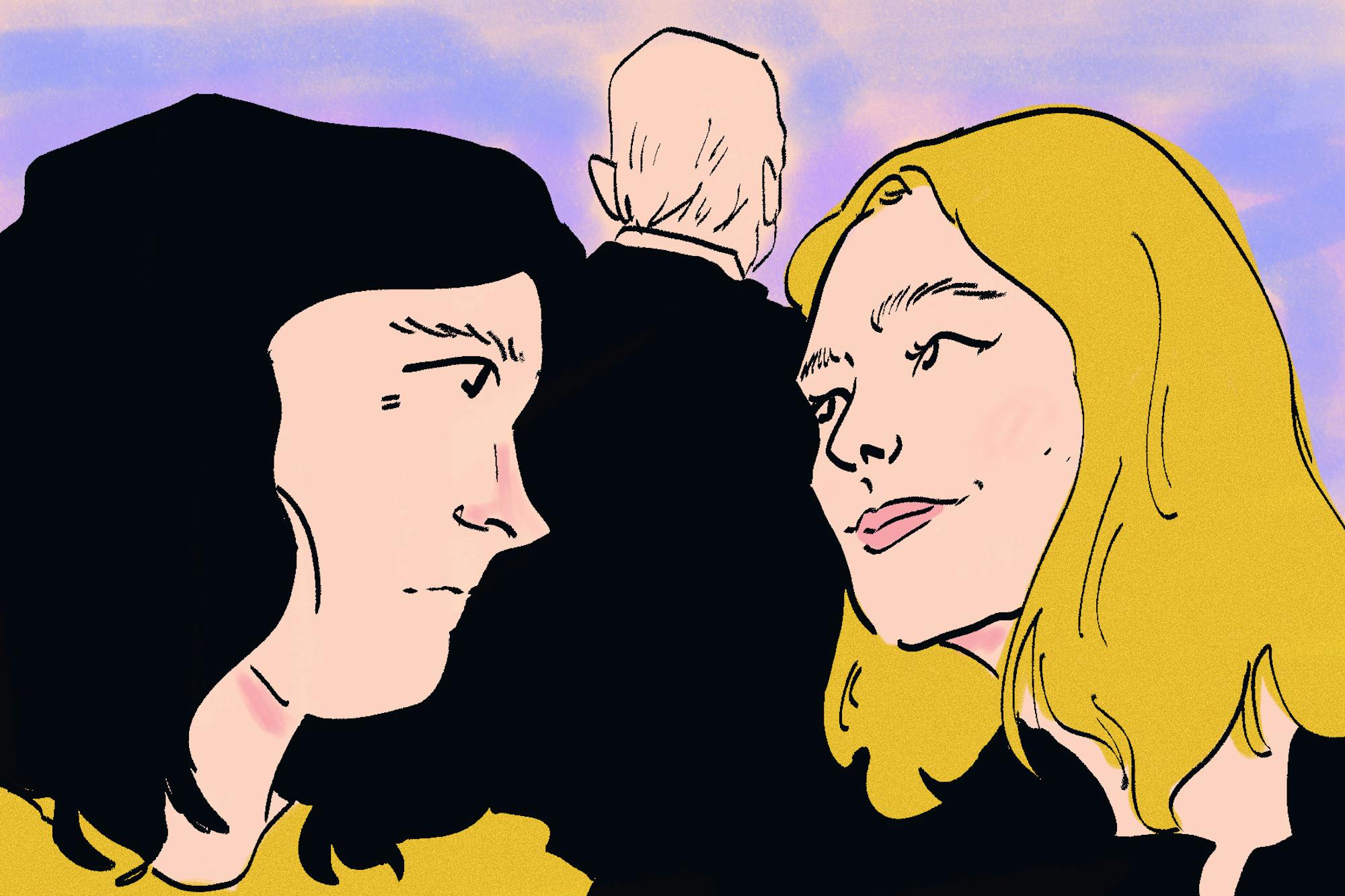
Now that the Academy has released its ironclad grip on the Oscars contenders on Jan. 22, it is time to discuss Joachim Trier’s “Sentimental Value.” The staggering nine nominations — unprecedented for a Norwegian film — acknowledge the remarkable script and direction, stunning performances and tender yet gripping story. In short, “Sentimental Value” may be a perfect movie.
“Sentimental Value” is Trier’s third collaboration with Renate Reinsve, who delivered a breakout performance in his 2021 film “The Worst Person in the World.” The tongue-in-cheek title is a reference to the themes of self-loathing and isolation Trier has long explored. As a writer and director, Trier is fixated on often melancholic themes of despair and communication. His movies are visually bright and bold, but thematically introspective and contained. His characters are figuring things out.
He unites these themes perfectly in “Sentimental Value,” a wholly unique family drama. The movie begins with a shot of a vibrant yet foreboding Victorian house in Oslo, a vault of family secrets and repository of love. A generational home passed down the Borg family, it is where Gustav (Stellan Skarsgård) was raised, and where protagonist Nora (Reinsve) and her little sister Agnes (Inga Ibsdotter Lilleaas) grew up after Gustav walked out. When the film commences, the sisters’ mother has died and they must figure out what to do with the house. As Trier put it in an interview with Script Magazine, “The house is a witness of the unspoken. It’s also a witness of the 20th century … The house also represents the dichotomy of emotional entanglements.”
Nora is a successful stage actress who, audiences learn through bits and pieces, struggles with depression. She harbors resentment for her successful filmmaker father and declines to act in his upcoming film. “I wrote it for you,” Gustav tells Nora at their reunion. “You’re the only one who can play it.”
At Nora’s rejection, Gustav casts famous American actress Rachel Kemp (Elle Fanning) instead, and the two start filming the movie in the Borg family home. He also casts Erik, Agnes’s adorable son (Øyvind Hesjedal Loven). The result of this forced proximity is a reconnection between father and daughters. Reinsve and Skarsgård establish phenomenal chemistry as hurt, flawed, and charismatic mirrors of one another. The scene when they initially reunite at a café to discuss the script is deliciously tense, with overt resentment but subtle facial expressions.
At times, the movie is almost as humorous as it is poignant. About halfway through, Gustav and Rachel embark on a press tour where the former finds out Netflix won’t release his movie in theaters. In another scene, he buys 10-year-old Erik the risqué film “The Piano Teacher” in a comedic moment that also highlights his inability to engage with children he loves.
Every core member of the cast has received an Oscar nomination — Reinsve for Best Actress, Fanning and Lilleaas for Best Supporting Actress and Skarsgård for Best Supporting Actor. In addition, the film has been nominated for Best Picture, Best International Feature Film, Best Director, Best Original Screenplay and Best Film Editing.
Every scene except for those with Fanning is in Norwegian or Swedish, yet English-speaking audiences don’t lose much. So much of acting is in delivery, but Reinsve’s performance in particular transcends language barriers. Beneath layers of abandonment and grief is a girl who can’t bring herself to admit she misses her father. Skarsgård’s nearly-imperceptible facial expressions are equally wrenching.
As the family buffer — a role that in another movie would be a bit underdeveloped — Lilleaas is quite compelling. She is a research historian, so, not in the family industry, and the only member of the Borgs who has started a family of her own. There is one particular scene with Reinsve that she steals. Nora asks, “Why didn’t our childhood ruin you? You’ve managed to make a family. A home.” In response, Agnes says, “There’s one major difference in the way we grew up. I had you.” At risk of giving too much away, in this moment Agnes allows Nora to fully inhabit her grief but simultaneously pushes her toward forgiveness. Her delivery here is tender yet direct; truly remarkable.
While it is not her movie, Fanning also pulls off a remarkable balancing act. Her role is undeniably meta: a Hollywood starlet transitioning to subtler and more emotionally demanding roles. In one key moment, Rachel must do an okay job delivering a monologue that Nora later nails. Fanning subtly executes an extremely layered task, playing an actor struggling to inhabit a character. One can imagine this is a vulnerable role.
At risk of giving too much away, what solidified “Sentimental Value” as one of my favorite movies of 2025 was its final scene. It has no dialogue, with “Cannock Chase” by Labi Siffre playing in the background. “Sentimental Value” concludes with Gustav and Nora staring at each other, with implied reconciliation if not full forgiveness. In the foreground is Agnes, content with her own nuclear family.
Trier’s work is not trite, nor does it introduce groundbreaking themes about the healing properties of art or the difficulties of family. It is a simple mediation reminiscent of the opening line of Tolstoy’s “Anna Karenina”: “Happy families are all alike; every unhappy family is unhappy in its own way.”

