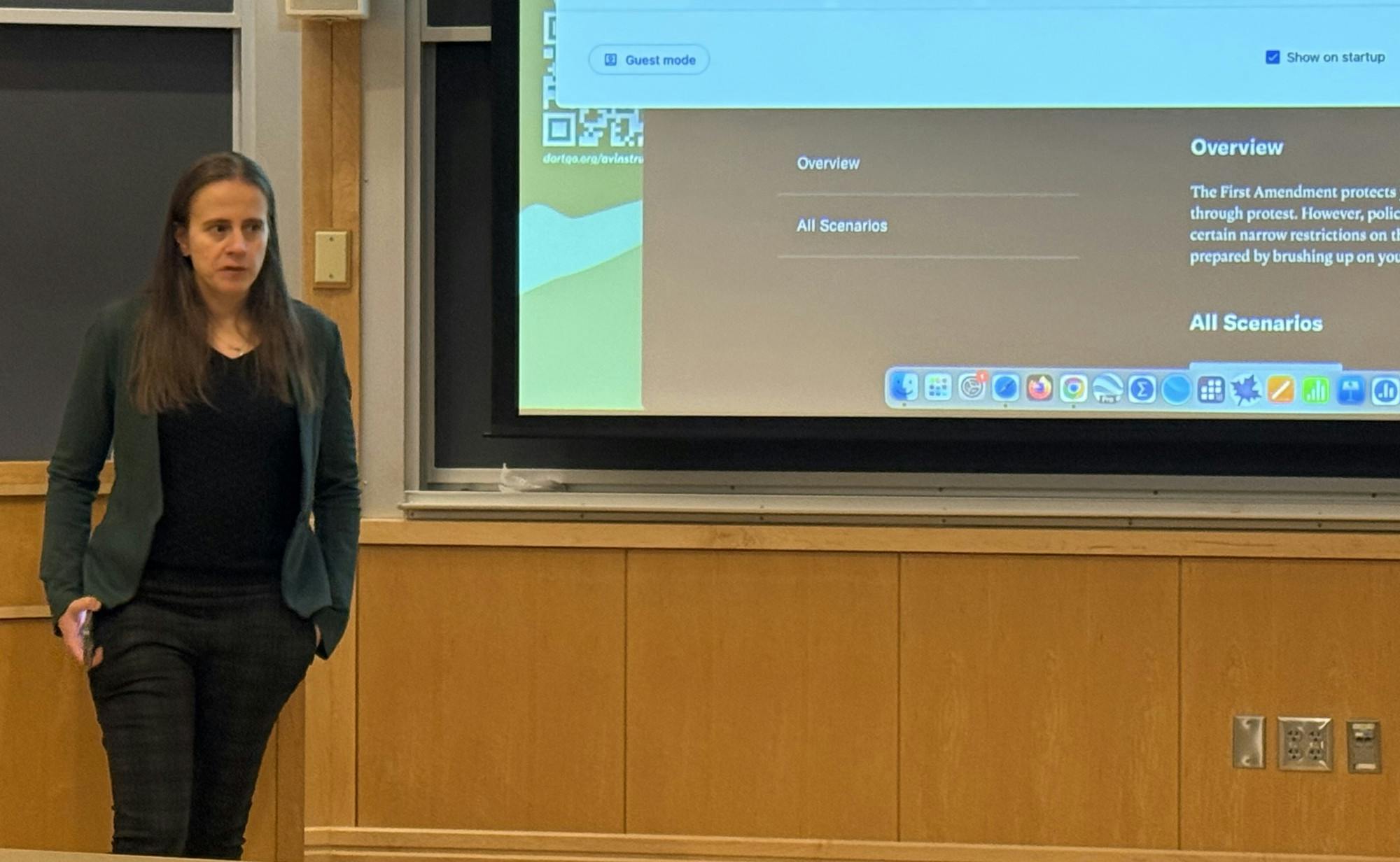
On Nov. 14, the College hosted First Amendment litigator Kathleen Farley ’10 for an event titled “Transitioning Advocacy and Activism Efforts from Campus to Community: What to Know.” Farley was a member of the legal team that won the National Press Photographers Association First Amendment Award in 2023 for ensuring reform in the New York Police Department after photojournalists were assaulted and arrested at Black Lives Matter protests in 2020.
Following the event, The Dartmouth sat down with Farley to discuss changes in student expression of dissent and pathways toward greater transparency from Dartmouth and the town of Hanover to ensure students know their rights and overall student safety.
Have you observed changes in the way students protest since when you were at Dartmouth?
KF: Protests have just become larger and more frequent because of better communication. A person who is more casually invested is more able to access the information and simply turn up.
Dartmouth and other institutions have been slow to catch up on how much easier it is for there to be a spontaneous protest. Back in the day, you used to have to plan a protest in advance. My understanding of the constitutional jurisprudence is that protests now need to be facilitated because they can happen more spontaneously. I would honestly argue it’s even more important now, because everything is much faster. The news cycle is shorter, so if the protest is going to happen, it’s going to happen now.
How does the First Amendment apply on college campuses?
KF: Only the government or a government actor can violate your First Amendment rights; a private actor can’t.
Dartmouth gets federal money, which can make them a state actor in some contexts, but they are a private landowner, and the most important thing about protesting is knowing if you’re on publicly-owned or privately-owned property.
The Green is private property that Dartmouth owns, which means they get to make the rules. That being said, it’s commonly used by the community, is the natural place in town for people to gather and is surrounded by public sidewalks and the public right of way.
How can Dartmouth students ensure they’re safely dissenting on the internet?
KF: You can be doxxed, and that is a legitimate concern. It is incumbent upon Dartmouth to remind people that you can get doxxed. It’s important to remember that when you post something on the internet, you’re talking to the whole world, and they may not have the context for what you’re saying. All Dartmouth can do is police what Dartmouth students say on Dartmouth’s campus.
What advice do you have for Dartmouth students who seek to peacefully protest safely?
KF: Students right now should be cognizant of where they’re allowed to protest with Dartmouth’s permission. While they are at Dartmouth, that doesn’t strip them of their status as a U.S. citizen. If you’re in the U.S. on a visa, you have First Amendment rights. But if you want to have a protest at Dartmouth for a Dartmouth-specific issue, then you need to play by the College’s rules.
Also, Dartmouth students should not overlook the dialogue of negotiating the event. It seems hard and annoying that you have to work with the College, but it’s really good practice. Dartmouth is letting you protest where you are safe and probably not going to get arrested. At the same time, if you want to have a protest on a public sidewalk and it spills into a public street, that’s your right. The Supreme Court has been explicit about the sidewalk as a traditional public forum.
Considering two staff members of The D with press credentials were arrested while covering the May 1, 2024 protests, how do you envision that the Hanover Police Department or New Hampshire State Police might make similar changes to the NYPD to ensure press reporters’ safety?
KF: What the Hanover Police Department did on May 1 was a mass arrest. What that does is it stops the protests. In particular with reporters, it stops the public from knowing what actually happened. What the NYPD has been able to do is more of a practice of individual enforcements. If there’s someone who’s genuinely breaking a law, they can be arrested. That doesn’t mean that everybody else who’s protesting gets arrested along with them.
When there’s a huge show of force right by the protests, that can be antagonistic. Encourage the police to either not have riot gear, or — this is what the NYPD does — keep them hidden a few blocks away, so they can come in if they’re needed. Police presence often raises the temperature. Being cognizant of that is really helpful, and having liaisons with the community is something the NYPD does now, kind of like what Dartmouth does, specifically for Hanover police. I applaud that, and they could do more of it.
Are there ways that Dartmouth students can be involved in making changes to improve safety and better communication between Dartmouth and the Hanover Police Department to ensure safety?
KF: An individual student can’t really reach out to Hanover Police, but Dartmouth has the institutional power to do that. By taking advantage of the resources and infrastructure Dartmouth has provided for student groups, students get their concerns heard by Dartmouth. The people in the Office of Civic Expression, Engagement, and Learning are helpful and making your concerns known to them is the first step.
This interview has been edited for clarity and length.
Sahil Gandhi ’29 is a reporter from Staten Island, N.Y., and is majoring in environmental studies and government modified with philosophy and economics. He loves word searches and falling down internet and Wikipedia rabbit holes.