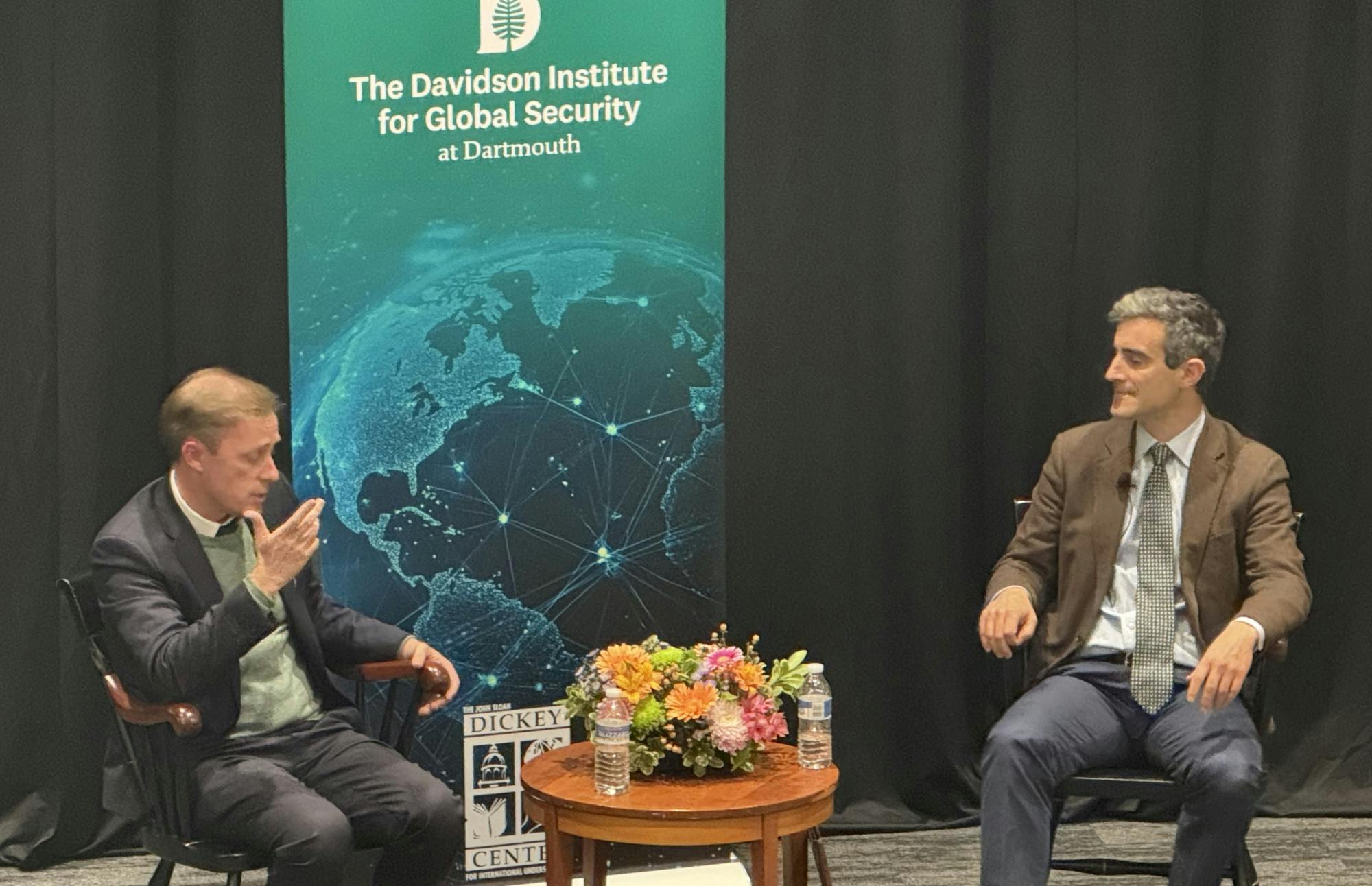
Former national security advisor Jake Sullivan devoted much of his campus lecture on Nov. 4 to defending the Biden administration’s foreign policy record, including his roles during the wars in Gaza and Ukraine.
Sullivan said he has a “deep conviction” that he approached his job with a “good heart,” his “best advice” and by presenting the president with all his options. But he said he still lies awake at night thinking about his role — asking himself “should I have done this, should I have done that?”
Sullivan, who helped negotiate a short-lived ceasefire in Gaza earlier this year, said he is heartbroken over the suffering of innocent civilians in the war.
“I’m human, and I see those images [of destruction in Gaza] and they break my heart,” Sullivan said.
He argued that the Biden administration left the Middle East in a “dramatically different position” with a ceasefire on the table and a “written pathway” to end the conflict.
“Then there were six more months of war,” Sullivan said. “For me, the real question is, why was it necessary for there to be six more months of war before we got to October ’25 and we got this done? I don't have a good answer to that, but I find it interesting that people skip over all of that to say, ‘Well, Trump got it in October, so why didn't you get it last done October?’”
Sullivan said “diplomacy is about timing” and that the Trump administration “deserves credit” for the current ceasefire but that “it’s important for people to understand the full history and context of how things unfolded at the end of 2024 into the beginning of 2025.”
The event — titled “U.S. Foreign Policy in the Biden Years and Where We Stand Now” — served as the inaugural program of the Davidson Institute of Global Security, which was established earlier this summer, according to government professor Daryl Press. Approximately 200 people attended the event in person, with an additional 150 watching online, according to Dickey Center events program manager Judith van Rhijn Jackson.
Sullivan has spent time at Dartmouth before. In 2019, as a visiting professor, he taught a seminar in the government department entitled “The Future of the International Order.” The course’s hypothesis, Sullivan said during the talk, was that the world was entering a period of “transition, turbulence and challenge.”
“I didn’t really realize that I would go sit in the middle of that world a few months later as national security advisor,” Sullivan added.
Sullivan also discussed the Biden administration’s response to the Russia-Ukraine war. He said that President Biden’s two priorities were to “make sure that Ukraine does not fall” and to “take every reasonable measure to avoid World War III.”
“Thus far, we have achieved those two things,” Sullivan said. “And I hope that in the end, the Trump administration continues to take steps to protect Ukraine.”
Sullivan concluded by discussing how foreign policy — and the United States’s competition with China — affects the American middle class.
“China has designed a strategy … to basically dominate industries in the future,” Sullivan said. “I do not think that is in the interest of the American middle class, and [I’m thinking] of a coherent strategy to push back against that.”
Sullivan said the United States has to use the “tools of public investment” to build “the technologies of the future.”
“Semiconductors, batteries, clean energy [and] critical mineral supply chains,” Sullivan said. “I think the Trump administration has taken some important steps to try to push that forward, but even that is not enough.”
One audience member asked Sullivan how he takes care of himself despite the pressures of his job.
“Rom coms,” Sullivan said. “I would watch Hallmark movies, like a whole Christmas series.”
Government major Conner Sullivan ’28, no relation, said that Sullivan was “incredibly insightful.”
“He balanced between the textbook view of international politics while also talking about communication networks and the experience of being a person,” he said.
Sullivan added he appreciated the “degree of vulnerability” in Sullivan’s answer about Gaza.
“He’s both a person and an entity in the government, so he needs to make hard decisions, but the fact that he’s still human means that he has feelings about all this,” he said. “And at the same time, he was very stern about his own beliefs.”
Sophia Kohmann ’28, a prospective Government major, said it was “really cool to hear [Sullivan’s] real thoughts.”
“I think he did a really great job of peeling back the curtain on some of the decisions,” Kohmann said. “It was really cool that he opened the door on behind-the-scenes thoughts and processes.”