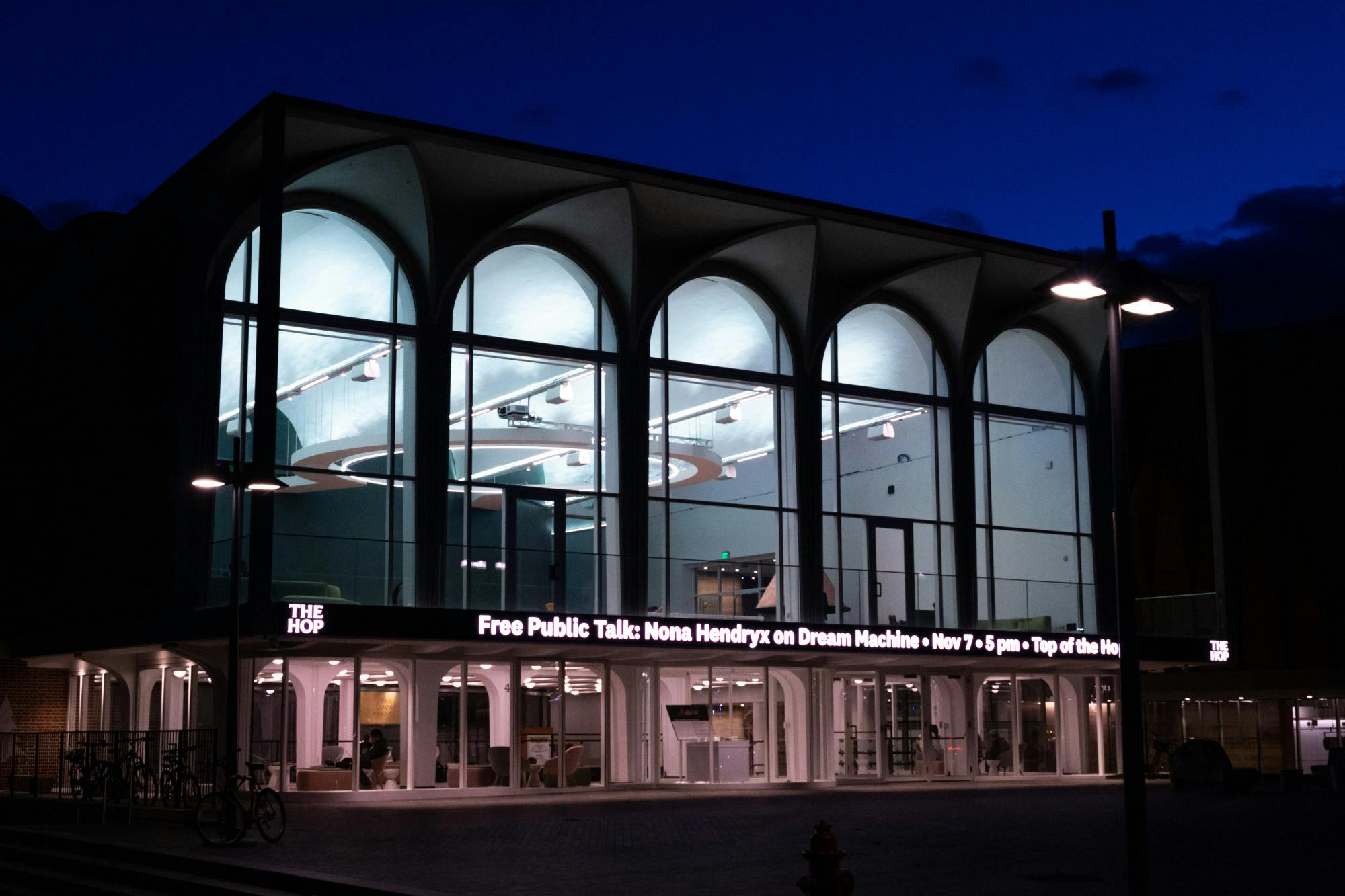
In the first few weeks since the Hopkins Center for the Arts reopened, members of some student performing arts groups have said that spatial and staffing constraints, along with content regulations, have limited their ability to perform there.
Under the collective bargaining agreement between Dartmouth College and the local branch of the stagehands’ union, Spalding Auditorium and Moore Theater are “union spaces,” Hop managing director and executive producer Joshua Price Kol said. This means that those theaters require the use of bargaining unit employees to operate performances, according to the contract.
Students who are “engaged in student or academic productions, irrespective of any involvement in the Hopkins Center,” are “exempt” from the union’s agreement with the College. However, challenges with staffing prevented several student groups from using these spaces in practice.
For example, although not required by the union agreement, shows in the Roth Studio Theater often need professional assistance from Hop production staff to utilize the space’s “highly technical” equipment, Kol said.
“We hope to get to a place where there is some level of a threshold where students could walk in, and if they don’t need a lot of tech, could still use the space without technical support,” he added.
Hopkins Center fellowships and student initiatives manager Daniel Burmester said that providing production staff for the various shows throughout the year amid such high demand is often difficult. Although production staff “can get paid overtime sometimes… they also have to go home,” he said.
Burmester noted that spatial constraints pose an additional challenge.
“We have more spaces now, and our staff are working with more things in it. It presents a logistical puzzle when you’re trying to figure out how to make it all work everywhere, all the time,” he said.
To circumvent coordinating with Hop staff for their shows, students can perform in the Bentley Theater, Mindy Kaling Studio or the Top of the Hop. However, due to ongoing construction, only the Top of the Hop is available for student performing groups to use in the fall.
The Bentley Theater is currently undergoing renovations after Hop staff discovered structural issues in the floor in the fall.
“We anticipate the Bentley being back online in January [2026], but we had thought we would have it starting in September and then be able to have some student performances in there in this fall, which, unfortunately, is just not the case, because the room isn’t safe to be in at the moment,” Kol said.
Additionally, the Mindy Kaling Theater Lab is currently unable to accommodate performances, according to theater professor Peter Hackett.
“There’s a lighting grid that’s up, but there are no lights yet,” Hackett said. “[The studio] can eventually be used as a performance space as well, but there’s no sound system yet.”
Failures to communicate these performance limitations for student groups at the Hopkins Center hindered students’ ability to plan their fall performances.
Sarah Hochman ’28, co-captain of the student group Displaced Theater Company, said in an interview with The Dartmouth that her company had to make a last-minute venue change from the Bentley Theater to the Top of the Hop for their fall show, “Ride the Cyclone.”
Performing at the Top of the Hop came with its own difficulties, most notably budgeting issues for the group as they had to plan their performance in a place not designed for theater.
“That [venue change] gave us a couple weeks’ setback, because we had to redesign and re-figure out our materials — what we could get into the Top of the Hop,” she said.
In a follow-up interview after “Ride the Cyclone” debuted on Nov. 3, Hochman said the “only issues” the group faced during its performance were related to the sound and lighting equipment.
“We had to bring in our own sound system … so with getting that connected, and balancing the mics and the sound amplification with the live band … sometimes led to the mics giving feedback,” she explained. “And it was hard to program the lights, because the light board they gave us only had certain functionalities.”
The anonymous member of a student theater group said their group decided not to perform at the Hopkins Center at all this term due to prop regulations at the Top of the Hop. Their group was told that they could not use a prop weapon “because of the large windows,” the student said.
“We just came to a point where we couldn’t visualize how we would be able to stage our show under these restrictions,” they added.
Both Hochman and the anonymous student emphasized that their primary frustrations with the Hopkins Center were not with staff, but rather the center’s policies and construction delays.
“The Hopkins Center staff and faculty are really trying their hardest with the limited resources that they’ve been allotted due to various institutional meddlings,” including prop regulations, the anonymous student said.
In a similar vein, Hochman said that Hopkins Center staff and the theater department have helped accommodate Displaced Theater to perform at the Top of the Hop.
“The theater department … has tried to make themselves more available and inventory more available to us, to kind of compensate for the fact that we're now having to figure out a few more technical elements and add that into our budget, which we weren’t expecting, because we thought we would have a theater that already had those,” she said. “And I think the Hop is also doing their best to give us what they can.”
In late October, the Hopkins Center released a venue request form online through which students can request to reserve a space for a show. Once a week, Burmester will meet with other Hopkins Center staff “to figure out how we [can] best facilitate all of those requests that come in.”
Hochman said she hoped to continue to work with the Hop and improve their current venue system.
“We’re not… making a ruckus … because we hate the Hop — we’re doing it because we love the Hop, and we want to use their spaces, and we want to use these amazing technical aspects that all these alumni have donated and show that student theater is really incredible and people care about it here,” she said.
Noor Swanson ’29 contributed to reporting.