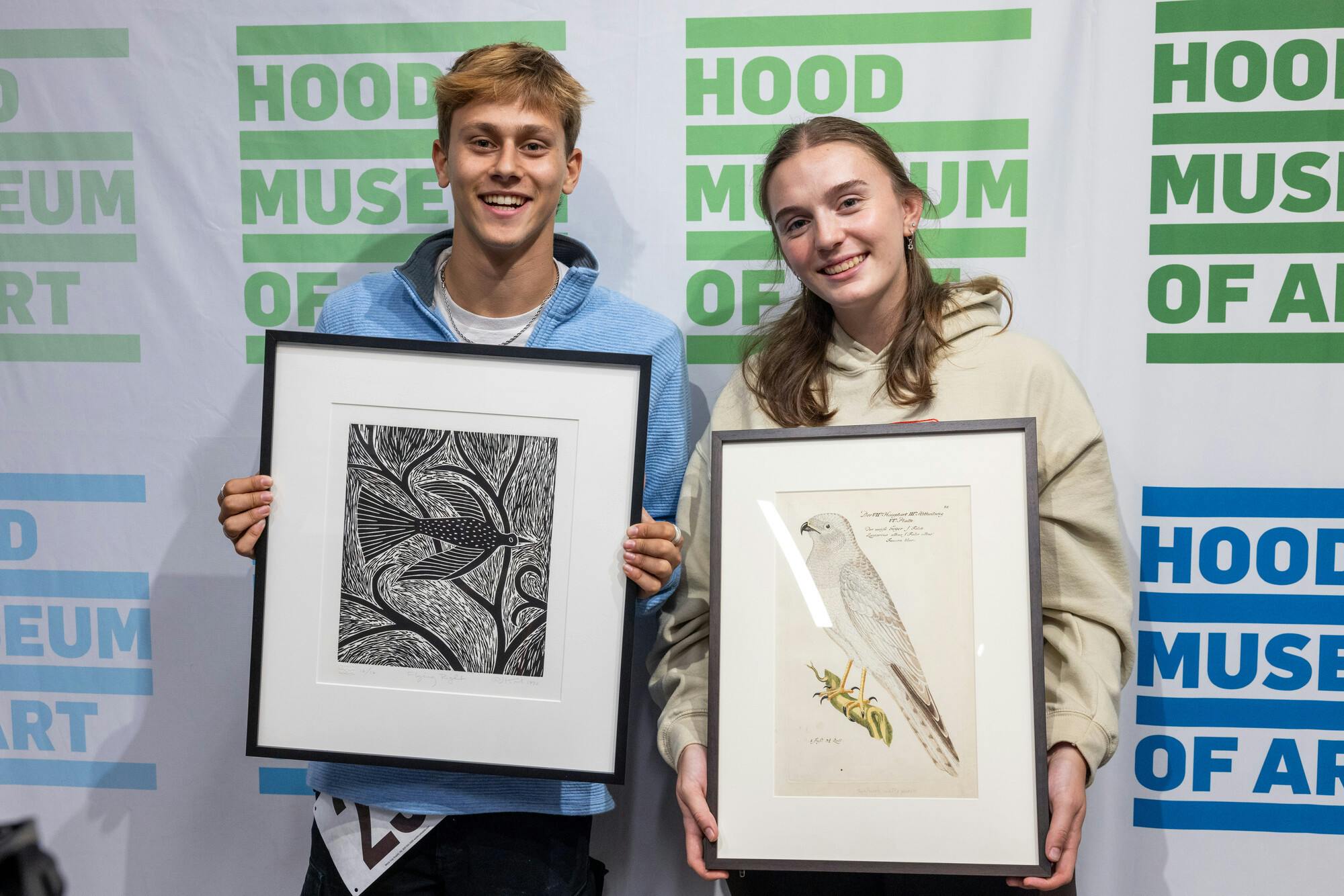
Student Art Lending at Dartmouth, an initiative by the Hood Museum of Art that began in fall 2024, provides a unique opportunity for students to come into direct contact with art. Through this program, students can borrow original works of art from the museum’s collection and display them in their dorms during the academic year.
The Hood’s senior curator of academic programming Amelia Kahl spearheaded the pilot program last fall in collaboration with Hood Museum director John Stomberg, who secured funding for the program. Campus engagement manager Jenna Blair has since directed the program. Under Blair’s direction, the SALAD collection has grown considerably in size from 13 to 66 pieces of art.
At the beginning of fall term, the museum displays the entire lending collection at the Hood before opening it up for students to take their pick. After the artwork is packed up by the Hood — including hanging hardware and care instructions — and paperwork is signed, they take it home.
Blair explained that to curate the collection, she collaborates with the Hood’s curatorial team as well as the student Museum Club and student employees. Blair and research assistant for art lending and campus initiatives Anja Grover ’26 emphasized the “intentionality” behind the process.
“There’s a little bit of me as an activist in here wanting to be like, ‘How do I make a collection that feels really inclusive?’” Blair said.
Blair said they focus on works whose diversity both “connects to different students on campus” and represents identities traditionally “missing in the museum field,” such as female artists. Grover added that their focus on “underrepresented communities” in art has also included choosing works by artists of color.
Blair said they are also concerned with temporal diversity, looking at works “across time periods.”
Still, two-time student borrower and Levinson Intern at the Hood Lucie Morton ’26 expressed her appreciation for the “contemporary” focus.
“I think it is really important to have contemporary works and interact with art across campus, not just through textbooks and through classes, but to actually have it in the space and work with you,” Morton said.
Grover said the nature of the art’s destination — student dorms — imposes size and medium “constraints” on the types of works. She mentioned limits of size — emphasizing that the process of framing works with glass protection increases their size and weight — as well as medium.
“We typically pick works on paper, such as prints and multiples, because it’s just kind of the easiest art form to preserve, because we know some of these works could get damaged,” Grover said.
Although damage is a concern, Blair said a fundamental part of SALAD is “trusting students to take care of the work” — a responsibility in which she also sees an “educational component.”
Blair expressed her enthusiasm for seeing students’ reactions to the artworks and their different ways of “connecting” with them.
“It’s really rewarding for me to see at the pickup day that students are excited about what is available, and they are connecting to this variety of works that really do run through history and across all kinds of identities and experiences,” she said.
Each lended artwork is also accompanied by a journal that stays with the art as it is passed between students. Before a series of reflective prompts, the journal explains that it is a space to “share comments and thoughts about your artwork” and that it will be “passed on to the next student borrower,” according to an email statement from Blair.
Blair said the idea is to create “an ongoing conversation between generations of students,” adding that the team was inspired by similar programs at other university art museums.
Two-time student borrower Matthew Tucker ’28 said he “love[s] having a piece of artwork hanging in my room,” which he said currently “hangs as the only piece on the wall next to my bed.”
“I love how it frames the room and allows my college dorm to look a bit more put-together than it should,” Tucker said.
Tucker also appreciated the journal initiative. He said that while he was “the first person” to contribute to the journal accompanying his artwork last year, his journal this year already contained “a fellow student’s experience and thoughts” for him “to read and add to.”
In addition to the journal, each student receives a write-up when they pick up the art providing deeper context about the piece.
Grover said she intends to start conducting “interviews with the artists” currently in the collection — many of whom are “contemporary artists” — in order to deepen the research behind the works.
She called the opportunity “really exciting.”
“I’ve done so much of the research and speculation and thinking about these artists and their works, but it's so rare to actually get to interact with the artist and hear what they have to say,” she said.
Emeline Moss ’26, a Studio Art minor who is currently an Erbe Intern at the Hood, took home a work by Kiki Smith, a contemporary German-American artist whose multidisciplinary work explores themes of embodiment and nature.
“I’ve always loved going to museums and seeing art, but it’s cool to have a part of that now in my space,” she said.
Moss said the experience of living with the piece has allowed her to “appreciate” it both “on its own” and “in conversation” with her own art.
“Especially as an artist myself, it’s cool to have my own artwork in my room in conversation now with a piece from the Hood,” she said.
Having borrowed the work “Arla Lucia” by Cara Romero, whose exhibition “Panûpünüwügai (Living Light)” was presented at the Hood earlier this year, Morton emphasized the piece’s significance for her.
“It was so cool to have something like that at the Hood, and then to be able to bring part of that back home was really great,” Morton said.
She also recalled how the piece has prompted conversation when visitors like her roommate’s parents have seen it.
Looking ahead, Grover expressed her desire for the SALAD collection to continue to grow with the student population. “I always want the works to be representative of our student population, but also to challenge and push new ideas and be interesting and relevant,” she said.
Blair said there will “hopefully” be around 80 works for lending on pickup day next fall.
“I hope that SALAD becomes a beloved tradition for as many students as possible,” she said.