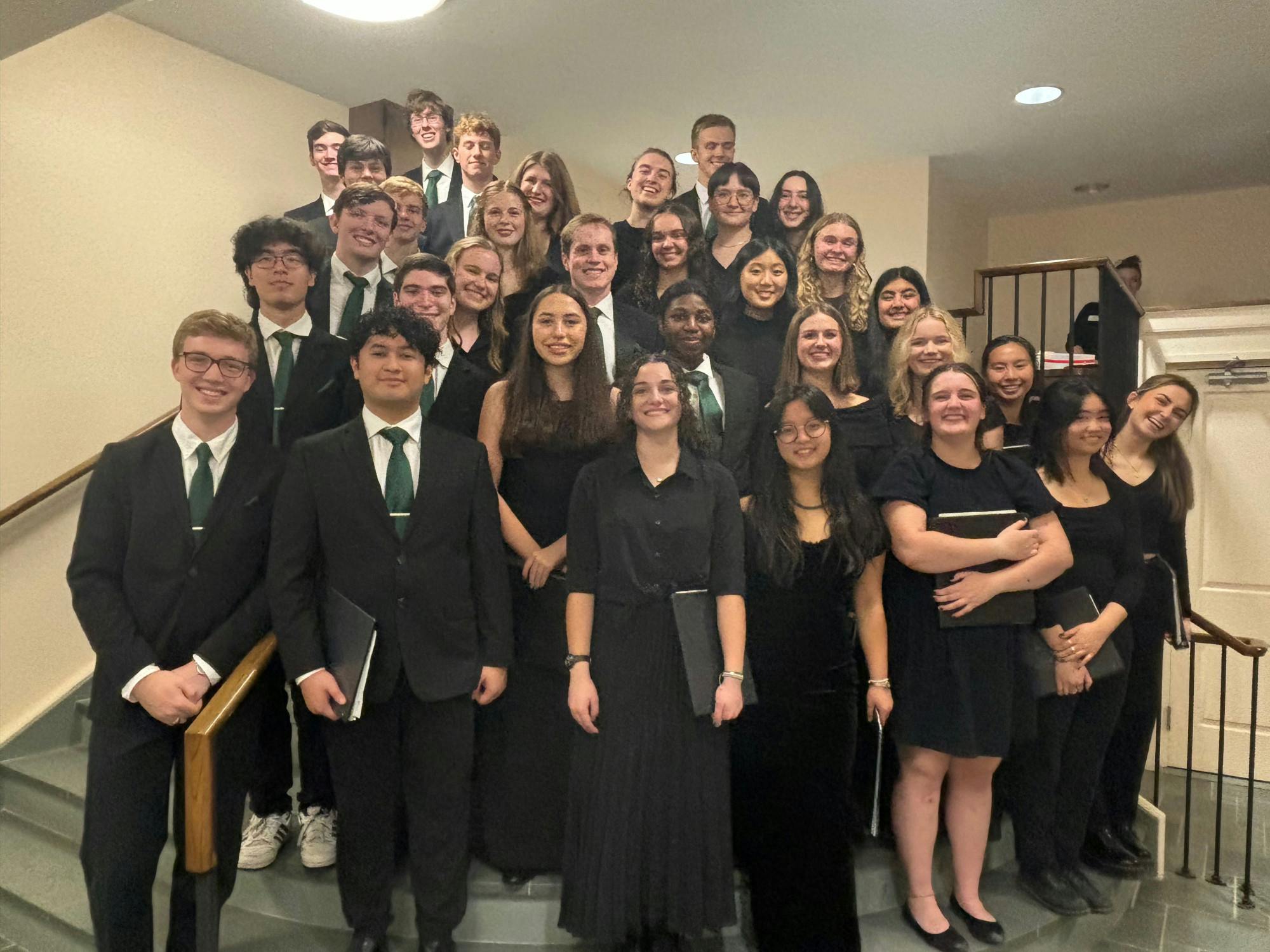
On Nov. 2, the Dartmouth College Glee Club — a longstanding professionally-run Hopkins Center for the Arts ensemble — performed its termly concert at Rollins Chapel for a full audience.
Guest pianist Andrew Jonathan Welch accompanied the performance, which featured a solo by Ashley Headrick ’28. Spanning six centuries of music from Bach to Barber, the ensemble presented a sharp and moving program that radiated joy.
Ciabatti described this spirit as reflecting a typical intention of artists — especially choral musicians — of “trying to find light and give a sense of hope” in their work.
Choirs “try to uplift the audience and give a [sense] of either levity or deep hope or somehow catharsis,” he said.
Since 1899, Glee Club has offered a space for around 30 undergraduate and graduate students to perform a range of choral music. The group is currently led by director Filippo Ciabatti, who also serves as music director of the Dartmouth Symphony Orchestra, alongside assistant conductor for choral ensembles Erma Mellinger, who is also a senior lecturer voice instructor at the College. Glee Club has previously toured both the United States and internationally and plans to resume this tradition “sometime in the future” following disruptions from COVID-19, according to Mellinger.
In spite of the “challenge” of preparing the performance within the term’s short time frame and scheduled twice-weekly rehearsal times, Mellinger said the ensemble’s work paid off.
“They worked really, really hard, and to see them feel their sense of accomplishment and their excitement afterwards is really rewarding,” Mellinger said.
As the director as well as conductor responsible for bringing the pieces to life, Ciabatti described his role as that of balancing form and feeling.
“I think that the greatness of great artists is the ability to put together extreme poetry within a frame — right within a coordinate — within a form that somehow not only makes sense, but has an organization,” he said.
Explaining that these two components “cannot live in a vacuum,” he said his execution of the “technical work” had to ensure the performance was “as precise as possible” as a “way to reach a higher being — which is great art, great poetry, great emotion.”
“And a conductor’s job is to try to sort of convey to a group both things at the same time: train them technically, but also remind them and lead them to what needs to be an emotionally charged performance,” Ciabatti said.
Mellinger highlighted what she saw as an effective rapport between the conductor and ensemble members on Sunday.
“Knowing the music as well as the kids did, when Filippo decided, ‘You know what, I think I’d like to go softer here’ — you could see his conducting — they responded,” she said.
“They were capable of giving him in the moment what he wanted, which was just an extension of what we’ve been rehearsing,” she added.
That said, Mellinger noted how the ensemble members’ commitment was evident throughout the rehearsal process. The early 19th century spiritual “Ezekiel Saw the Wheel” by the African-American composer and choir director William Dawson, for example, is divided into 16 parts, making it particularly challenging. She said that students were “a little apprehensive” to take on the work at first.
However, Mellinger said Filippo was able to break down the different parts for the students.
“All of a sudden, it was like everybody’s faces were out of the score, because they could memorize the pattern very easily,” she said.
Headrick worked with Mellinger to prepare for her solo performance of Felix Mendelssohn’s “Hear My Prayer.”
“We isolated certain vocal techniques, such as breath support, to ensure [that] when I did my solo during the concert, it was by all technical means exactly how I had rehearsed it through muscle memory,” she said.
As a teacher, Ciabatti described his “biggest goal” as “planting the seed for the students to love music for the rest of their lives.” At the same time, he hopes to foster a “sort of emotional value” in what his students learn.
Ciabatti added that besides a love for music, he hopes that students also “carry in their life the ethical values that music brings with it,” including the value of “community.”
He said he considers a performance a “success” if “the audience has felt somehow uplifted or inspired.”
“As a musician, I think that I measure success in what we are able to communicate as a collective to an audience … if somehow our work has eased some pain, … or it’s maybe just given someone a very pleasant afternoon,” he said.