
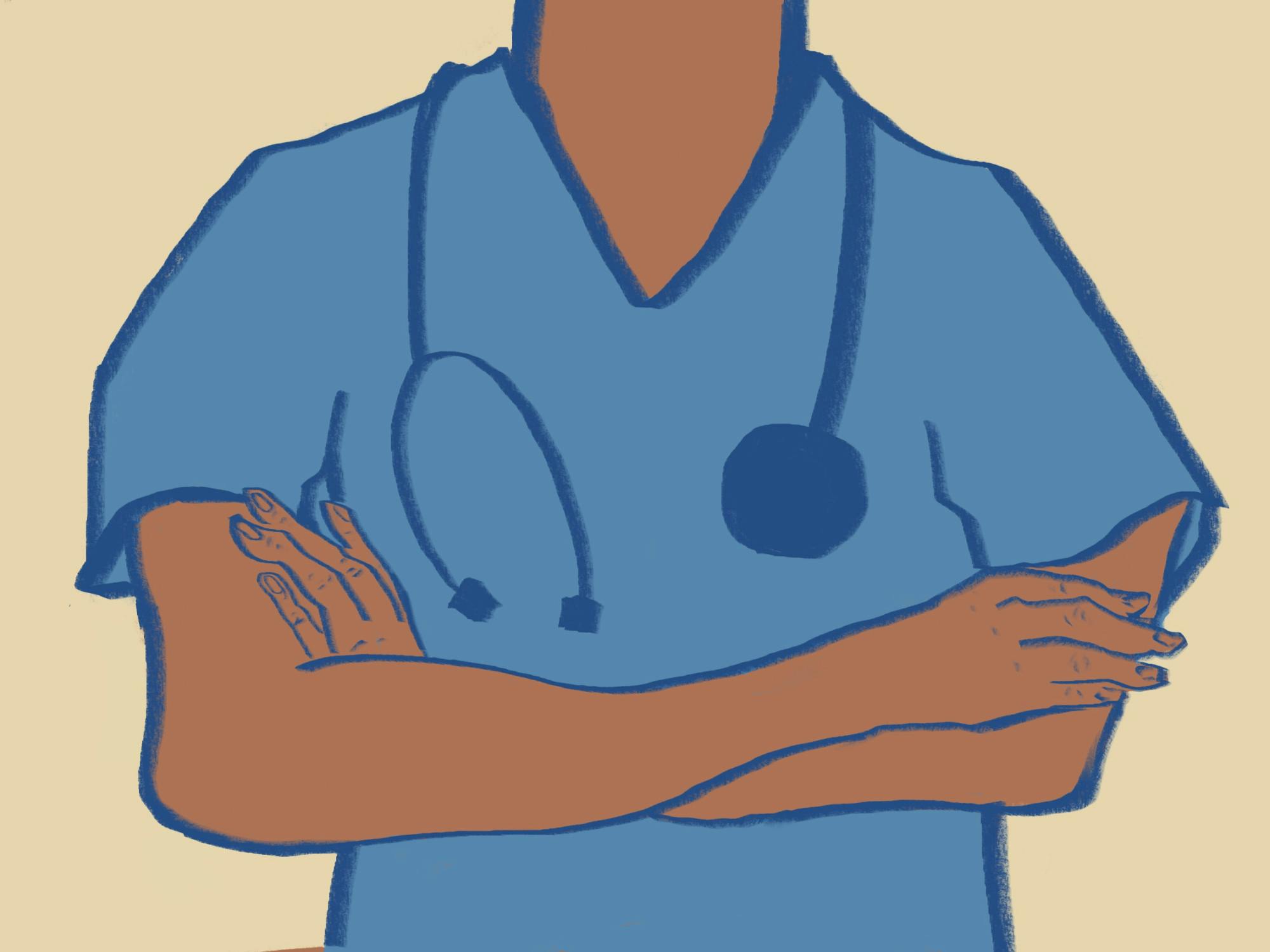
At Dartmouth, being pre-medicine is more than just taking a sequence of classes — it’s a culture. Although the College’s pre-med track is notorious for its rigorous course structure, students have found ways to foster a sense of community with others who are also planning to pursue careers in medicine.
Alexis Park ’28, a biochemistry major and anthropology minor, said that pre-med students often lean on each other for help.
"Pre-meds tend to pool their resources,” she said. “They always try to help each other out.”
She also emphasized the importance of a “good support group” and explained that she attempts to surround herself with students who “see [Dartmouth’s learning environment] as a collaborative experience.”
Alicia Cage ’26, a biochemistry major and Latin American, Latino and Caribbean studies minor, hopes to pursue a master’s degree in either health administration or public health. She described how she has developed friendships with classmates that have persisted even after the class has ended.
“I've bonded with a lot of people,” Cage said. “We still have group chats that we still talk in."
Joshua Hunter ’27, a biology major, encouraged underclassmen to befriend the people they meet in their classes.
“The pre-med community is kind of small, but it’s tight,” Hunter said. “If you’re going to be seeing the same people in the same classes for your whole four years, it’s good to be friends so you have people to study with [who] recognize the process … and have that foundation.”
In addition to classmates, Park has also found support for her pre-med studies from professors.
Professors “try their best to make sure every single resource is available to you,” she said. “My experience[s] with professors have been really great because the professors I've interacted with have always wanted to help students and not make the class unfair."
Cage also expressed appreciation for the accommodating nature of Dartmouth pre-med professors.
“A lot of professors have office hours on the weekends,” she said. “Sometimes you really do need that extra support.”
Park added that if she could redo her freshman year, she would take more advantage of the support offered by the pre-health advisors.
"They genuinely are such a godsend,” she said. “They know the classes."
Cage’s interest in pre-med influenced her decision to attend Dartmouth, as its small class sizes, proximity to a medical school and ability to provide her “mentorship” made the College an attractive option for her.
“I’m a kind of person that thrives in classroom settings [that are] a little bit smaller, where you have more one-on-one with teachers,” Cage said. “You know everybody in the class; the teacher knows you. It helps to build relationships, … and I think it helps to become more engaged in the course.”
Though laborious, the pacing of the pre-med track at Dartmouth has prepared her well for a future in medicine, Cage said.
“My brain has been attuned to learning how to process so much information in 10 weeks,” she said. “I think that once I go to a med school that is operating on a semester system, I’ll be able to think quicker and more efficiently, and also process information at a quicker pace.”
Hunter also reflected on how his pre-med track at Dartmouth began.
“Coming out of high school, I always wanted to do architecture, but the architecture program was kind of small, so I was kind of leaning away from that and medicine was always kind of interesting to me,” he said. “So I took a class freshman fall, Biology 11, and all the class topics were good … and it made me more interested in pursuing the medical path.”
Although support systems can improve the experience, the intensity of the pre-med track can take its toll, often forcing students to sacrifice parts of their Dartmouth experience.
Hunter, who took Organic Chemistry during his sophomore summer, found that the academic demands of the class often required him to turn down social activities.
"My friends would be like, ‘Do you want to go to the river and hang out?’ and each time, you have to make the decision before you go to either stop or [continue to] do more work,” Hunter said. “I feel that having a decision to make can take away from the Dartmouth experience because you kind of have to study, and if you pick studying over fun every time, you miss out on some activities.”
Furthermore, pre-med requirements can also make it difficult to study abroad, according to Park.
"I do want that [study abroad] experience, but definitely being pre-med at Dartmouth is limiting,” she said. “If you really, really want to do it, then you can make it work. It just would be very difficult and definitely a sacrifice for that experience."
Park, who is involved with WebDCR, has found it difficult to juggle additional commitments while also studying for classes.
"I think being pre-med and balancing something else that's a bigger commitment is so, so difficult,” she said.
However, Park acknowledged that being involved in radio gives her a “break” from her pre-med commitments, which “definitely” helps her manage the balance.
Despite the difficulty of balancing commitments, Cage noted the importance of investing in communities outside of academics to maintain enthusiasm for her future career.
As president of Dartmouth’s chapter of the National Society of Black Women in Medicine, Dartmouth’s National Pan-Hellenic Council and a member of Delta Sigma Theta sorority, Cage added that her desire to give back to others motivates her to continue working towards a career in medicine.
“I think if I just solely focused on school I would have probably [given] up pre-med a long time ago; I think that I would have forgotten why I wanted to do pre-med,” she said. “But … being involved in all these different aspects of our campus has reminded me [that] I want to do this for my people, for our communities, for other pre-health students that want to continue on this journey, but [are] really struggling through it.”


