
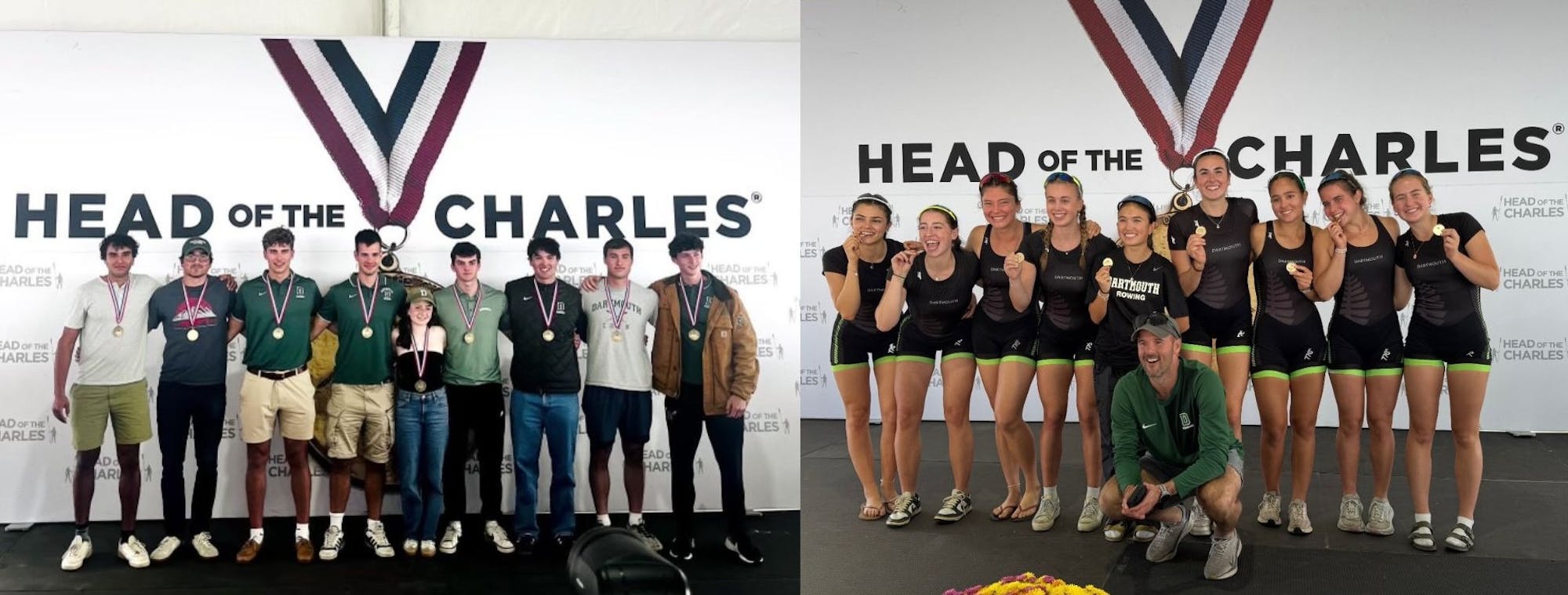
The 60th annual Head of the Charles Regatta took place on a picture-perfect fall weekend in Cambridge, Mass. from Oct. 17 to Oct. 19. At the prestigious event, Dartmouth rowing produced one of its strongest collective performances in recent history. The Big Green earned multiple medals and finished second overall in team points for the MacMahon Cup — presented annually to the club, school, college or university with the highest overall score at the races — behind Princeton and ahead of Harvard.
The regatta, held each October on the Charles River, is the world’s largest three-day rowing competition. The 4,800-meter course features tight turns and a time-trial format called a “head race,” in which crews launch at intervals and race the clock. Spectators line the riverbanks by the hundreds of thousands to watch almost 12,000 competitors.
The Dartmouth women’s club eight captured silver in the race, crossing the line in 16 minutes and 15 seconds — less than a second behind Yale — while the championship eight finished tenth in 16:06, one of Dartmouth’s best results in years. The women’s club four took seventh with a time of 18:31, and the championship four placed eleventh with 17:54.
“I think we were very consistent all around our stroke,” said Cate Hamilton ’29, who rowed in the women’s club eight. “Lis Madigan ’27 set a really good rhythm, and we just were working on syncing our power curves. I think it really clicked throughout the week and especially during the race. We all just were kind of like, ‘It’s all upside, what can we prove?’ and that was a really good mindset to have going in.”
Hamilton and the crew stayed steady from start to finish, and the win was a “very collective row,” according to Hamilton. With the tournament featuring staggering crews, a challenge on the course was passing boats who “didn’t entirely yield,” causing clashing oars and boats. At one point, Hamilton said that the crew was trying to pass another boat and “hit oars a little bit.” However, despite small setbacks, Hamilton said the crew’s determination never wavered.
“We all just had a very big desire to win — a lot of competitive energy in that boat,” Hamilton said. “We all put our best foot forward and moved together as a boat.”
On the men’s side, the Big Green lightweight eight finished in 14:21 to place fifth, while the lightweight four placed ninth in 16:14.
“Our plan was to be super aggressive the first 3,000 meters,” lightweight eight’s coxswain Skylar Rockmael ’27 said. “We’d made the mistake in past 5Ks of not starting hot enough, so that was our main goal: to start off the line really fast.”
Rockmael said the crew executed its opening plan and managed the Charles River’s challenging turns well.
“It’s one of those races where the coxswain very much makes or breaks the race,” she said. “I’d done a lot of studying and course review with alumni coxswains, memorizing the fastest line. We started off really strong, good rhythm, and in the first 1K, we were in third place overall.”
Around the three-kilometer mark, fatigue set in.
“As the wind picked up, we kind of ‘popped,’” Rockmael said. “That’s when the forearms, legs, and lungs all give out. We popped around the Elliott turn, and though the rate stayed the same, the boat slowed a bit. Washington started gaining, and we drifted a little farther from Harvard.”
Rockmael said the crew stayed composed during the struggle.
“When you pop, it’s important to stay positive and in the moment, stroke by stroke,” she said. “I think I learned that they have a lot of guts and trust in each other.”
The men’s heavyweight team added hardware of its own. Dartmouth’s club eight captured gold out of 36 crews by more than three seconds with a time of 14:21, while the club four earned silver in 16:30 out of 43 crews. In the championship eight, the varsity placed seventh overall and fourth among collegiate crews, just under 14 seconds behind first-place Cambridge, whose winning boat featured Dartmouth alumni Sammy Houdaigui ’25 and Felix Rawlinson ’24. Houdaigui and Rawlinson currently attend University of Cambridge where they are on the rowing team.
“Our coach told us to go off pretty hard at the start, and we did,” rower Tom Thomas ’26 said. “Our coxswain did a great job holding a very steady line.” Thomas was the stroke, or eighth seat, who set the pace for the gold-medal club eight.
A brief mishap mid-race nearly changed the outcome.
“We did have someone ‘catch a crab.’ That’s when your blade gets stuck in the water, and it throws off the rhythm,” Thomas said. “It cost us a little bit of time. We actually came in second at first, but Harvard got a time penalty for cutting someone off, which bumped us up to first.”
Still, Thomas said the crew’s rhythm and fitness carried them through.
“We were really prepared and had a great team catch this season,” he said. “We were really happy with how we raced.”
Across women’s, men’s lightweight and men’s heavyweight squads, Dartmouth placed among the top crews at the nation’s most prestigious fall regatta. The Big Green will compete next at the Princeton Chase for the women on Nov. 2 and will host Columbia for a men’s lightweight dual on Nov. 1 before they look toward the spring championship season.
Isabel Menna ‘29 is a reporter from Leavenworth, Wash., is majoring in economics and is a member of the Dartmouth Ski Patrol.


