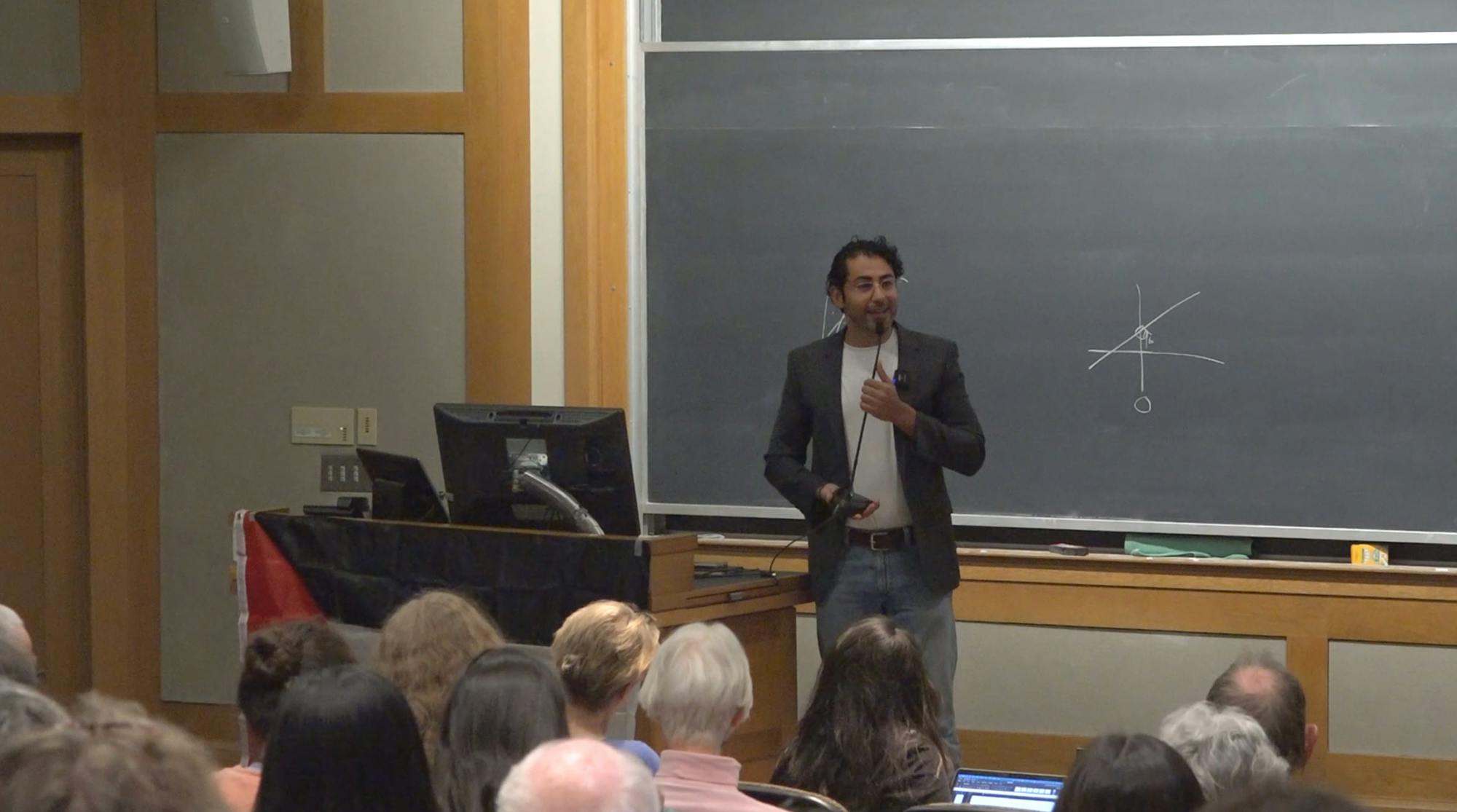
The war in Gaza is a “genocide” and a “destruction of the international order,” pro-Palestinian activist Mohsen Mahdawi told community members at Dartmouth on Oct. 23. The event, entitled “Mohsen Mahdawi @ Dart,” was co-hosted by the Palestine Solidarity Coalition of Dartmouth Students and the Arab Student Association. Approximately 50 community members attended the event.
Mahdawi — a Palestinian immigrant to the United States who led several pro-Palestinian protest movements at Columbia — spoke about his childhood experiences in the West Bank, his activism and his recent detention by Immigration and Customs Enforcement.
In an interview with The Dartmouth before the event, Kevin Caballero ’26 said he was attending as part of his class HIST 32, “Migrant Nations.” He noted that he “did not know” much about student activism before taking the course.
“[I’m here] to learn how the current Trump administration is changing things with freedom of speech on campus,” Caballero said.
Mahdawi, who lives in Vermont, began the talk by discussing the “very special” recent Israel-Hamas ceasefire.
“Even though many of us are very suspicious of the ceasefire, we have a ceasefire,” Mahdawi said. “We pray that it would last and it would be transformed to a much more sustainable resolution.”
Mahdawi then pivoted to reflecting about his childhood. He was “born and raised” in a fifteen-by-fifteen foot home in a West Bank refugee camp that was like a “concrete jungle.”
“There is no living room, tiny kitchen, tiny bathroom, and I shared it with eight siblings and two parents,” Mahdawi said. “So you can imagine that's a difficult life to start with, and this is the situation in now 58 refugee camps.”
After describing his childhood in Palestine, Mahdawi said that the conflict in Gaza was not about just “Palestine and Israel” but “about humanity.”
“What we are witnessing is a destruction of the international order and the international system, and an attack on human rights,” Mahdawi said. “If we justify this and allow it to happen, we should be worried about who is going to be next.”
Mahdawi then criticized the Trump administration for its “attacks on free speech, crushing dissent, the attack on immigrants and the deployment of armed forces.” He criticized Project 2025, which was a document put together by the Heritage Foundation as a “playbook” for Republican administrations, according to The New York Times.
“Project 2025 is the most dangerous thing,” Mahdawi said. “It’s being applied step-by-step in this country.”
Mahdawi concluded by describing his release from detention under ICE.
“I walked out, and I gave the V sign, and I smiled to the camera, telling people, I am free,” Mahdawi said.
Mahdawi’s talk was followed by a brief Q&A. In response to a question about the future of student activism, Mahdawi said that he believed pro-Palestinian student movements “created an infrastructure” for future activism, even though demonstrations had “successes and some mistakes.”
“The reality of it is that what happened at Columbia at other universities, including Dartmouth, has raised the consciousness and awareness of so many people around the world,” Mahdawi said.
In an interview with The Dartmouth after the event, attendee Maya Drowski ‘29 said Mahdawi was “incredibly well spoken” and “poignant.”
“He blew me away with the poise with which he spoke,” Drowski said. “I'm still thinking about his assertion that for student activist groups, it’s important to lead with the heart.”
Isabela Pierry ’29 is a reporter from New York and is majoring in comparative literature and government.