
This article is featured in the 2025 Homecoming Special Issue.
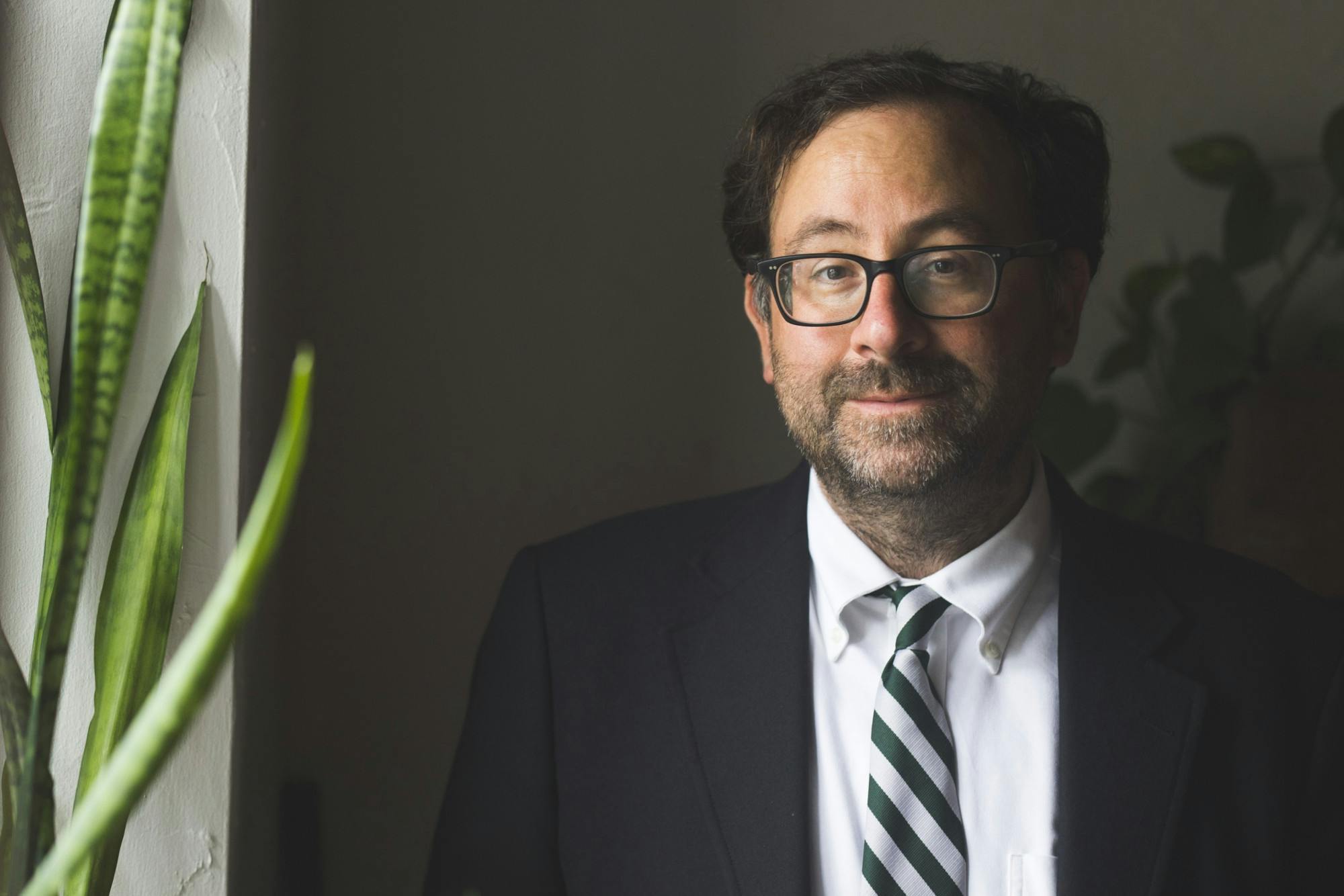
On July 1, 2024, English professor and Writing Program director James Dobson was appointed special advisor to the Provost on artificial intelligence. Dobson advised the College throughout the 2024-2025 academic year on how to best incorporate AI into course curriculums across disciplines. The position originally was created as a one year term, yet Dobson’s tenure has been extended as he continues to guide the College’s AI policy. The Dartmouth sat down with Dobson to learn more about his plans for this year.
Can you tell me a bit about your background in academics and research at Dartmouth?
JB: I’ve been at Dartmouth for 23 years. I’ve had a variety of different roles. I’m a professor of English and creative writing. I’m the director of the writing program. I’ve been serving as Special Advisor to the provost for artificial intelligence (AI) — that was a one year appointment that has continued on in a transitional capacity. I think at this point, the goal of that role was to develop a proposal list of recommendations for how Dartmouth should respond to the generative AI movement.
Tell me about your academic research and its relationship with this advisory role.
JB: One of my many topics of research and scholarly interest is AI, machine learning in particular, and my most recent book was an intellectual cultural history of machine learning and computer vision. I’m an affiliate faculty in the department of quantitative social sciences on text mining and the analysis of data for cultural purposes. I call it cultural analytics, and I’ve been teaching a course called critical AI for the past couple of years. These are topics of interest to me in a scholarly way. I research machine learning, text analysis, visual analysis, how neural networks represent data. Also, as director of the writing program, I’ve been thinking a lot since the fall of 2022 — when ChatGPT was released — about what the advent of generative AI means for the teaching of writing and the use of academic writing in places like Dartmouth.
Among professors at the College who study AI, what makes you particularly well-positioned to take this on?
JB: Generative AI is clearly a cultural technology. If you think about how generative AI is trained and how it functions, it’s operating on large amounts of cultural objects. Text, images, video, audio samples, all kinds of culture. So having someone in a role who can think about the ways in which machines are modeling culture and are then making claims about culture being used to modify and produce new objects is very important. I think it’s great to have someone in this role who can understand that the concerns here are not just technological. They stretch right across all the disciplines and fields.
Are you concerned about what AI means for the future of a liberal arts institution like Dartmouth? What is the best way forward?
JB: It absolutely should be a subject of concern and study above all else on college campuses, and it does require an interdisciplinary approach to understand it. It will require perspectives of many different departments, many different expertise. So I think, number one, it’s a crucially important technology that requires the resources of many different fields to understand. What it means for education is not really known at this point. There’s a lot of things that we just don't know about.
What have you worked on over the course of the last year?
JB: Last year was a big year for information gathering. I went to many different departments and programs, I talked with all of the support staff who assist faculty and students with technology and teaching and learning related activities. I talked with student groups; I surveyed our faculty. I collected a lot of data and synthesized that into a set of recommendations. I tried to really create conversations around generative AI. I was trying to build community, learn what people’s needs were, what their concerns were, what they felt Dartmouth should do in response to generative AI.
What are you most worried about in AI at Dartmouth?
JB: The concerns I have relate to all the things that we don’t know about the models. Not knowing how to assess whether the outputs are correct or not — that seems to be a somewhat insurmountable problem
What do you hope your impact in this role will be?
JB: I’m hoping that we’re able to claim some sort of distinctive role for Dartmouth in the AI space, and figure out what that is to land on what the liberal arts should look like in the age of AI — how generative AI can both enhance what we’re doing and is also subject to the liberal arts.
This interview has been edited for clarity and length.


