
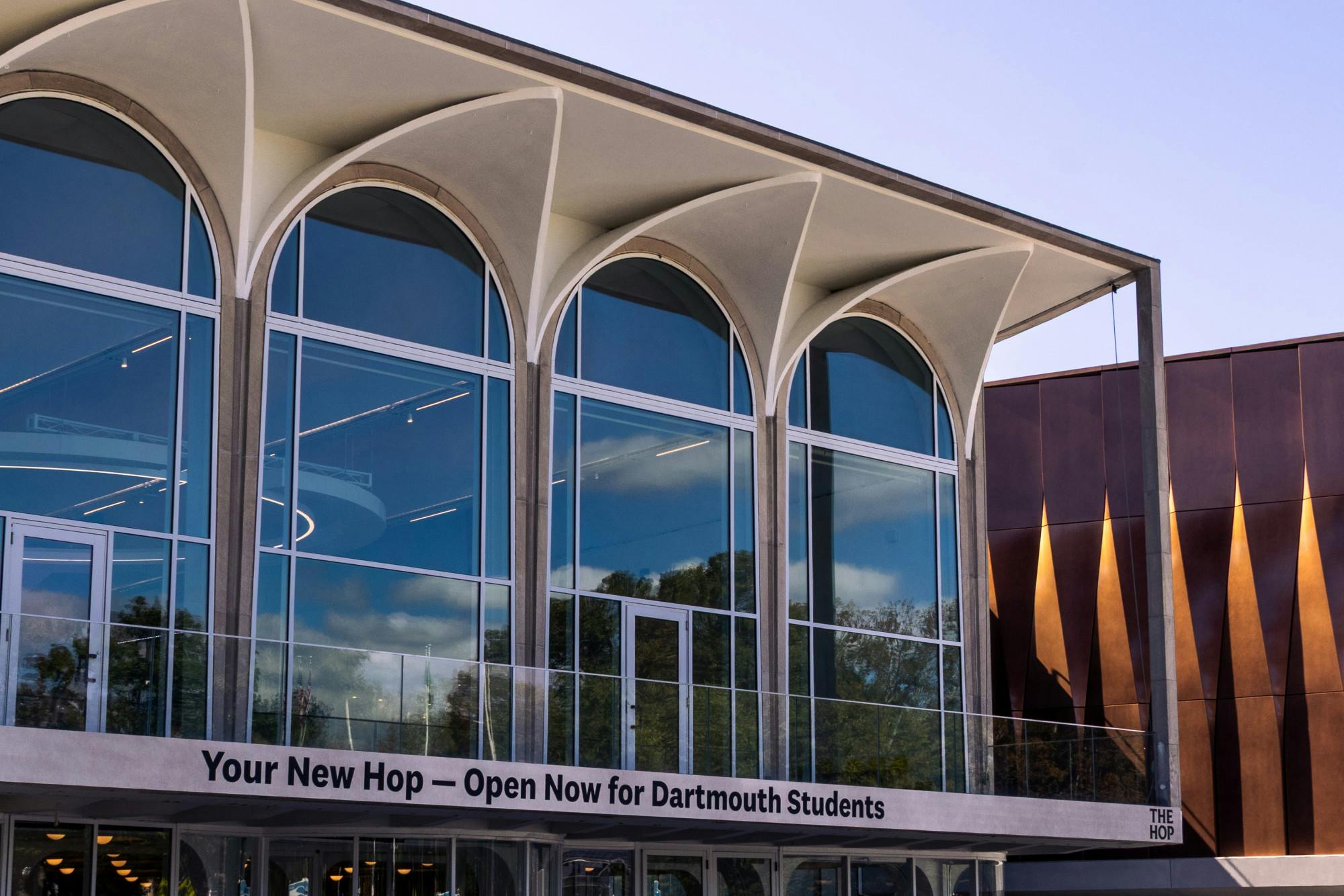
The partial opening of the renovated Hopkins Center for the Arts on Sept. 15 has provoked mixed feelings from students and staff members. Some said they are frustrated with the incomplete construction, while others expressed excitement about access to the new facilities.
The $89 million renovation project on the Hopkins Center began in December 2022. In advance of the Oct. 17 grand opening, construction is still ongoing, according to the College’s Campus Service’s Hopkins Center Renovation and Expansion tracker, which is updated weekly.
“We are on track for a wonderful opening weekend next month,” College spokesperson Jana Barnello wrote. “We are confident that the Hop is well-prepared to support our students, faculty and visiting artists this year.”
People who work for and use the Hopkins Center, however, have had challenging experiences. Costume studio manager Bethany Padrón, who works in the Hopkins Center, said in an interview on Sept. 12 — three days before the partial opening — that there was a “mishmash of unfinished parts and pieces” from the construction throughout the center when she left work that evening.
“The building hasn’t been under janitorial maintenance for this whole time period, and lots of little parts have not been considered or fulfilled to make the doors opening on Monday [Sept. 15] the safe and vibrant thing that it’s supposed to be,” she said.
The theater department did not propose fall student productions or “technical” theater classes because they “predicted that this [renovations] was not going to go to schedule” after earlier delays for staff move-in, Padrón added. Barnello disputed this account, writing in a follow-up statement that the department’s first production was “always scheduled” to be held in the winter term. Though the “hope” was for staff members to be able to move in "sooner,” the project included “built in buffer time,” as with “any complex construction project,” she wrote.
Padrón said she also has been unable to collaborate with student employees on costume design because of construction constraints.
“I managed a lot of things, but I haven’t done any of what is the most fulfilling part of my job, and that is walking our student employees through building costumes, identifying fabric, and … teaching them garment repair,” she said.
In addition to the construction’s impact on students’ educational and extracurricular opportunities, Padrón said she has not worked on sewing projects because the machines are “delicate instruments that cost $600 plus,” and would be easily damaged if they were put out and “lead paint [were] scraped into them” in the construction process.
In a written statement a week after the partial opening, Padrón wrote that her perspective “has not changed.”
“The soft opening had contractors working overnight to make the partial opening presentable, but the infrastructure problems behind the scenes remain,” she wrote. “The more the new spaces are used by audiences, students and staff of all levels, the more idiosyncrasies will appear.”
Several students have already noticed concerns with the newly-renovated spaces.
A member of a dance group that rehearses in the Hodgson Family Dance Studio, who requested anonymity to avoid negatively impacting the relationship between their group and the Hopkins Center, said they appreciated the “really pretty space” but had noticed several issues with the new floors. They said the “rough texture” of the floors resulted in several dancers “cutting [their] feet” during practices.
Additionally, the new material used for the floor felt like it was “not sprung,” the dancer said. Sprung floors are typical in professional dance studios to help reduce impact.
“We’re a dance group that does a lot of jumps and is high-impact on our knees … so it’s problematic when the floors aren’t sprung enough, because that can lead to injuries,” they explained.
Barnello wrote in the follow-up statement that “students from a wide range of practices, dance faculty and professional dancers including those with mixed abilities were consulted on all aspects of the studio.”
During the group’s first practice in the studio, the dancers also noticed “metal shards” that were cleaned up by their next rehearsal — without discussion between group members and the Hopkins Center, the anonymous dancer said.
In contrast to the anonymous dancer’s observations, Dartmouth Dance Team member Andrew Pham ’27 said the team’s new practice space was “comparatively better” than their previous space — the Straus Dance Studio in the gym — because the “quality” of the marley flooring is “a lot better,” the mirrors and room itself are bigger and the new space is air-conditioned.
According to the construction tracker, “finishing infrastructure work remains” for Hodgson.
A member of a student music ensemble that practices in the Hartman Rehearsal Room said they had observed several “aesthetic” issues with the room. For example, the floors in the room were “not fully flush” with the wall, they said. The Hartman Rehearsal Room is not listed as currently under construction on the tracker. The student also requested anonymity because they were concerned about the effects of speaking on their ensemble’s relationship with the College.
At the same time, some newly-opened parts of the Hopkins Center have been embraced by students and community members alike. During the Telluride at Dartmouth film festival, which featured screenings of six films from the Telluride Film Festival at the Hopkins Center from Sept. 17–21, attendees sat in the 792-seat Spaulding Auditorium. The auditorium is still undergoing “lighting programming and banner commissioning,” according to the construction update tracker.
Hopkins Center usher and projectionist Solveig Lyssand ’28 said Telluride at Dartmouth “worked really well” in Spaulding Auditorium.
“We have so much more space, which just makes [the auditorium] great for projecting because the screen’s bigger [and there is] new equipment, new opportunities to learn, new technology,” she said.
Lyssand, who also participated in the College’s production of “Hamlet” during her freshman fall, said there has been “lots of anticipation and build up” to “get back in the theaters this upcoming year.”
“In due time, whenever they’re ready, we’ll have a grand opening, and it’ll be ready for the students and the community to be able to enjoy those spaces,” she said.
Ongoing projects include the Daryl Roth Studio Theater, the Hodgson Family Dance Studio and the Courtyard Café, which is “being upgraded” and will be open “in time for opening weekend,” Barnello wrote.
Annabelle Zhang '27 is a reporter and editor from New Jersey. In the classroom, she studies Geography and Government modified with Philosophy and Economics. She enjoys creating recipes, solving puzzles and listening to music.


