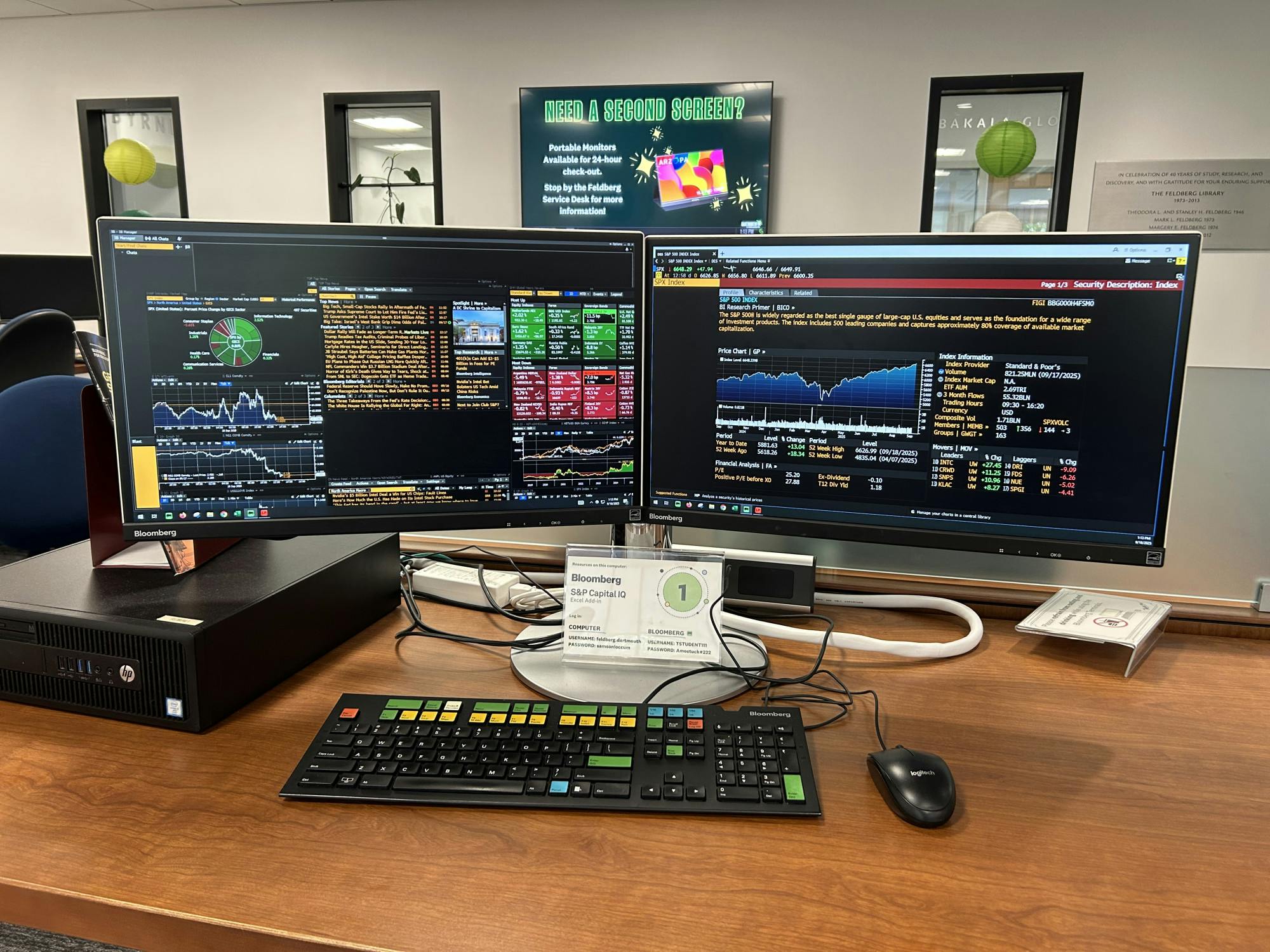
You might recognize them from “The Wolf of Wall Street”: Bloomberg terminals are the go-to platform for everything in finance and economics, from news to options pricing to networking. Dartmouth has 12 of the computers that typically cost upwards of $20,000 annually. Administrators did not disclose how much the College pays in total for the subscriptions.
Since the installation of the first Bloomberg Terminal at Feldberg Business and Engineering Library in 1995, students have used the terminals for academic, extracurricular and professional needs.
The library currently has 12 terminals through Bloomberg’s “buy three, get nine free deal” for academic institutions, according to Feldberg librarian Amelia Looby.
Bloomberg Terminals “end up being really important to folks who go into investment banking or are doing anything in finance,” Looby said. “It’s important for students to have the opportunity to learn [from] them while they’re in business school.”
For students who are looking to explore the terminals, the library has a guide for their use and holds at least two “Introduction to Bloomberg” workshops a year which are recorded and posted on the library’s website, according to Looby.
The terminal “is one of those tools that uses mnemonics — codes to find what you’re looking for — and once you know those codes, you can move around really fast,” Looby said.
Tuck professor Franz Hinzen states the terminals are “very special” as they provide “very recent data more or less immediately.”
“So that’s why when you go to Wall Street, everybody has terminals around,” he said. “It’s basically the main business of Bloomberg to collect data [and] offer it to people in a very streamlined, fast way.”
The terminals also have “a lot of depth” in terms of data, so “it doesn’t really matter what you want to study,” according to Hinzen.
“The data is going to be somewhere available on Bloomberg,” he said. “If you want the whole specific funds at a given point in time or specific software prices or other securities prices, it’s basically going to be there right away.”
Mathematics and economics lecturer John Welborn uses the terminals in his teaching for the two course mathematical finance series MATH 86-96.
“We use the Bloomberg terminals for the analysis and the pricing of sophisticated financial derivatives,” Welborn said.
Welborn said the terminals are “very valuable” to his teaching since they allow him to “translate the theory in our textbooks and our lectures into a practical application of the theory.” He added that Bloomberg is “generous” with their education materials, providing academic papers to explain pricing tools and access to experts for the students.
“Having a class like mathematical finance where they can meet with a Bloomberg expert, use the Bloomberg terminals, is a great way to see how their Dartmouth education is used in practice,” Welborn said.
Economics professor Andrew Levin, who teaches ECON 62: Topics in Macroeconomics, uses the terminals for his research, and a number of his students have used Bloomberg data “on global financial markets in preparing their analyses.”
“I’ve used the Bloomberg terminals extensively for my own research on analyzing the cost to taxpayers of the Federal Reserve’s purchases of mortgage-backed securities,” Levin said. “Bloomberg is unique in providing detailed data on MBS valuations and prepayment rates.”
One catch: The amount of data that can be downloaded from the terminals is limited, according to Welborn.
“Bloomberg does have a data limit,” Welborn said. “The undergraduates and the Tuck students are always competing about who gets to the data limit first.”
For students looking forward to spending some time on the terminals, Looby recommends students make an appointment on the library website.
“Put some time on my calendar, or my colleague Crystal’s calendar, and we can walk you through,” Looby said. “If that’s tricky, check out one of our videos, and then just come down and play.”