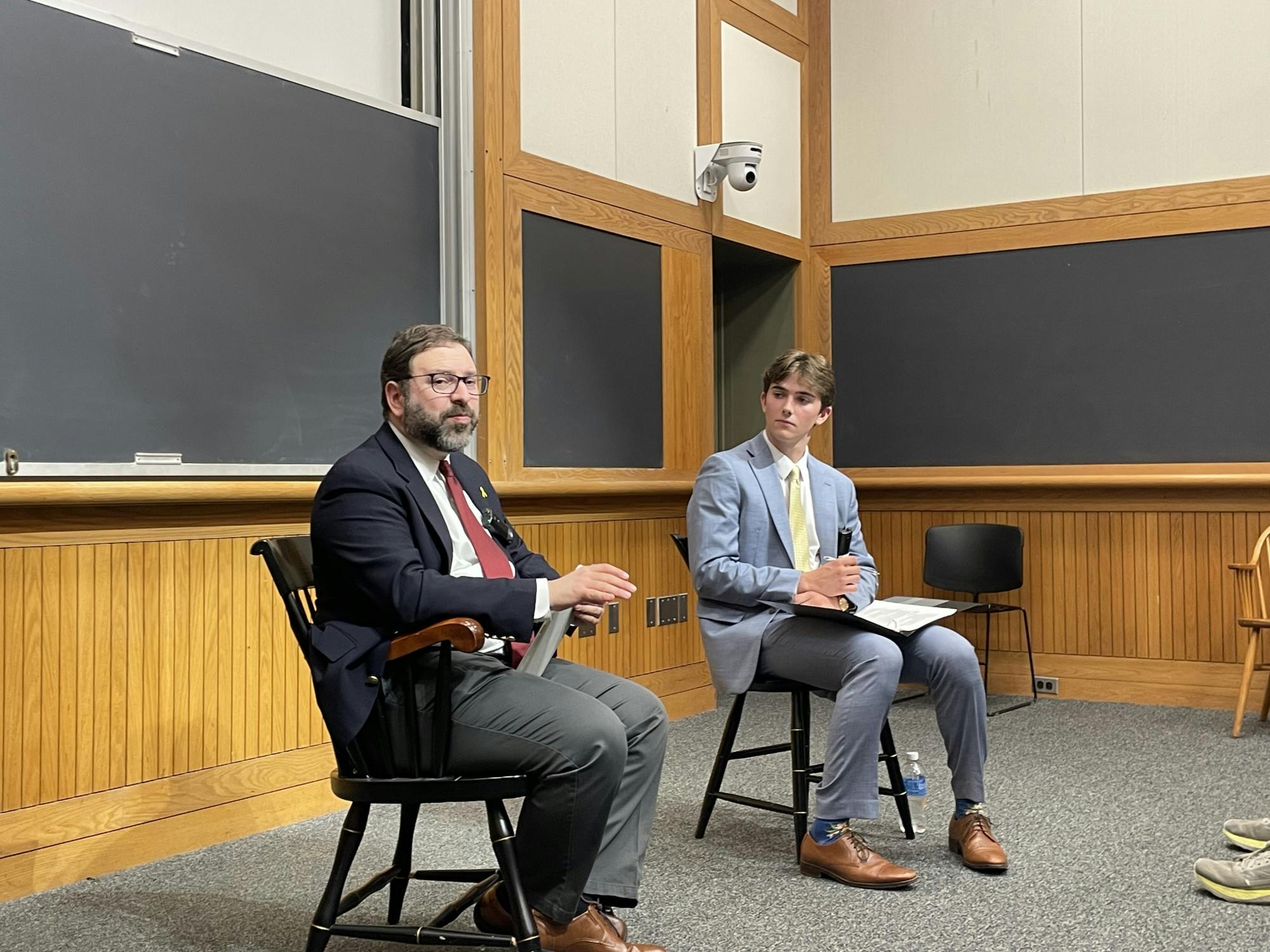
On August 5, Dartmouth’s chapter of the Federalist Society hosted Harvard Law School Professor Stephen Sachs for a moderated Q&A on recent Supreme Court rulings regarding birthright citizenship.
The Federalist Society is a conservative organization of legal professionals with substantial influence, according to reporting by NPR.
Sachs’s research focuses on civil procedure, conflict of laws and constitutional law, according to his faculty profile. He is also an elected member of the American Law Institute, a founding member of the Academic Freedom Alliance and the faculty advisor to Harvard’s chapter of the Federalist Society.
Sachs focused his lecture on the recent Supreme Court Case Trump v. CASA, Inc. — a ruling that has drawn national attention for restricting birthright citizenship. He began his presentation with a question: “What are the ways in which law is political?”
“A lot of people are fond of saying things to the effect that law is political, or that law is politics,” Sachs said. “What the Supreme Court does is not political ... their job is very often to take the things that we actually agreed on and apply them in the case before them, until we agree on doing something else instead.”
Sachs then elaborated on the “very controversial” Supreme Court ruling in the Trump v. CASA, Inc. case. The 6-3 ruling was split according to the political parties that appointed each justice, with all three Democratic-appointed justices dissenting.
“The 14th Amendment states that all persons born or naturalized in the United States and subject to the jurisdiction thereof are citizens of the United States and of the state where they reside,” Sachs said. “So one initial question that comes up is, what does ‘subject to the jurisdiction thereof’ mean?”
Sachs explained that the phrase could historically be interpreted as “children of [foreign] diplomats [in the U.S.]” or “the children of invading soldiers” as well as “the children of Native Americans” before the Indian Citizenship Act of 1924 was passed.
However, the Trump administration’s interpretation and subsequent enforcement of the 14th Amendment through Executive Order 14156 sought to eliminate birthright citizenship for children of undocumented immigrants and immigrants with temporary status, according to the American Immigration Council.
After three federal judges struck down the executive order, the Trump administration appealed the case to the Supreme Court. The case that reached the Supreme Court pertained to whether the nationwide injunction used to block Trump’s executive order was constitutional — essentially, whether the individual ruling that restored birthright to the plaintiff was universal.
“If the district court decides, as it did, that birthright citizenship includes a broader group of people, and somebody sues saying, ‘I want you to declare me a citizen and to stop the government from denying me a passport,’ what does that mean for somebody else who’s not a party to the lawsuit?” Sachs asked.
Justice Ketanji Brown Jackson wrote in her additional dissenting opinion that courts must be able to mandate that “everyone follow the law — full stop.”
“To conclude otherwise is to endorse the creation of a zone of lawlessness within which the Executive has the prerogative to take or leave the law as it wishes, and where individuals who would otherwise be entitled to the law’s protection become subject to the Executive’s whims instead,” she wrote.
Sachs also discussed a variety of other court issues in a moderated Q&A with Roger Friedlander ’27, vice president of Dartmouth’s chapter of the Federalist Society. In an interview after the event, Friedlander described the discussion as “great.”
“We took inspiration for the event from the recent litigation between Trump and Harvard, but in planning and executing the event, we ended up covering a great deal more, focusing on Trump v. CASA, Inc., nationwide injunctions and birthright citizenship,” Friedlander said.
Regarding the Federalist Society’s mission, Friedlander explained that the national organization was founded with the mission of “inspiring [future judges] to apply originalist and textualist interpretations to the law and the Constitution.”
“We also try to incorporate as much dialogue and opportunity for different perspectives and opinions to be discussed at our meetings, and to host informative events that go beyond just one specific agenda,” he added.
Event attendee Alex Rockmore ’27 said he found the discussion “really enjoyable.”
“I think the intention was, of course, to focus on the role of politics in the Supreme Court, to focus a little bit on the modern court and the way that obviously perception of the court has shifted, certainly towards the negative in the past few years, and I found it super informative about that,” Rockmore said.
Rockmore is also a member of the Dartmouth chapter of the American Constitution Society, which is the “ideological counterpart” to the Federalist Society, according to Rockmore.
“I disagree with the premise upon which the Federalist Society was founded, which suggests that interpretations of the Constitution should be originalist and textualist, rather than seeing the Constitution as a breathing document meant to reflect modern American society,” Rockmore said. “But I do appreciate the Federalist Society and what they do in terms of fostering high-level debate.”