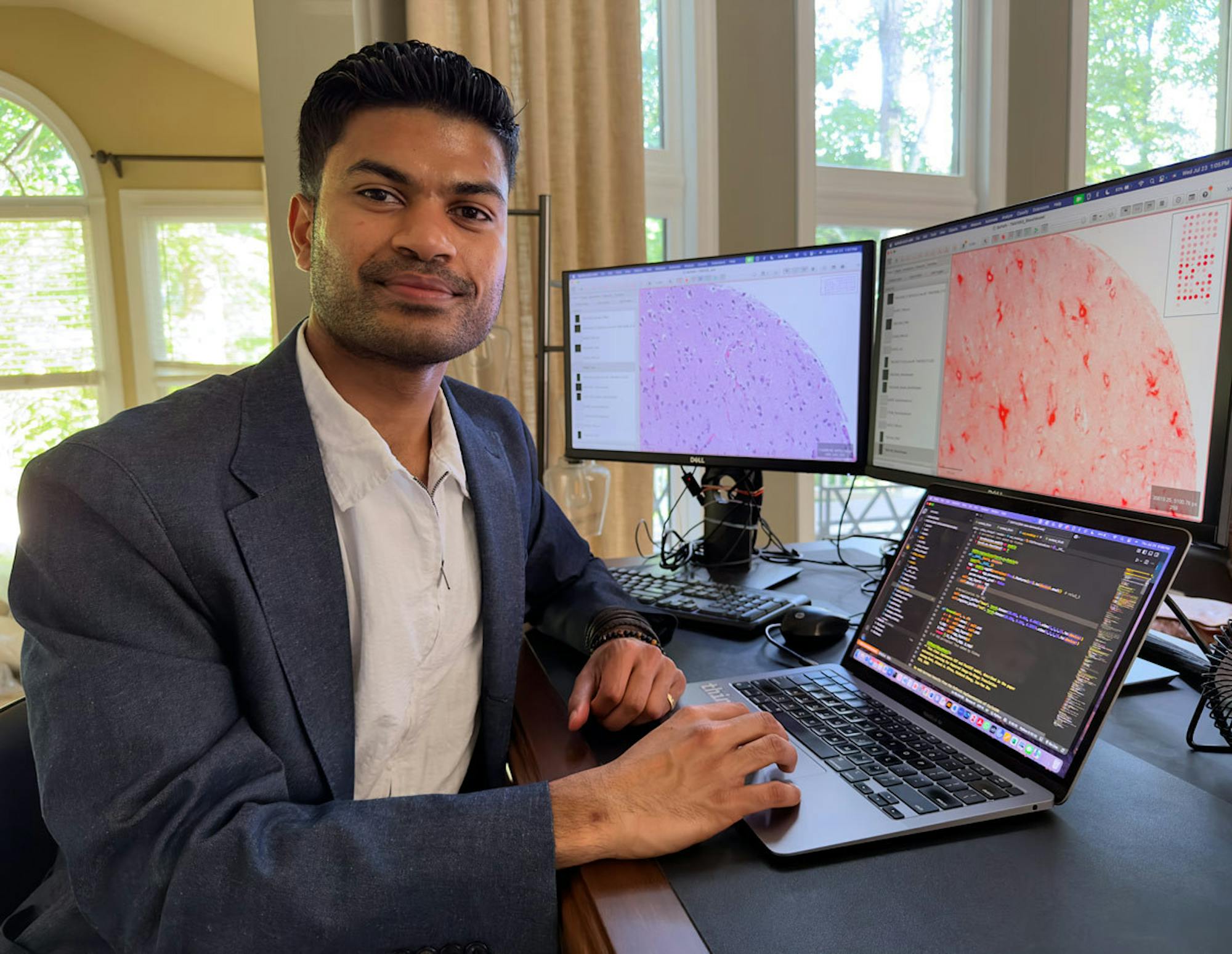
Vishva Natarajan MED ’28, a second-year student at the Geisel School of Medicine, was recently named one of 11 recipients of the 2025 Jack & Fay Netchin Medical Student Fellowship from the American Brain Tumor Association. He will receive a $3,000 grant from the ABTA to facilitate further research. Natarajan’s project, which uses artificial intelligence to analyze data from rare brain tumor tissue to improve the study of tumor-related epilepsy, builds on collaborations with Geisel faculty mentors Dr. Jennifer Hong and Dr. Saeed Hassanpour and reflects his interest in harnessing AI to advance neurosurgery. He spoke with The Dartmouth about his research, the importance of his mentors and the future of AI in healthcare.
The ABTA fellowship is incredibly competitive, with only 11 recipients nationwide. What did it mean to you personally to be selected?
VN: I have to say it would not have been possible without Dr. Hong and Dr. Hassanpour. When I began medical school, I shadowed Dr. Hong and instantly became interested in neurosurgery. She also had an existing collaboration with Dr. Hassanpour, the founding director of the Center for Precision Health and AI. I saw that and thought, this is exactly where I want to be.
Winning this award serves as a strong validation for where we’re headed. To me, it feels like the internet boom, except now it’s the AI boom. I want to ride that wave, and I think it will be especially impactful in neurosurgery and brain tumor research because we now have this amazing data. I feel fortunate to be in the right place at the right time, and I’m grateful the American Brain Tumor Association decided to support this project.
For readers outside medicine and outside of AI, explain what your project is about.
VN: The disease we’re interested in is brain tumor-related epilepsy. Patients with brain tumors often also have epileptic seizures and researchers want to understand why. The way you study that right now is by putting this very valuable brain tissue through slow, expensive chemical processes that destroy it. You can see the problem: you have an important disease to study, but the tissue needed to study it is so rare.
That’s why AI is helpful here. We already have this database, Dr. Hong has collected — all the chemicals that have been applied to brain tissue and the resulting data. The question is: can we use AI to learn the patterns that connect the initial brain biopsy to those expensive laboratory results? Essentially, we’re taking a process that’s very slow, inefficient and expensive, and making it more efficient, less destructive and less costly.
As you mentioned, you’re being mentored by Dr. Hong and Dr Hassanpour at Geisel. What’s one piece of advice or perspective from them that’s changed how you think about your research?
VN: If I have to narrow it down to one, I would say it’s not necessarily one particular thing they said, but something I noticed being around both of them — whether in the Dow Surgery grant talks [at Dartmouth Health] or during lab meetings.
What I noticed in both Dr. Hong and Dr. Hassanpour is that if you want to have good ideas, you first need a lot of ideas. You can’t be afraid to think, “Am I going to say the right thing all the time? Am I going to have the perfect idea the first time?” It’s much better to let your mind operate freely. Even if not every idea is good, others can see things you may not, and once in a while, one of them will be pretty strong.
You’re creating an open access tool from your work called VirtualPNN. Why was it important to you to make this technology open rather than proprietary?
VN: [Open access] is very important because I want the field to progress. We’re building something that is really first of its kind, since the gold-standard data Dr. Hong collected does not exist anywhere else. She is studying a novel, cutting-edge question that few others are addressing. There isn’t much work being done in this area, but we want more people to investigate and develop better tools in the future. That won’t happen unless others can look at the progress we’ve made. So we have to make these scientific contributions available for people to review, improve and build on. It’s about helping the field move forward.
A lot of people are still skeptical about AI in healthcare. What do you think is the most realistic and immediate way in which AI can improve patient outcomes in the next five years?
VN: It’s interesting when you say five years, because now it seems like five years in this field is essentially 1,000 years. Even one year from now feels unpredictable, so I won’t pretend to forecast five. But let’s say one year from now: large language models could already be extremely useful for cutting out a lot of the administrative work doctors waste time on. That seems like their most important and compelling use, because so many healthcare troubles could be automated.
The problem with applying AI to medical diagnosis is that much of it is a black box — you don’t know how it’s making predictions. If a model says a patient has an infection, but blood cultures disagree, there’s no explanation. That’s the explainability problem, and it’s a serious limitation.
But no one cares about explainability when it comes to admin work. People hate it, and AI can make it much easier — Institutional Review Boards, forms and other paperwork that slow research down. The bottleneck is often administrative, not intellectual. Extremely smart people spend hours filling out forms, and if an AI bot can do it, that’s a win.
This interview has been edited for clarity and length.
Jeremiah Rayban is a reporter and editor for The Dartmouth from Wilmington, Del., majoring in economics. Outside of The D, he enjoys reading, art and trivia.