
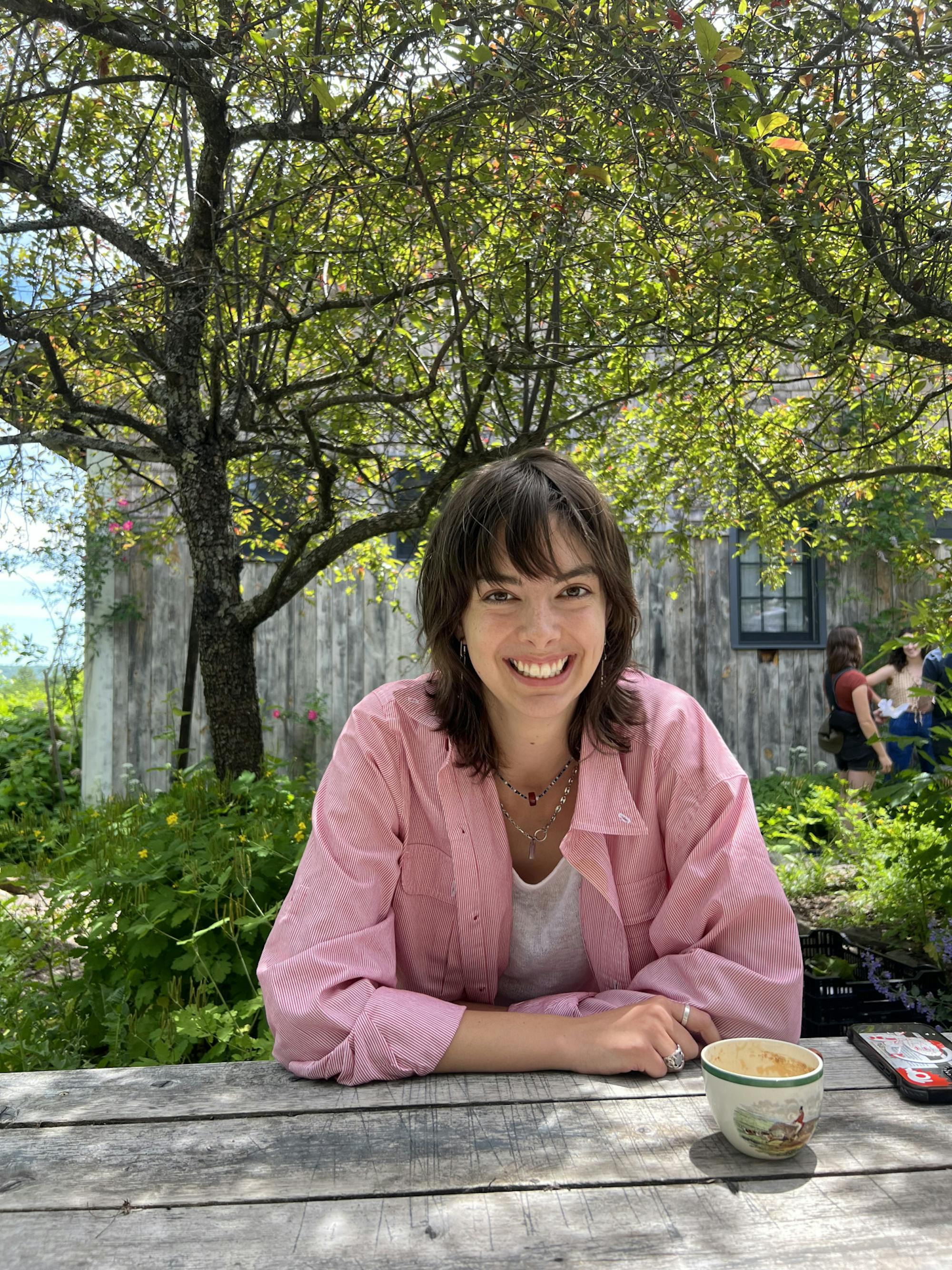
Wynn Johnson ’26 — a psychology and French studies major from Kansas City — was introduced to the Book Arts Workshop while working on her final project for an introductory women, gender and sexuality studies class she took her freshman year. Johnson began to spend more time at Book Arts before starting to work there. In addition to working at the Book Arts Workshop, Johnson has always had an interest in writing, frequently journaling and producing personal pieces of work. The Dartmouth sat down with Johnson, who is one of eight student workers at the workshop, to discuss her journey in Book Arts and how it has shaped her creative endeavors.
What does your job usually look like as a student worker at Book Arts?
WJ: We oversee open studio hours. Your main job is to help people who come in with whatever project they want to do, whether it’s binding a book, making a card or stamp or setting type and printing type. We also get to make things and experiment with new techniques. I’m really into book binding, so I sometimes spend time just learning how to do a new type of binding.
Did you do anything related to book binding before joining Book Arts at Dartmouth?
WJ: No, I had never considered myself an artistic or creative person, like in any way. I just never thought that it was who I was. And I think that Book Arts was really special for me because it allowed me to sort of tap into that creative side and realize that, ‘Oh no, I am creative, and I really enjoy it.’ Specifically with bookbinding, it’s in sort of a structured way, so you have to be pretty meticulous, but you have creativity within that. I think I really thrive in that environment. I had never done anything like it before, but I’ve always loved books.
Do you have any favorite projects that you’ve been working on?
WJ: I learned how to do hardcover binds this summer, and I’ve been really into that. Right now, I’m making my dad [a project]. We have these collage binds, and so I found a book of children’s poetry and I’ve cut out a bunch of these poems that reminded me of him. Now, I’m collaging a book with these poems in it, so I’m excited about that.
What would you recommend to other students who are interested in getting involved with Book Arts?
WJ: We teach classes every term, which are really fun. I personally really enjoy teaching them. In the winter, there’s poster printing for Winter Carnival, so that’s always fun because you get to see a little window into the world [of Book Arts]. But, honestly, just coming to open studio hours and exploring and drawing and collaging and making stuff is, I think, one of the best things.
Did anything surprise you coming in as someone who didn’t have a background in Book Arts?
WJ: I think just the level of dedication it takes and the level of knowledge, especially within printing, which is not necessarily my strong suit. But to be able to set a poster and make it actually look good takes so much work. Every time I’m setting type, I think about how books were made back in the day, and it’s insane to me, going through the slow process of putting every letter in.
How have you been able to combine your own writing work with Book Arts?
WJ: I make all my own journals so that is really fun to have. When I finish a journal, I get be like, ‘Wow, I made that whole journal,’ and then [I] fill it with my writing. I sometimes will make collages that have words and fragments of things in them. For my French class this summer, my final project was this weird, hanging sculpture that had all these typewriter pages on it with stuff that I had written both in English and French about the books that we were reading. So, that was one opportunity to really bring those things together.
What are you looking forward to doing with Book Arts during the rest of your time at Dartmouth?
WJ: I really want to work on doing engravings and carving my own blocks to print … I have so many things I want to do. I want to make my grandma stationery, and then I want to learn as many bindings as I can. Sarah, who runs the Book Arts Workshop, is such a great binder and such a great resource, and she also has so many books and materials and ideas. So, I just really want to take advantage of that in my last year.
This interview has been edited for clarity and length.


