
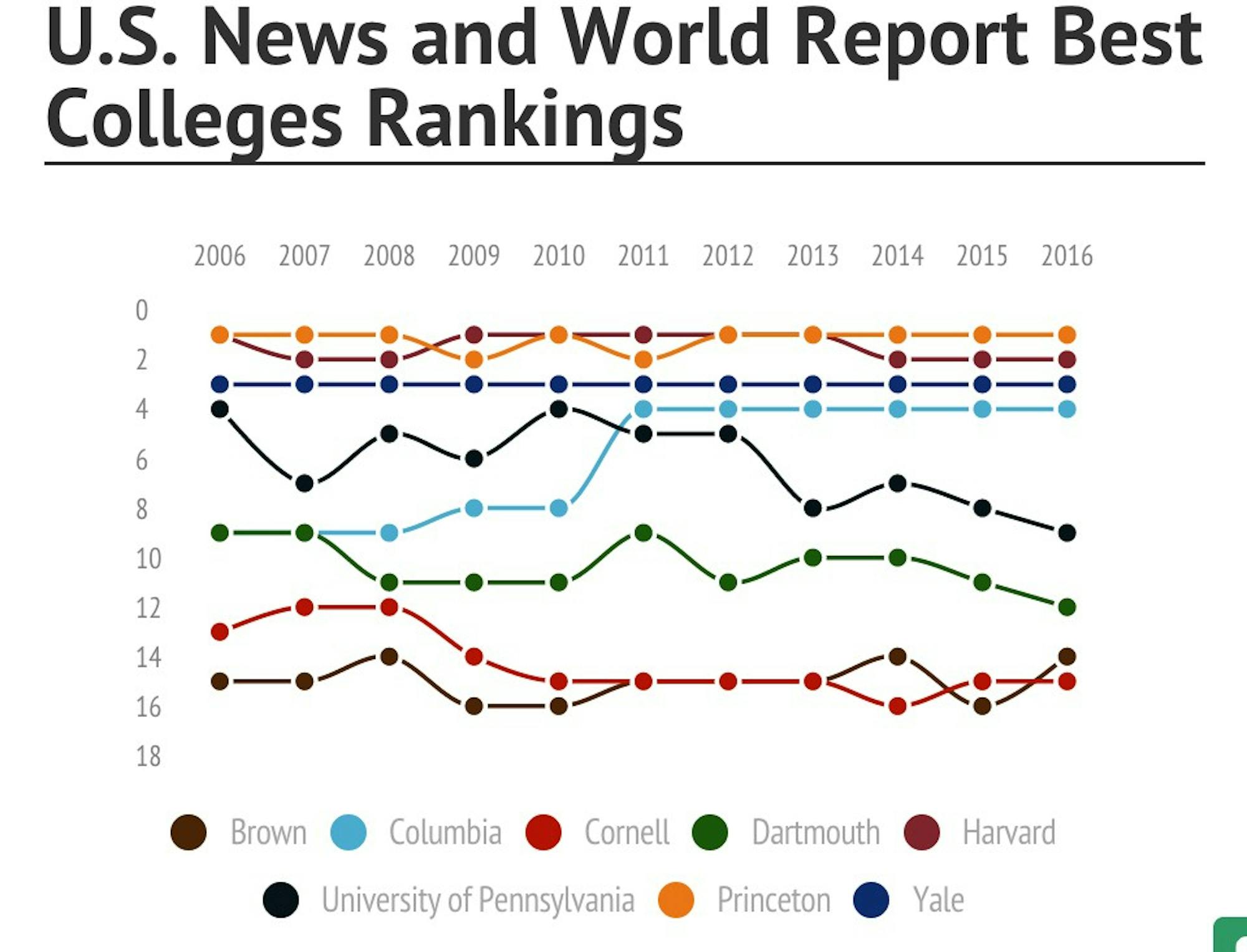
In the lead-up to the annual U.S. News and World Report rankings, interim dean of admissions and financial aid Paul Sunde said he hopes that the policy initiatives of “Moving Dartmouth Forward” will be recognized in the rankings.
The College is tied with Northwestern University for the 12th best national university in the 2016 U.S. News list. Last year, the College was ranked the 11th best national university on the U.S. News List, falling out of its previous spot in the top 10 universities.
Each year, U.S. News collects various pieces of data to create its annual national universities list. In 2012, Bob Morse, chief data strategist at U.S. News and World Report, announced that the publication would be expanding its data analysis of the various colleges and universities assessed annually.
These criteria include the success of minorities in higher education as measured by graduation rates, the affordability of colleges and the quality of the connections provided by the institution.
Additionally, the publication released information concerning the methodology behind the rankings in Sept. 2014. Though the specific algorithm behind the list is not available to the public, the vast majority of information used by the publication is provided by the various surveyed colleges and universities. According to the release, the academic reputation of an undergraduate institution and its student retention rate are the most important factors in the rankings, each taking up 22.5 percent of the total evaluation of an institution.
Sunde said that he feels the U.S. News and World Report rankings garner a significant amount of attention from the press and that, overall, Dartmouth’s place in the rankings has improved during his time at the College.
Sunde also said that he hopes the changes instituted by the “Moving Dartmouth Forward” policy initiative will show in the rankings.
“Dartmouth institutionally is making a lot of improvements — one would hope that these will be recognized,” he said.
He added that he believes that the rankings only are one small part of the College’s successes.
“We’re proud of how we perform in the rankings, but we are also recognized as a great institution in a lot of other ways,” he said.
Sunde said that he believes more specific lists, such as the annual lists on undergraduate teaching, an area in which the College consistently performs well, are more valuable to prospective students and applicants. He said that the larger, broader lists often contain information that might be misleading to the reader.
“I think that when these lists offer some sort of specificity, the information is a lot more valuable,” Sunde said.
Abby Zweifach ’19 agreed with Sunde, saying that Dartmouth’s high rank in the undergraduate teaching list by U.S. News was more helpful to her than the broader national universities list. She said that she only looked at the national university rankings after she had already been accepted to the College through the early decision program.
Zweifach also said that the College’s reputation amongst her family and peers was more important to her than published rankings of any kind. Zweifach added that her visit to the College significantly influenced her decision to apply early to the College.
Molly Hughes, a consultant at the Chicago area-based College Bound Consulting company, said Zweifach’s experience is similar to that of many of her clients. Hughes urges parents and students to visit the colleges to which they are applying whenever possible, as clients who do not possess as much knowledge as the typical college consultant are more susceptible to falling victim to only looking at the published rankings when considering a college.
“It’s usually people who are just starting the college process who pay attention to these sorts of lists,” she said. “Once people know what they want, they start looking at their own specific criteria.”
Hughes said that college rankings, though far from obsolete, have become less important with the increase of information about colleges in the public domain.
“When I applied to college, all we had was the information in college guidebooks and in the published rankings, so we had to rely on those,” she said. Now, regardless of whether or not an applicant is able to visit a college, a wealth of information about the institution is readily available on the internet.”
Both Hughes and her business partner Laila Alamuddin agreed that parents place more weight on a university’s ranking than students do.
“Parents are paying us as an additional service for their kids, so a lot of them are pretty open about only wanting their child to attend a college of a certain caliber,” Alamuddin said.
Alamuddin, who worked as a college counselor at the American Community School in Beirut, Lebanon, for 17 years, remarked that she found the rankings to be useful in her work with international parents. Since it is often more difficult for international students and parents to visit the schools to which they are applying, rankings often serve as an integral part of the college process for these families.
“Most of these parents are sending their kids really far away from home, so it’s important as a counselor to assure them that they will be getting their money’s worth at any one of the colleges,” Alamuddin said.
Almuddin said that during her time serving the Chicago area, she has used the rankings with her students far less than with her previous students in Beirut.
“When I was in Lebanon, I’d use the rankings to reinforce a point and to get a family to look at a school they might not have heard of,” she said. “There isn’t really an issue with that in the states.”
Though Sunde said that he believes it is difficult to correlate rankings with application numbers, Almuddin said that she feels colleges become more popular with her clients as they rise in the rankings.


