
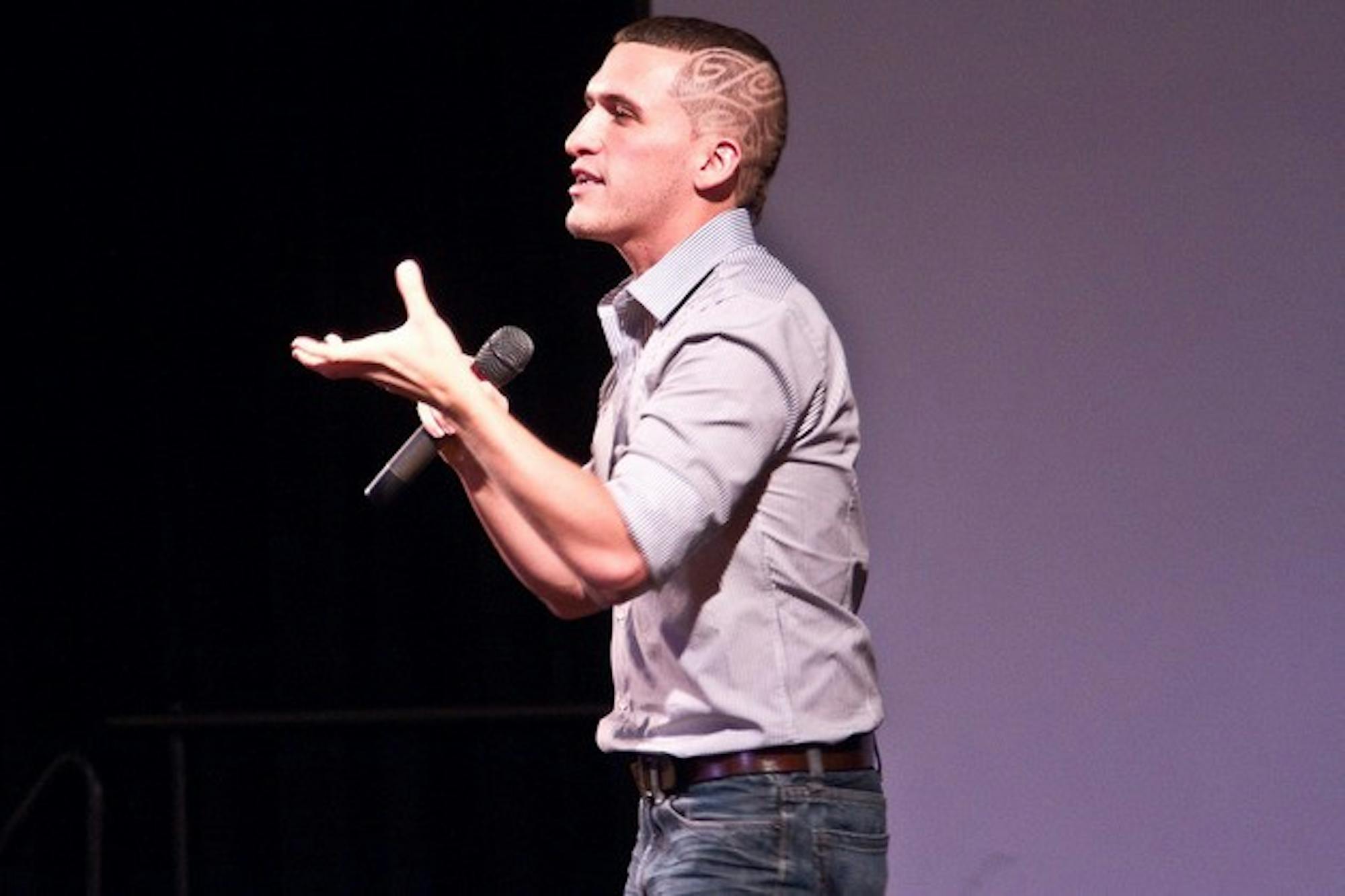
Describing his fundamental goals as an HIV activist, Murray explained that HIV/AIDS can be found in every community in America and that society must allow for an open and honest dialogue about the disease.
"If you are human, you are at risk," Murray said, emphasizing that this was not a threatening fact, but an empowering one. "I am here today because I am a person living with HIV without shame."
Murray asked the audience what words they immediately associate with HIV. "Drugs," "sex" and "condoms" were among the crowd's initial responses.
"How many of these words inspire you to get a test to find out your status?" Murray asked.
Stressing the importance of comprehensive sex education in schools, Murray attributed his HIV-positive status to a dysfunctional upbringing and his family's unwillingness to discuss sex in an honest way. There are several ways to transmit HIV, including sexual intercourse, exposure to infected blood and in utero transmission, Murray said. He dispelled the common misconception that HIV can be contracted from kissing or sharing a drink with an HIV-positive person.
"There is no cure for HIV, but there is treatment," Murray said.
For the uninsured, treatment can cost up to $5,000 a month, according to Murray.
Murray was born to an abusive mother in Michigan and was eventually adopted by a Mormon family in rural Oregon. He began his personal story by detailing his journey to accepting himself as a gay man.
"Loving, honest and supportive they were really just amazing people," he said while discussing his family. "They were really good about talking about a lot of things, but sex they didn't want anything to do with."
Murray came out in ninth grade and soon learned how difficult it was to be a gay teen in a Mormon family. He said he was too scared to explain the bullying he experienced to his family and was unable to talk to them about his sexuality.
"I quickly became a punching bag for anyone who was having a bad day," Murray said.
After dropping out of school before turning 18, Murray started working and traveling. He moved to New York, where he met many gay men, and then acquired a merchandising job in Salt Lake City for the 2002 Winter Olympics. While working at the Olympics, Murray met Ryan, who would become his best friend in spite of their opposite personalities.
One day, Murray brought Ryan, who was worried that he had been infected with HIV, to a clinic for testing. When they learned the results, Murray said he discovered it was he, not Ryan, who was HIV-positive. After discovering that he had the disease, Murray returned home to Oregon, where his sister had recently revealed to his family that she was pregnant.
"The lack of sexual education in my home was having its apparent consequences," Murray said. "I had a disease without a cure, and she had a child."
After learning of his HIV status, Murray struggled with accepting that a man he had dated in New York had infected him and later died of AIDS-related complications without ever informing Murray.
"I had to cope with not only losing someone who I did love but also realizing that they had infected me with HIV," he said.
While dealing with suicidal thoughts, Murray developed a strong friendship with his doctor, who had been practicing since the AIDS outbreak in the 1980s. Her frequent compliments and confident demeanor helped him through his depression, he said. As a result, Murray began to accept personal responsibility for his HIV status.
"It is always easier to give blame than take responsibility," he said. "I had the right, I had the choice and I had the opportunity to ask [about my partner's status], but I didn't."
Kari Jo Grant, Dick's House Health Education Programs coordinator, said she hoped Murray's lecture would encourage students to get tested for HIV.
"I want you [students] to feel like this is a responsibility for you and your friends," she said.
Shelby Schrier '15, who had never met someone with HIV before Murray's presentation, said she had never considered the potential implications of being HIV-positive.
"It was such an inspirational story that he was able to take something that could be devastating and decided to help others," she said.
Chelsea Mandel '15, a Programming Board member who had met Murray at the National Association for Campus Activities in the fall, said she encouraged Murray to come to campus and introduced him at the presentation.
The event was sponsored by Programming Board, Sexperts, Alpha Phi Alpha fraternity, the Tucker Foundation and the Social Justice Alliance.


