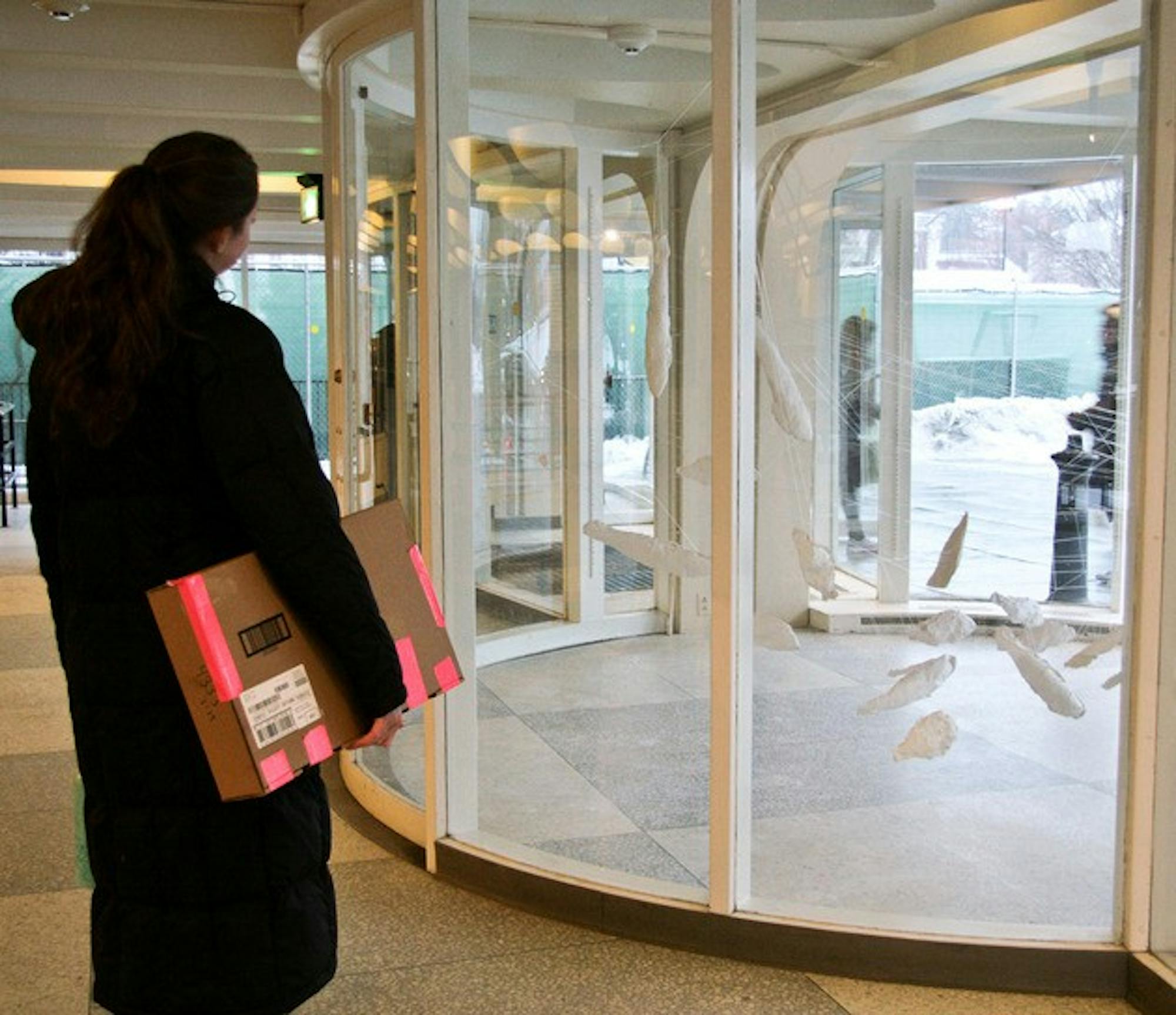
Appropriately called "The World Implied," the exhibit by studio art intern Caroline Moore '11 opened Dec. 12. "The World Implied" is a perfect piece for the circular space between the two main entrances of the Hopkins Center, merging the outside world with the building's interior through its nature-inspired design.
As shown in the exhibit, Moore has no trouble experimenting with multiple mediums, though her focus is in painting and printmaking, she said.
"More important than the medium is the idea," Moore said.
Moore's exhibit is inspired by the beauty of the natural world both the web made by the wires and the hanging fish in the rotunda are references to the influence of nature on the piece, she said.
As displayed by the unbelievable intricacy of the piece, Moore is quite the perfectionist in her meticulous art.
"I think it went through 100 different permutations," she said.
To get the interwoven wires perfectly situated in the rotunda, Moore spent countless hours squeezing between them, wary of touching any in the fear that it might offset the entire piece.
"I felt like a bank robber," Moore said. "I got very familiar with the [wires]."
This installment is the third exhibit by a studio art intern this year. Each intern has about two weeks to set up their work and three months to display it at the front of the Hopkins Center, according to Moore. It is a project that is embraced by the interns but is also considered a challenge because of both the limitations of the space and the very central, visible location of the exhibit on campus.
"I wanted a piece that could exist nowhere else," she said.
By taking advantage of the uniquely sized and shaped circular rotunda, Moore was able to accomplish just that.
One of Moore's favorite aspects of the piece is the differing qualities the exhibit takes on during the nighttime and daytime.
"During the day, the display is much more about the fish," she said.
In the daylight, the viewer can more easily appreciate the wires and the overall intricacy of the work, according to Moore. At night, however, the piece is "more about the subtlety," she said.
Under the artificial light at night, the black shadows of the fish on the white floor, combined with the glimmered reflections of the wires, become both elegant and essential touches that cannot be appreciated during the day.
Moore, who completed most of the work at night, was surprised at the substantial differences the exhibit displayed depending on the different lighting caused by the time of day.
"It's really two different pieces," Moore said.
Although much of her exhibit's appeal is based on the elegant intricacy of her work, the process itself was not always so elegant.
"To make the fish, I used casts of actual fish," she said. "The fish rotted, and the whole studio smelled like rotten fish for the next few days."
Moore crafted her exhibit as a part of her post-graduate year on campus, during which she said she aims to expand and explore her art. Although she is unsure of what she is going to do in the future, she is considering pursuing art on a long-term basis, according to Moore.
"I am figuring out how big a role art is going to play in my life," she said.
As her biography says on the studio art department's website, Moore is characterized as always striving "to create a tactile experience to bring the viewer closer to the subject," and in "The World Implied" with her mesmerizing web of wires and deep natural significance she successfully does just that.