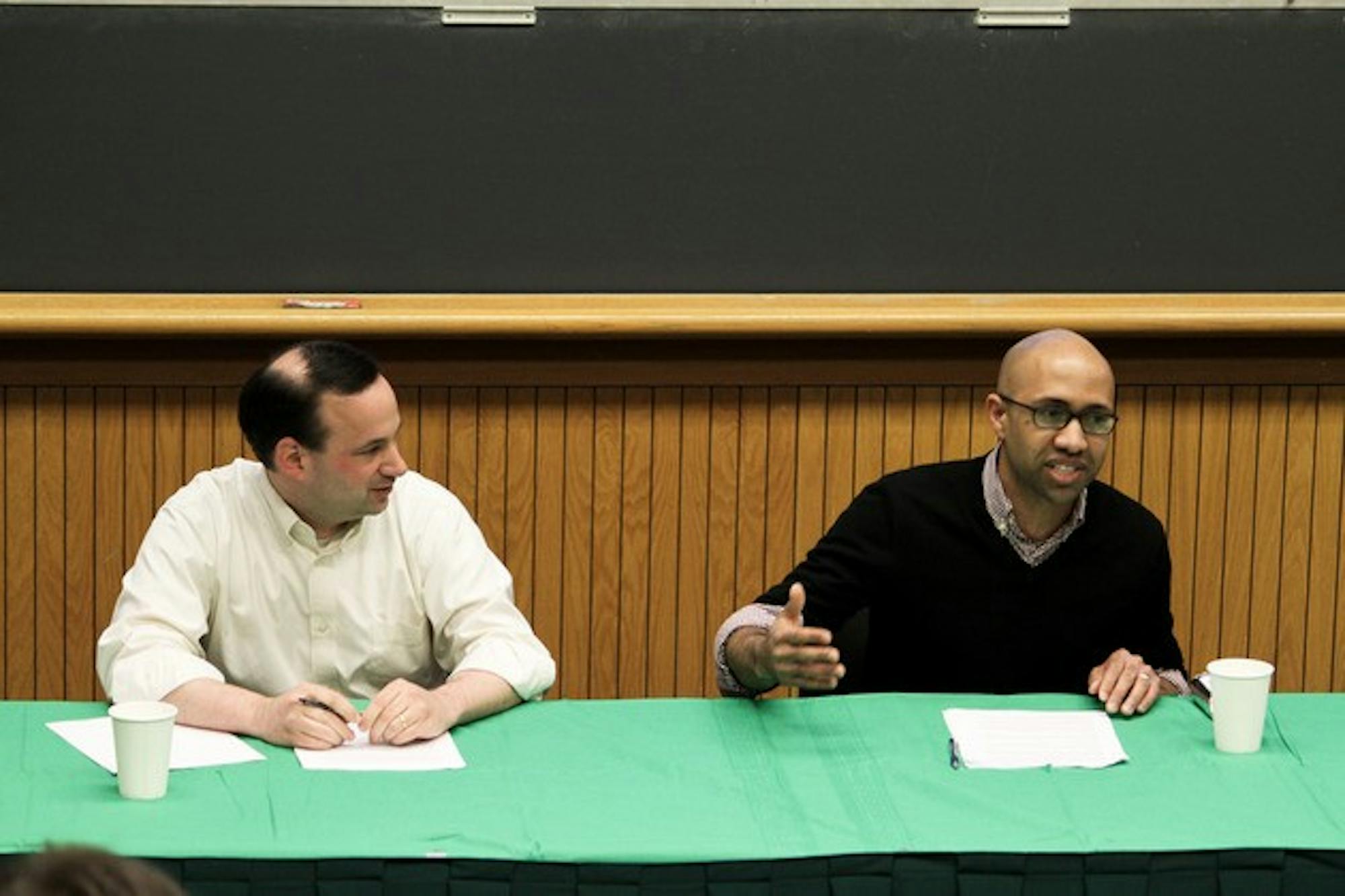
Rickford advocated for socialism in society as he enumerated the ills of capitalism in a historic and racial context.
"The West is wealthy due to slavery, imperialism and exploitation," Rickford said. "All of us here, including those who look like me, enjoy centuries of white privilege. We see that wealth as natural instead of being accrued by race or privilege, but it's not natural it's the result of a historical system of exploitation."
Rickford said his opinions of capitalism may sound strange to audience members because most people have grown accustomed to being the beneficiaries of white supremacy, which has provided them with wealth and privilege. He urged students to think of that wealth as "ill-gotten."
"There's a danger of compromise in the bourgeois experiment of higher education," Rickford said. "After these discussions, we go back to benefiting, participating and suffering from an unequal system. But as intellectuals we are called to do more. We are in an intellectual pursuit of a more just society."
Samwick discussed capitalism's practical merits, challenging Rickford to cite a country that has flourished without free markets.
"People need economic liberalization to pull themselves out of poverty," Samwick said. "This is what's carrying large populations in places like China and India out of poverty."
Rickford instead linked capitalist means of production with vast disparities of wealth and power in the world.
"Capitalism is the source of third world deprivation not the solution from Indonesia to Detroit," Rickford said. "Capitalism has produced prosperity at the expense of the creation of gender and race hierarchies and the exploitation of workers and the environment."
People have been so indoctrinated with the values of capitalism that it becomes difficult to conceptualize a society based on a different set of ideals, Rickford said.
"The source of wealth is redistribution and is based on systematic expropriation of slavery," Rickford said. "Traditional lands that promoted the ideals of cooperation were plundered by the West, creating a surplus for industrialized nations."
While Samwick argued that there is a continuum between capitalism and socialism, Rickford said there is a dichotomy between the two economic constructs.
"The idea of a continuum is a dangerous idea," Rickford said. "A get-out-of-jail free card exonerates us from taking a look at our society. In the richest country in the world you have high rates of infant mortality in certain communities. Some cities struggle to keep street lights on. We're not on a continuum but at an extreme."
Historically, unbridled economic activity in capitalist societies has led to the unbalanced distribution of resources, but a more equal vision of capitalism is possible, Samwick said.
Rickford also argued for a new vision, but advocated for a greater acceptance of socialism.
"We need a moral transformation where we are dedicated to supporting all of society's members," Rickford said.
The debate, hosted by Dartmouth's Multi-Faith Council as part of a series on civil discourse, was funded by the Tucker Foundation.