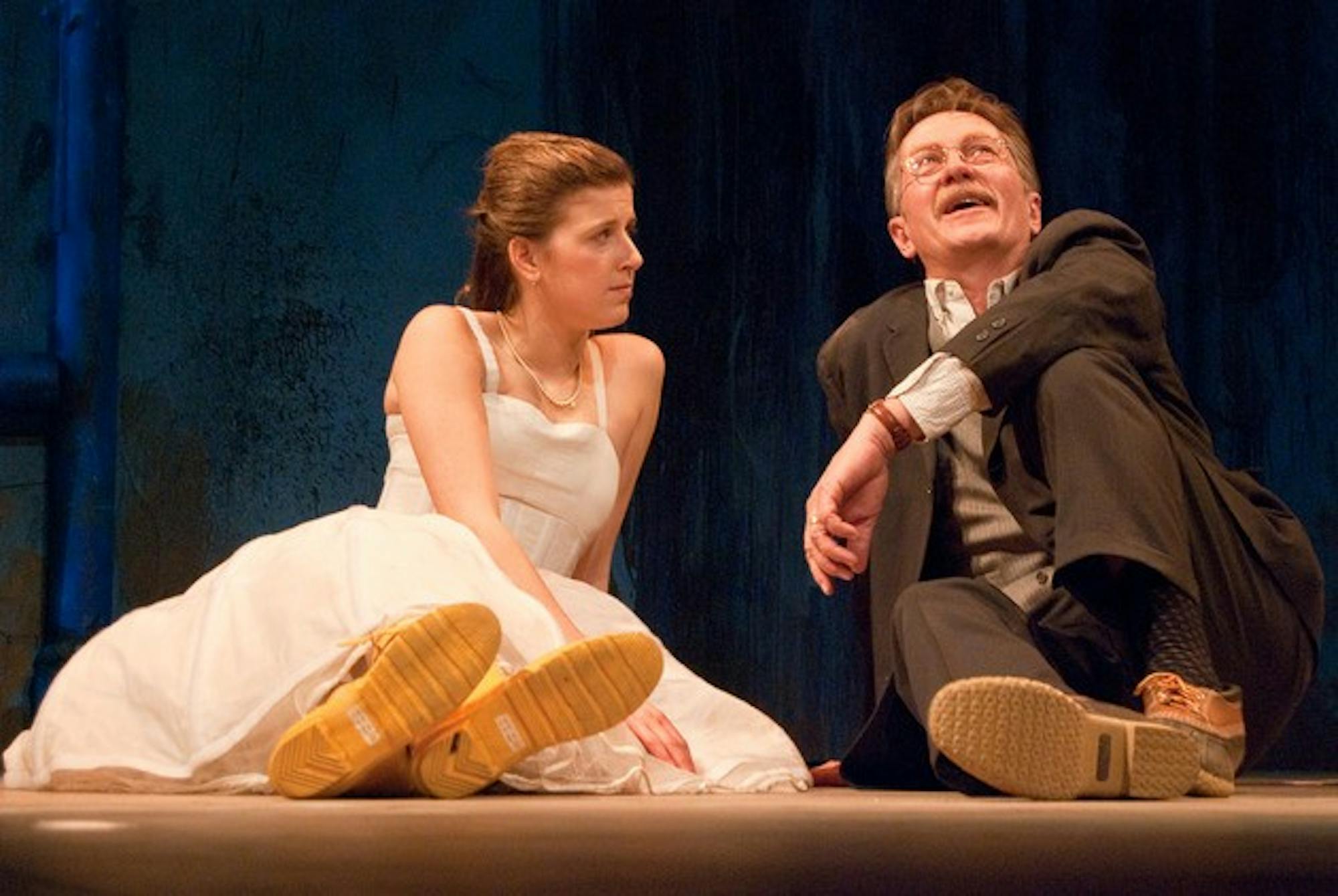
Based on the myth of Orpheus and Eurydice, "Eurydice" which opens Friday night at the Moore Theater explores classic themes such as love and longing, life and death. The play follows Orpheus as he sets out on a quest to rescue his deceased fiance, Eurydice, from the underworld. Orpheus is able to bring Eurydice back to life on one condition he must not look at her until they return to the upper world. If Orpheus takes a premature glimpse of his love, she will die again.
But instead of casting Orpheus as the protagonist, "Eurydice" takes the perspective of its eponymous character. The play explores Eurydice's relationship with her father, who she finds in the underworld. When Orpheus comes to claim his bride, Eurydice is reluctant to leave her father behind.
Theater professor Jamie Horton, who plays Eurydice's father, said his character did not appear in the original myth. Instead, Ruhl invented him for her play, modeling the role after her own father and using snippets of conversations she had with him during his battle with cancer.
"This was her way, as an artist, of coming to terms with and exploring her relationship with her father and his death," Horton said in an interview with The Dartmouth.
"Eurydice" manages to add considerable humor and intrigue to a tale that is often thought of as purely tragic. According to theater professor and "Eurydice" director Carol Dunne, Ruhl does not portray the underworld as dark and disgusting, but as wacky and whimsical.
The playwright provides abstract, zany stage directions in her script, dictating that the set should include "a raining elevator, a water pump, some rusty exposed pipes, an abstracted river of forgetfulness, an old-fashioned glow-in-the-dark globe."
In one instance Ruhl writes, "Apples and pineapples fall from the sky. Well, maybe just in his mind." Such surreal directions leave plenty of room for interpretation, according to Dunne.
"Do we get plastic apples and pineapples?" Dunne said. "Is it a sound cue that's sort of fruity? Or is it that the actor has more happiness in his voice? Her stage directions totally dictate freedom to create. Your imagination is basically the only constraint."
Genevieve Adams '11, who plays Eurydice, said that Ruhl's script warns actors and directors to steer clear of a strictly classical interpretation.
"What she does with the language, which is very poetic and lyrical and also funny, is force us to see the humanity in these mythical characters," Adams said. "These are real people in real situations."
The performance features a musical score written by composer Lewis Flinn specifically for the Dartmouth production, which help revitalize Ruhl's imaginative script.
An award-winning New York composer who has created music for Broadway, TV and film, Flinn was recruited for the project by Dunne, who met Flinn during her undergraduate years at Princeton University.
"[The music] will underscore monologues and serve as sort of the [guiding motif] for themes within the show," Flinn said.
Just as Ruhl's script offers a new lens through which to view a classic myth, Flinn's musical accompaniment to the play is a fresh use of music in a straight play. Flinn's compositions are interwoven into the action of the play, highlighting dramatic moments, underscoring important speeches and creating the surreal atmosphere of the underworld.
One theme Flinn communicates through his compositions is water, a device Ruhl employs in her play to connect the world of the living to the world of the dead. Using both synthesizers and traditional instruments, Flinn incorporates sounds that convey a pervasive sense of water without being too literal for example, Flinn uses echoes instead of the sound of running water.
According to Horton, the combination of Flinn's compositions and Dunne's direction add exciting new layers to Ruhl's already original work.
"It's incredibly personal, it is beautiful to look at and creates a very unusual world," Horton said. "It's heart-warming. It's magical. It's a different kind of theater experience."
"Eurydice" opens Friday at 8 p.m. in the Moore Theater.