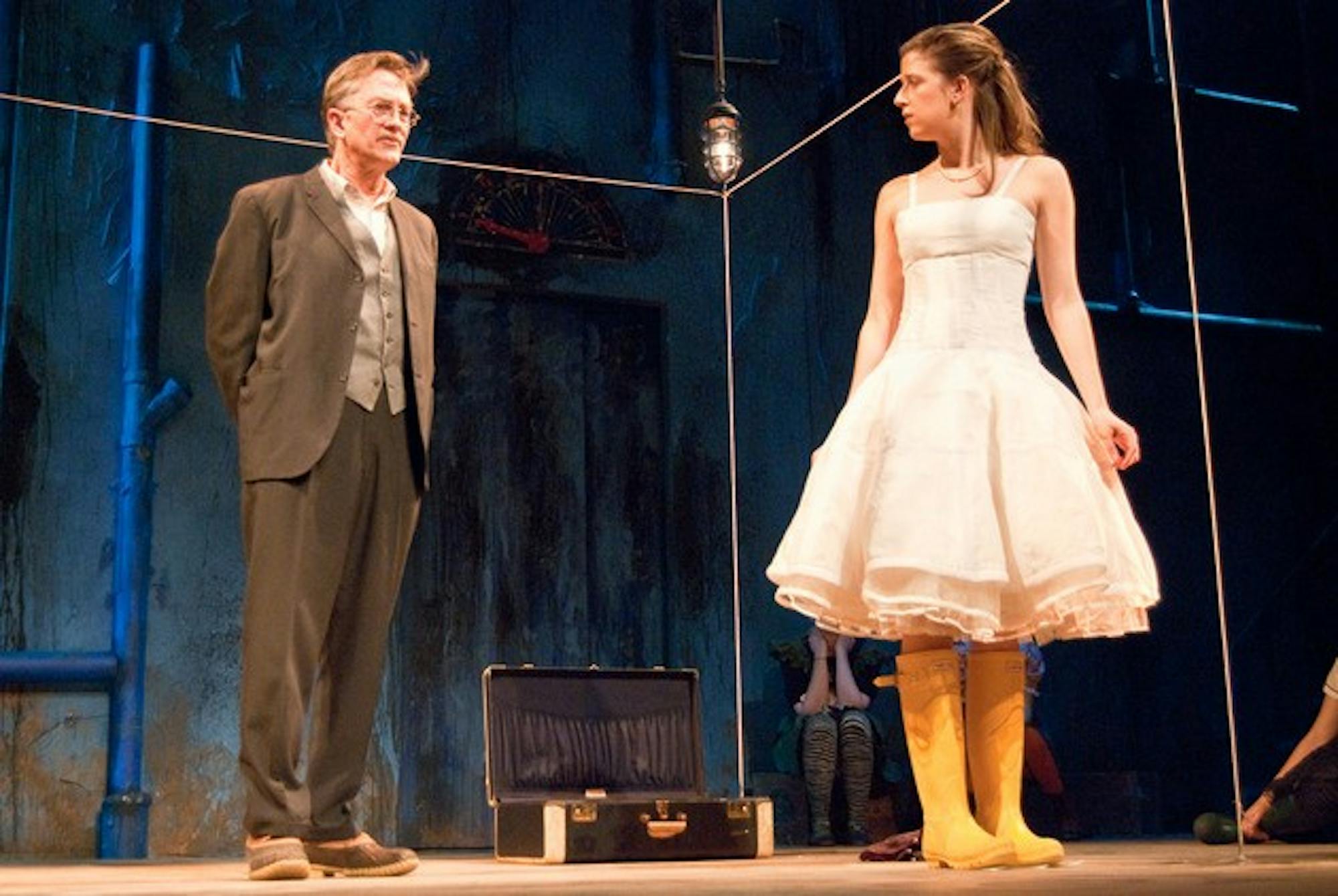
Playwright Sarah Ruhl's modern twist on the classic Greek myth begins with the engagement of young lovers Orpheus (Ben Edlin '14) and Eurydice (Genevieve Adams '11).
On her wedding day, Eurydice meets a mysterious character who says he carries a letter from her dead father (played by theater professor Jamie Horton). After following the messenger away from her wedding reception, Eurydice falls down a set of stairs and dies. She descends into the underworld where she meets her father, whom she no longer remembers.
Amid the protestations of a chorus of loud and obnoxious stones (Mary Rockwell '11, Elizabeth Neill '13 and Katie Lindsay '11), Eurydice's father begins to re-educate Eurydice about all the things she forgot during her journey to the underworld, including her own name and the concept of love.
The capricious and childlike Lord of the Underworld (Evan Curhan '14) gives Orpheus the chance to retrieve his bride from the underworld, but on one condition: he must not look at Eurydice until he reaches the upperworld, or else she will die and descend into the underworld once more.
The play is made up of moments that defy categorization as either comedy or tragedy. In one scene, Eurydice's father, still a world away from his daughter, mimes walking her down the aisle on her wedding day, while an eerie rendition of "Here Comes the Bride" plays in the background. He swaggers comically and gives a thumbs-up to an imaginary congregation, yet we fight back tears at the pathetic nature of his charade.
Likewise, the combination of the silly with the serious effectively contributes to the ambiguity of the play's genre, which cannot be defined as either tragedy or comedy.
When she arrives in the underworld, Eurydice steps out of an elevator in which she is pelted with rain holding an absurdly small umbrella and wearing bright yellow rainboots.
In his hilarious and memorable performance as Lord of the Underworld, Curhan wears a full-body pink bunny suit with bunny slippers to match. As Curhan pedals gleefully across the stage on a too-small red tricycle, the audience inevitably wonders if the Lord of the Underworld truly has things under control.
The line between life and death also becomes blurred, through inventive and highly successful use of the set, lighting and music, the latter composed by award-winning New York composer Lewis Flinn. A single set serves as the backdrop for both the underworld and upperworld, and living and dead characters frequently cross each other's paths.
At one point, the living Orpheus and Eurydice dance at their wedding reception in one half of the stage while Eurydice's dead father dances alone on the other half. A window in the underworld, created by projected light, sometimes looks out on the upper world.
The motif of water also serves as an important connection between the dead and the living: a water pipe travels from floor to ceiling, blue and green light seems to drip down the backdrop like water drops, and a synthesized wave-like sound plays between scenes in the upper world and scenes in the underworld.
The timeless, familiar father-daughter relationship set in the unfamiliar surroundings of the underworld provides yet another unlikely juxtaposition but, with the help of some extraordinary acting, it is a believable one.
"A wedding is for a father and a daughter," Eurydice says at one point, "They stop being married to each other on that day."
Adams portrays an innocent and guileless Eurydice who adores her father, although her consistent positivity could sometimes be taken for a dearth of emotion. Horton's performance as a strong Midwestern man meeting his deceased daughter is noble, honest and heartbreaking. Tender, classic father-daughter moments, such as swapping stories and reading together, are no less authentic because both father and daughter are dead and surrounded by wacky, otherwordly characters.
While the timing of such moments was for the most part impeccable, certain significant moments in the play flitted by too quickly. For example, we barely get a glimpse of Orpheus and Eurydice's love for one another before they are suddenly engaged, and Orpheus and Eurydice's journey to the upper world takes only a few seconds.
However, perhaps any frustration caused by the brevity of key scenes is a testament to the strength of the production as a whole. The rest of the show from stellar performances to spooky musical accompaniment to spectacular sets was so compelling that it left audiences wanting more.
"Eurydice" opened Friday night in the Moore Theater. It returns to the stage Thursday, February 24 and runs through Saturday, February 26, with performances at 8 p.m. There will also be a matinee performance at 2 p.m. on Sunday, February 27.