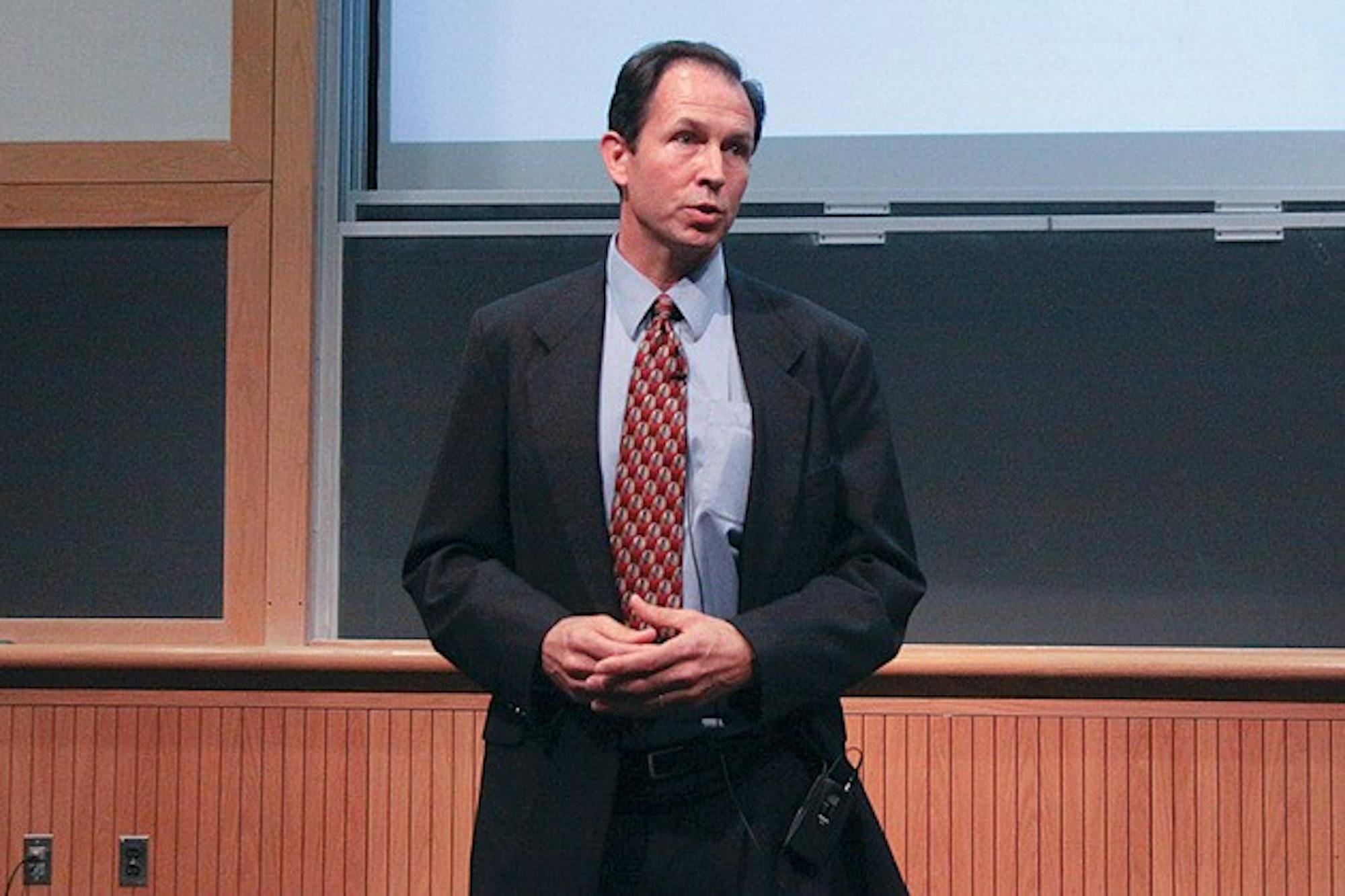
While federal laws against hate crimes have been in place for over 50 years, the new bill the Matthew Shepard and James Byrd, Jr. Hate Crimes Prevention Act adds a provision that covers hate crimes committed because of a person's gender, sexual orientation or disability, Mott said. The bill was passed in October 2009.
Under earlier laws, a part of the 13th Amendment that gives Congress the power to "eradicate badges and incidents of slavery" was chosen as the core Constitutional element for hate crime prevention, according to Mott. These laws allowed the federal government to prosecute only those who committed offenses based on races or religions recognized in 1865 for hate crimes, Mott said.
"Swedes were considered a race in 1865," Mott said.
According to Mott, this distinction limited the federal government's investigations into many modern hate crimes.
Previous laws held that a crime could only be deemed a "hate crime" if it interfered with a victim's federal rights, such as voting or attending a public school. The new legislation extends the definition of a hate crime to include all crimes committed due to the victim's race, religion or national origin, he said.
Crimes committed because of a victim's gender, sexual orientation or disability can only be investigated by the federal government as hate crimes if the acts are in violation of interstate commerce or other federal laws, Mott said.
The Hate Crime Prevention Act was named for Matthew Shepard, a homosexual man, and James Byrd Jr., a black man, who were both murdered in 1998 in separate hate crimes. While some politicians and action groups claimed the Hate Crimes Prevention Act would limit the First Amendment right to free speech because it allows for investigation into threats of violence, Mott said these claims are unfounded and that the law would not punish people for their personal attitudes.
"This is not an act that punishes belief," Mott said. "It punishes violence and the threat of violence. You can't prosecute thought at all and words per se."
Despite concerns raised by Republican leaders that the law would limit freedom of speech, civil rights protection is a bipartisan cause, according to Mott.
Hate crime investigations are conducted by both state and federal officials, who must work together to decide which authorities can best prosecute an individual, according to Mott.
The federal government often shows deference to state law, which is "the way it should be," Mott said. The federal government has limited jurisdiction over crimes, and state governments have primary authority to regulate crime within their borders, he said.
While the federal government generally does not interfere with crimes that come under the authority of state officials, in Washington officials have grown increasingly interested in trying those who have committed hate crimes. The national concern for civil rights began with the Declaration of Independence, which declared that all men had certain unalienable rights, Mott said. He added that all modern hate crime laws have their basis in the Constitution or the Bill of Rights, according to Mott.
"So the law enforcement response to civil rights violations is, and has to be, to push back and to regressively protect the civil rights, the constitutional rights, the inalienable rights of our people," he said.
Mott previously worked as an acting chief at the Justice Department and pursued cases against people who had committed civil rights violations. Throughout his career, Mott has seen many unusual cases of civil rights violations, he said.
One of those cases was that of "Satan's missionary," an Indiana drifter who burned down dozens of churches across the country with his topless dancer girlfriend, Mott said.
"This was a terrifying, and of course very interesting investigation," Mott said.
While current hate crime statutes are not perfect, Mott affirmed that legislation over the past 50 years has "[helped] to make this a more tolerant society, but one that refuses to tolerate injustice."
"I'm confident that the words of Robert F. Kennedy, spoken during the Civil Rights movement and the war on poverty, resonate today as they did in the 1960s," he said. "Mr. Kennedy wrote that Each time a man stands up for an idea or acts to improve the lives of others, or strikes out against injustice, he sends forth a tiny ripple of hope.'"
Mott briefly addressed the recently passed Arizona immigration law, which critics say will lead to racial profiling of Mexican-Americans. He said that he could not comment directly on the act because he had not read it, adding that he did not wish to comment on the merits of current laws as a sitting judge.
"I think any time a statute is passed that is directed at a certain group, it could be problematic," Mott said. "And any time a statute is passed that allows a large degree of discretion, with the local police interpreting, that could be problematic, especially in a racially-charged environment."