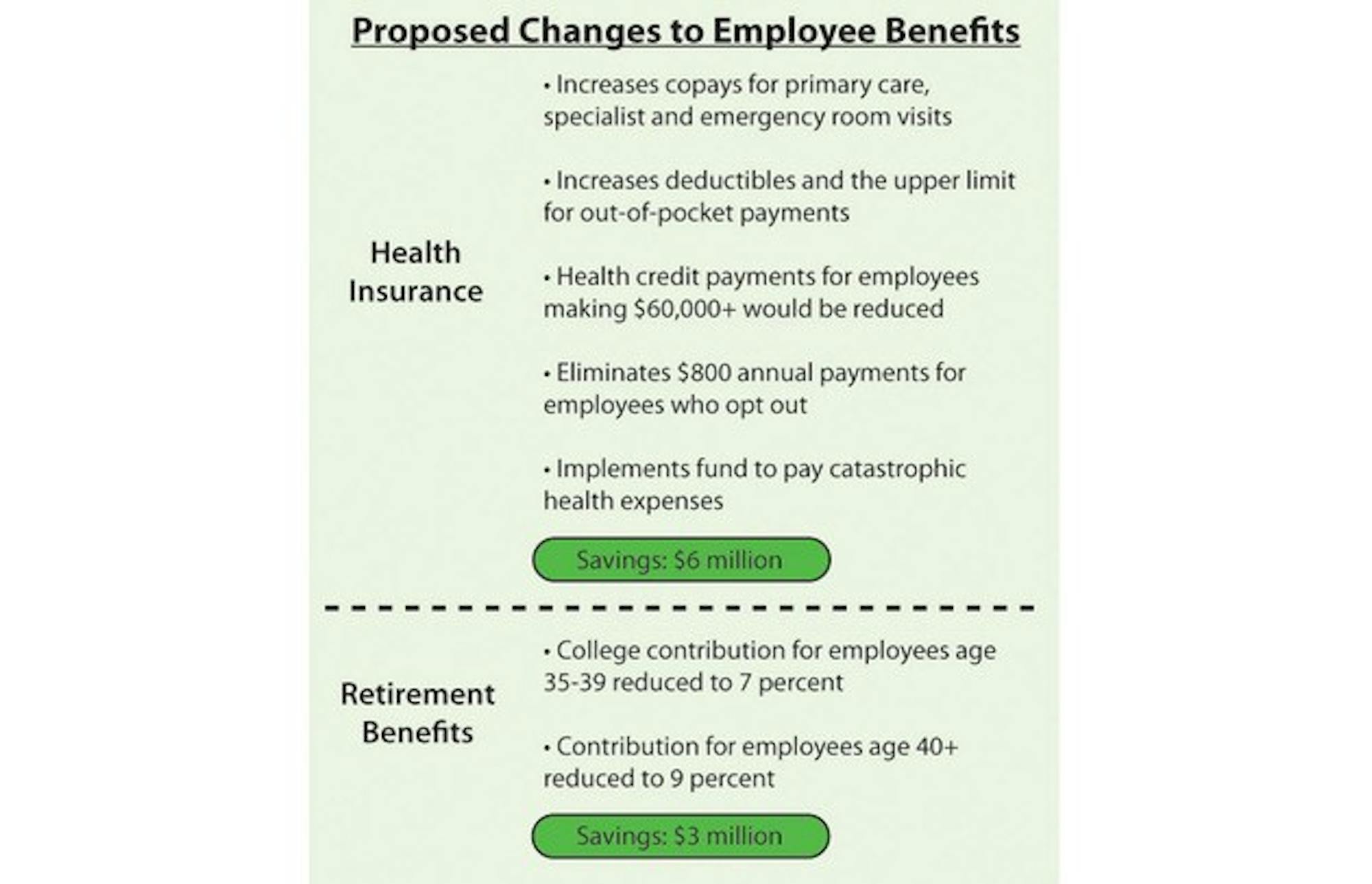
The health-related portion of the benefits changes will cover close to $6 million, while the changes in the retirement plan will cover the remaining $3 million, chief human resources officer Traci Nordberg said in an interview with The Dartmouth.
Under the suggested plan, Dartmouth would keep its "sliding scale" system for determining how much the College pays towards employees' health plans, although some of the specific figures would be changed to place a larger cost burden on those with higher salaries, she said.
"We're continuing with the same model of price-sharing that we've always had," Nordberg said.
With the current plan, employees pay between 4 percent and 31 percent of the total cost of their health care plans, according to Nordberg, with the lowest-paid employees paying the lowest percentage. On average, the College currently covers 80 percent of employees' health insurance costs, she said, noting that the College's average coverage would be reduced to 75 percent of the costs under the new proposal.
The proposed changes would reduce the size of the health insurance credit given to employees who earn more than $60,000. Under the new plan, employees would pay between 2.85 percent and 45 percent of their health care plan costs.
These changes in the lower boundaries of the pay-share percentages would be instituted to "protect the lowest-paid employees" and to compensate for increased costs in other areas, Nordberg said.
The new plan would also eliminate the $800 insurance credit that employees who opt out of the College-provided health plan receive. Getting rid of the health plan opt-out payment accounts for $350,000 in savings, according to Nordberg.
If implemented, the plan would reduce the College's contribution to retirement benefits for employees over the age of 34. Previously, employees age 35 and older received contributions of 10 percent of their base salary.
Under the new plan, employees between ages 35 to 39 would receive retirement compensation equal to 7 percent of their base pay, while employees over age 40 would receive annual contributions equal to 9 percent of their base pay.
Health insurance plans provided through the College would also carry higher co-pays for visits to primary care doctors, specialists and emergency room visits. Insurance deductibles the minimum amount an employee must spend before insurance payments begin would be raised under the proposal, as would the ceiling for out-of-pocket payments.
The new plan would also include a catastrophic health fund which would "provide financial assistance to eligible employees who face unanticipated catastrophic medical expenses," according to the web site.
The details of that fund have not been fully determined, Nordberg said in an e-mail to The Dartmouth. Administrators are still considering the administrative and legal consequences of "several different models," she said.
Eighty percent of Dartmouth employees have "minimum to moderate health expenses," Nordberg said in the interview. The design of the benefits plan has not been changed since the 1980s, and in comparison with other institutions' benefits plans, the proposed changes would "modernize" the College plan.
Although Nordberg did not have any specific data comparing the proposed changes to peer institutions, she said that Hewitt, the consulting firm with which Dartmouth has been working, used information about the practices at other higher education institutions as well as local and regional employers as a reference when developing Dartmouth's plan.
A public comment period on the proposed changes will continue until April 23, according to the web site.
After the plan is finalized, the changes will be legally implemented following an audit with the Internal Revenue Service. Open enrollment takes place in November, after which any changes would be processed until Jan. 1, 2011, when next year's plan takes effect, Nordberg said.