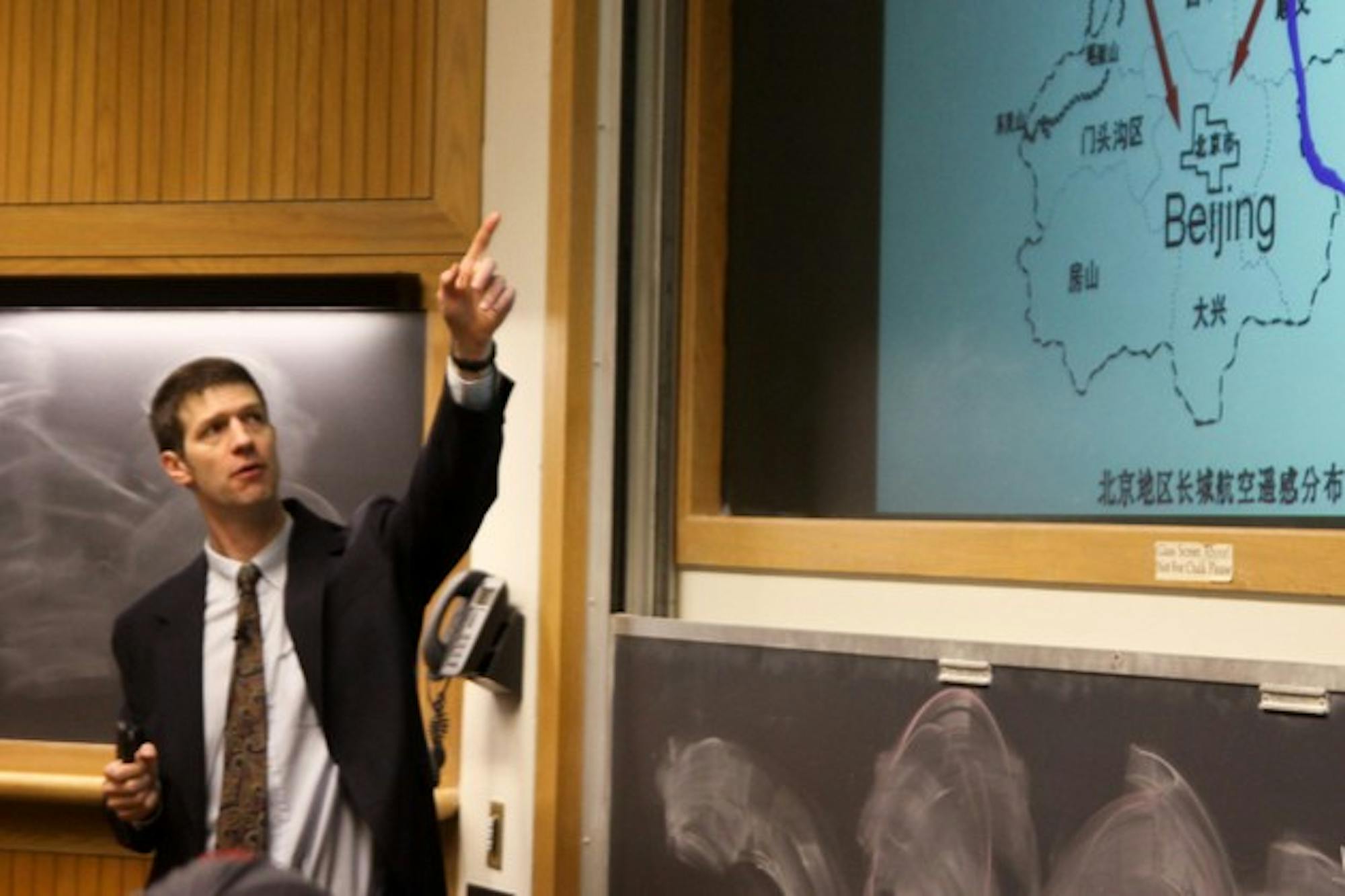
One common myth about the Great Wall is that it can be seen from the moon with the naked eye, Spindler said. In the right level of orbit, weather conditions and light it is possible to see the Great Wall from space, but the moon is "simply too far away," Spindler said.
The public also believes, incorrectly, that the length of the Great Wall is known, and that the wall is continuous. In reality, the terrain makes it impossible for the wall to be continuous in some areas. Some sections are also misrepresented or not represented at all on maps of the Great Wall, making measurements of the wall's length only estimations.
Spindler also described several historical battles that took place on the wall, arguing that the Great Wall was a successful defensive strategy for the Chinese.
"There are some examples of major Mongol attacks at which the Chinese successfully defended themselves," he said.
Although most people identify the Great Wall with its modern brick form, predecessors to the wall featured a variety of building materials, including layers of condensed soil or dry field stone. Spindler said.
The brick form that stands today was developed in the Ming Dynasty to defend against attack, he said. Rising tensions between Mongol and Chinese people escalated into a significant battle in July 1576, prompting Ming rulers to upgrade sections of the wall with brick, Spindler said.
"There wasn't just one wall that the Chinese at one time set out to build, and the wall that they set out to build doesn't just look like [the modern Great Wall]," he said. "It was a multi-step process done over quite a long time, and every step in the process was prompted by a Mongol threat."
Both Mongol and Chinese forces developed battle strategies that relied on certain features of the wall. he said.
According to Spindler, the Mongols planned their attacks several months in advance so Chinese intelligence was always aware of when the attack would occur, but because of misinformation spread by the Mongols, the location of the attack was unclear.
The Mongols, who relied on their speed and surprise, would send primary forces to attack low lying parts of the wall and would send decoy troops to higher, more remote places of the wall to try to get behind the Chinese forces. The Chinese forces relied on successful counterattacks, their ability to mobilize their troops at likely attack spots and their ability to outlast the Mongols, he said.
Spindler said he first became interested in the Great Wall because of his interests in history and research and his desire to work in an uncrowded field with few other academic experts on the subject.
Spindler received his master's degree in history from Beijing University and attended Harvard Law School. He worked at the consulting firm McKinsey and Company until 2002, when he began doing research in China on the Great Wall full-time, he said.
Spindler recently worked with photographer Jonathan Ball to create an exhibition of Ball's photographs of the wall on the anniversary of key battles. The collection features photographs taken from different perspectives, including that of a Chinese soldier defending the wall and that of a Mongol attacking, according to Spindler. The exhibition, titled "China's Great Wall: The Forgotten Story," is on display in New York through June.
Spindler said he plans to finish the manuscript for a book on the Great Wall for popular audiences by the end of the year. He also recently submitted an academic article about the Great Wall to the journal Ming Studies, he said.