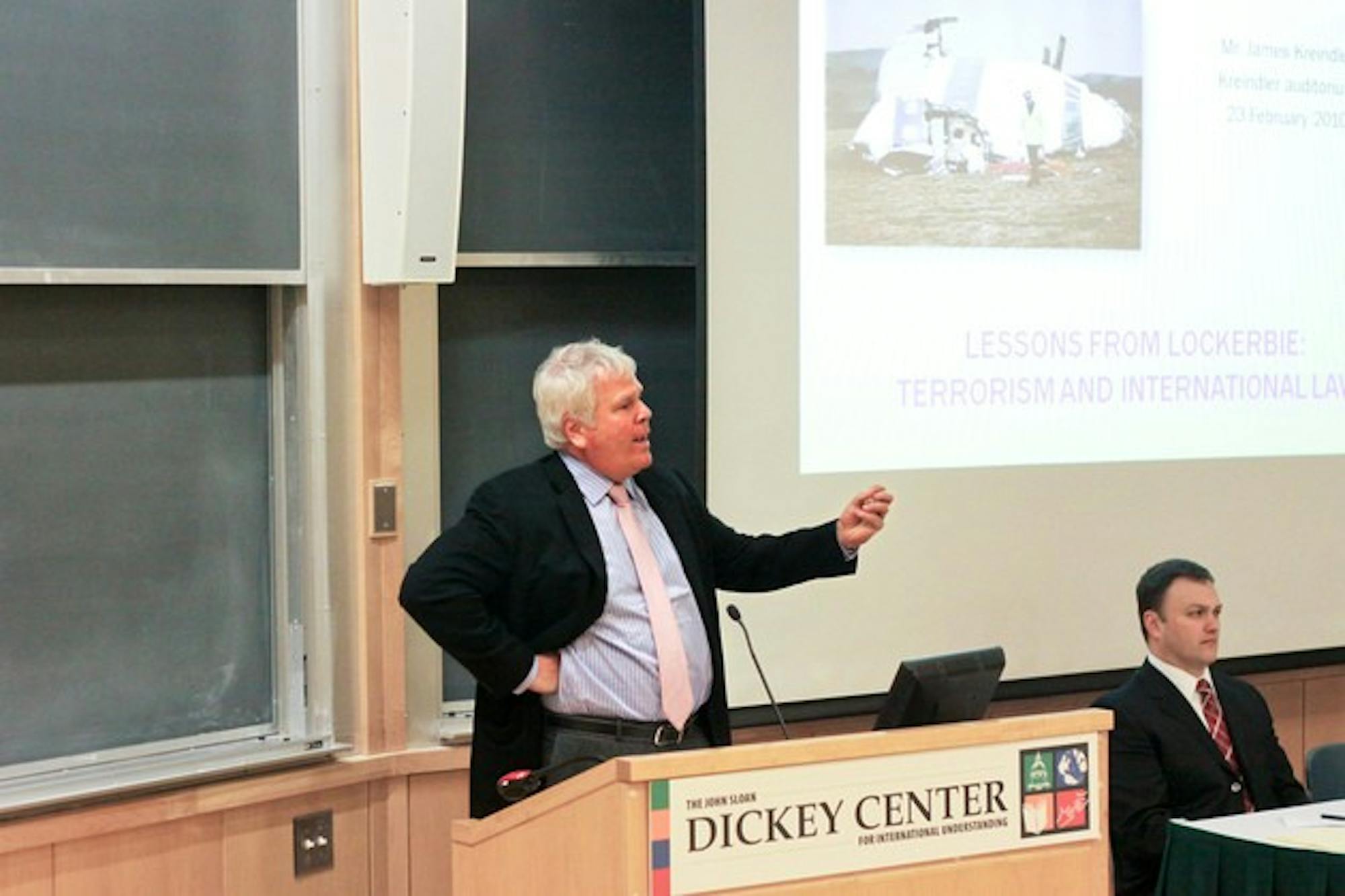
The Lockerbie incident is the name given to the bombing of Pan Am Flight 103 over Lockerbie, Scotland on Dec. 21, 1988. The attack, orchestrated by Libyan terrorists, resulted in the death of 270 individuals, most of whom were Americans. The resulting litigation in which Kreindler's law firm sued the Government of Libya and Pan Am airlines on behalf of victims' families resulted in the elimination of foreign nations' sovereign immunity in private U.S. lawsuits and was the first case in which a small group of plaintiffs led the development of a foreign policy issue, according to Kreindler.
The incident drove the international community to work toward the development of concrete policies on how to deal with international terrorism, Vandewalle said in an interview with The Dartmouth.
"Increasingly there is the sense that people who perpetuate terrorist acts should be accountable," Vandewalle said. "We should go after these terrorists financially, especially if linked to governments."
On the evening of Dec. 21, 1988, an explosive device blew a hole in Pan Am Flight 103 shortly after takeoff from London Heathrow Airport, killing the 259 people onboard as well as 11 residents of Lockerbie. Courts in the United States and Scotland indicted two Libyans for the crime, and the United Nations passed a sanction requiring Libya to renounce terrorism and accept responsibility for the bombing, Kreindler said. The victims were ultimately brought to trial in the Netherlands after the Libyan government protested that an impartial trial in the U.S. or Scotland would be impossible.
At the time, the victims' families could not sue Libya because foreign nations were protected by sovereign immunity, Kreindler said.
In 1996, several of the victims' families lobbied Congress to change the law to permit the victims of terrorism and their families to sue countries that sponsor terrorist attacks, according to Kreindler. Congress passed the Antiterrorism and Effective Death Penalty Act in 1996, allowing the victims' families to pursue their case against the Libyan government.
"The Libyans could never understand how 270 families could change the law in the United States," Kreindler said.
Kreindler's private firm, Kreindler & Kreindler LLP, represented the victims' families, he said.
"We sued Libya, accusing them of the largest murder of Americans in history," Kreindler said.
Setting a new precedent, the Justice Department agreed to allow a private firm to pursue litigation against the Libyan government, according to Kreindler. After two years of negotiation, Libya agreed to pay damages of $10 million per death to the victims' families under several conditions. Libya was to be removed from the U.S. list of state sponsors of terrorism, and U.N. sanctions against Libya were to be lifted.
In 2006, the U.S. government prematurely removed Libya from the list of state sponsors of terrorism before Libya made its final payment, leaving Libya with no incentive to pay the remainder of the payment, Kreindler said. At that time, Libya was involved in 22 other miscellaneous private lawsuits in U.S. courts.
The subsequent Libya Claims Resolution Act allowed Libya to pay money into a fund for the victims' families in exchange for the termination of all cases against Libya in U.S. courts, according to Kreindler. The victims' families received their final payment in December 2008, 20 years after the bombing.
Kreindler expressed confidence that, like Libya, several other countries on the list of state sponsors of terrorism will seek a "clean slate" once removed from the list. He added that these countries will likely be eager to pay into a global fund in exchange for termination of all U.S. litigation.
"This will be the prototype for formalizing relationships with countries such as Iran and Syria," Kreindler said.
Kreindler received the 2009 Trial Lawyer of the Year award for his work on the bombing.