
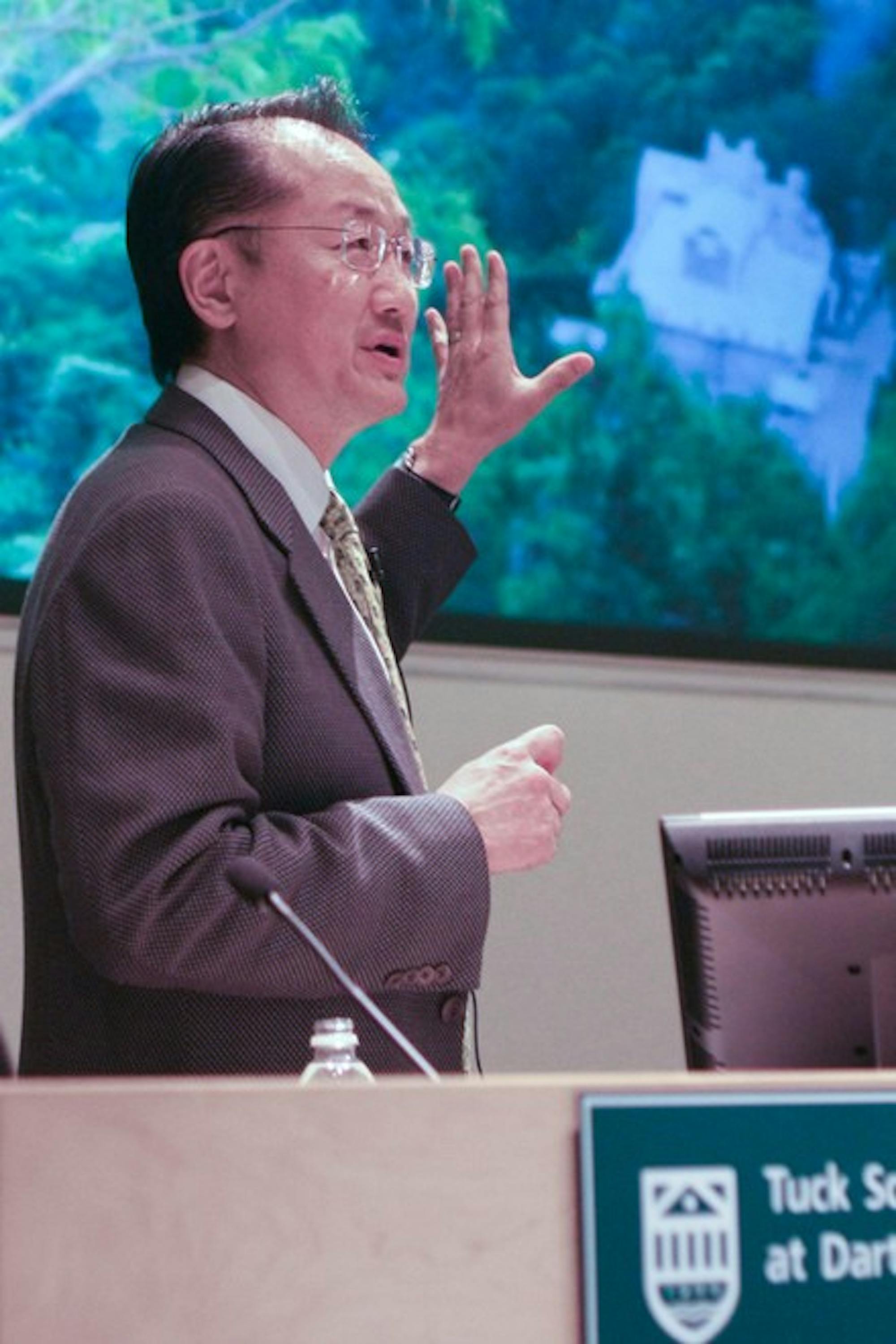
"I have no assumptions about how Dartmouth College works, and with great humility, I'm going to figure out how it works and then see if we can come together around some really inspiring goals," Kim said in response to a question from the audience. "I'm not good if we're just keeping things steady I'm no good at that."
Kim invoking the teachings of Dr. Martin Luther King, Jr. said he plans to face challenges that arise at the College head on.
"I can't tell you how excited I am to work with all of you, with a sense of urgency, to take the College to even greater heights," Kim said.
Kim said there were several aspects of the College that influenced his decision to accept the offer to become Dartmouth's next president.
"Once I started showing a real interest in the nitty-gritty of Dartmouth College, people started coming out of the closet, as Dartmouth people, to me, people who I thought were otherwise perfectly normal," he said.
Kim said he was amazed at the fondness alumni have for Dartmouth, which he said is a testament to the strength of the College as an institution of higher learning.
"Hard-edged investment gurus would start talking about Dartmouth and tears come to their eyes," Kim said. "There are lots of [Harvard University] people who cry but it's usually while they're at Harvard."
Kim said the close contact between students and faculty at the College impressed him as well.
"There's something really special about the time you have with the tenured faculty," Kim said.
Kim fielded a range of questions from faculty, graduate and undergraduate students at the end of his address.
"I'm a firm believer that the professional schools enhance the undergraduate experience," Kim said in response to one question. "Because of who I am and what I've done, I can help to take that to the next level."
Kim said he would still make undergraduate education a high priority.
"I'm not confused about my job," he said in an interview with The Dartmouth after the event. "My job is to focus on undergraduate education."
Kim, when asked whether his involvement with Partners in Health, the global health organization he co-founded, will change once he is College president, said PIH is "just part of my DNA now."
"I have absolutely no plans," he said in the interview. "I'm simply saying that [PIH has been] so close to me over time, that [integration with Dartmouth] might happen."
Kim said, however, that he would like to work with Dartmouth students to develop evaluation sciences to examine the quality of health care delivery.
Kim co-founded PIH with Harvard Medical School professor Paul Farmer in the mid-1980s, and soon became involved in addressing health inequities in Haiti.
"Still to this day, I haven't been to a place in which the poverty strikes me as visually as Haiti," Kim said.
PIH established clinics in the country, particularly in the Cange region, Kim said.
"In the last, now, 22 years, what we did was, we decided that we weren't going to just talk about the need for health care," Kim said. "We were going to do something about it, and we built a system that actually works."
Many observers thought that building a first-rate clinic in such a poor area was irrational, Kim said.
"Why would we do something like this? Just to be smart alecks?" Kim said. "We felt that, for some reason, aspirations in the field of global health were quite low."
The problem, Kim said, is that the developed world is now virtually untouched by ailments like tuberculosis and malaria, so drug production for those diseases is without significant market incentives.
"We've got to figure out how to harness [market forces] for the sake of global health," Kim said.
Kim used PIH's work in Lima, Peru, as an example of how market forces can be used to help the world's poor.
Although Peru made "stunning achievements" in tuberculosis treatment by the time Kim began his work there in 1994, Kim said the country was also increasingly devastated by strains of tuberculosis resistant to isoniazid and rifampicin, the two least expensive and most effective anti-tuberculosis drugs.
The Peruvian government threatened to force PIH to leave the country if the organization began treating the multidrug-resistant tuberculosis patients, Kim said. The group was also told by the World Health Organization that it was too expensive to treat these cases, he added.
"They just didn't feel, in 1996, that it was the right political thing to do," Kim said. "And so, of course, we started treating the patients."
Kim said he later approached the WHO and proposed that global health organizations explore taking advantage of drugs that are no longer patented. Once a drug's patent expires, the price drops by 50 percent within the first year, Kim said, and the drugs can be produced at a low cost by generic manufacturing firms in countries like China and India.
"I think one of our goals is to create leaders who are so well prepared on fire to tackle the world's problems," Kim said.
The conclusion of his speech was met with a standing ovation.


