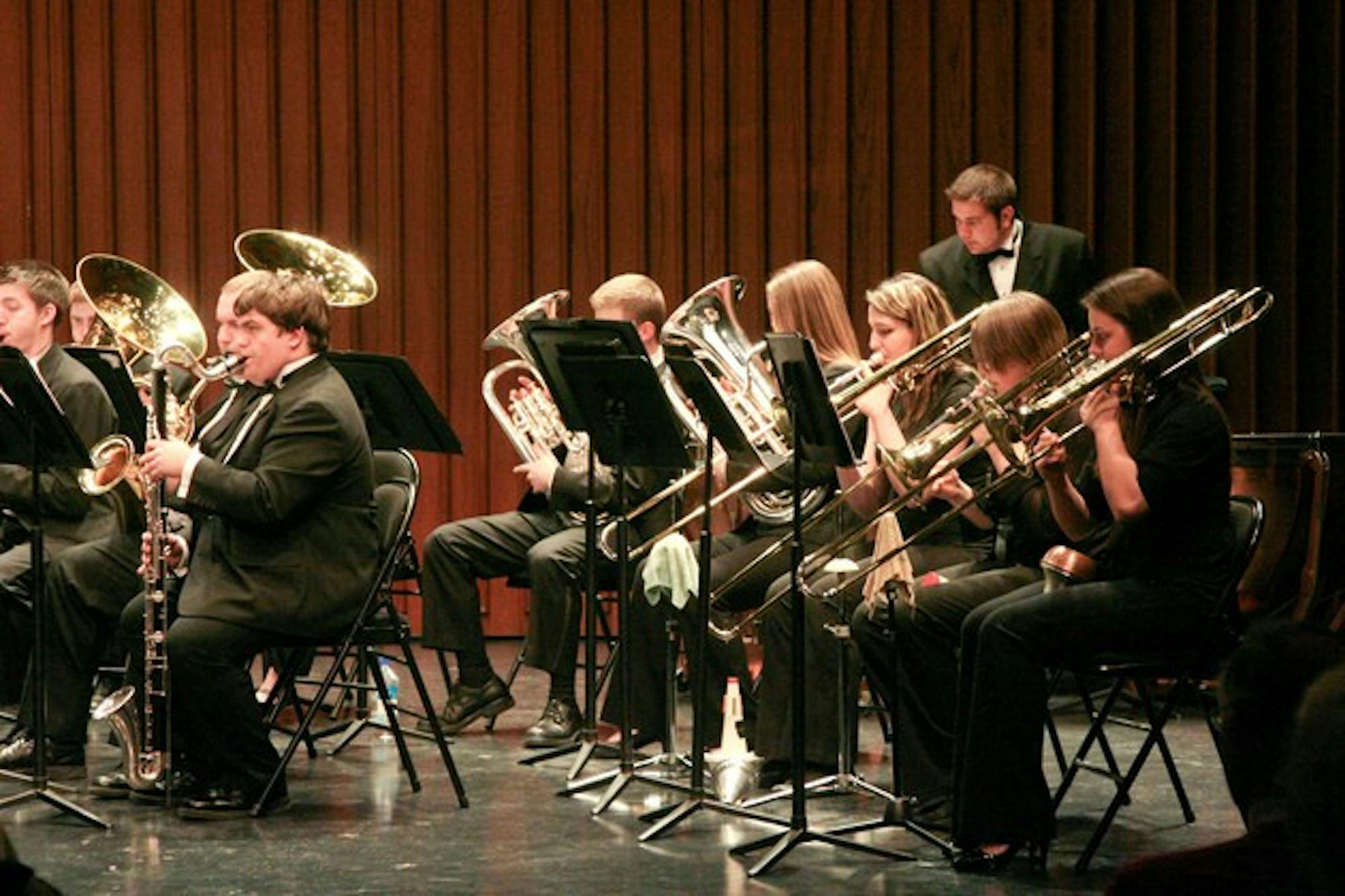
For the first half of the concert, the Wind Symphony stepped aside and The College of New Jersey Wind Ensemble owned the stage. Culpepper, a TCNJ alumnus, performed with his wife in the ensemble 55 years ago.
TCNJ conductor George Balog called Culpepper "a hero" who he had looked up to during his years as a high school band teacher in New Jersey.
His ensemble then performed composer Robert Jager's "Third Suite" in honor of Culpepper, as Balog explained that his first memory of the piece comes from a performance by one of Culpepper's bands.
After intermission, it was the Dartmouth Wind Symphony's turn to take the stage. The Symphony -- an ensemble composed primarily of Dartmouth undergraduate students along with a handful of community members, alumni and graduate students -- centered its program on the theme the "Games People Play," exploring the various concert pieces that have been inspired by games and sports.
He explained that there is a surprising number of these pieces, even from composers usually associated with more serious work.
The program began with the well-known "First Call Fanfare," used to signal the beginning of a horse race. Chris Gribnau, a community member in the Wind Symphony, played the piece on his bugle from the organ loft.
The concert continued with a full-company performance of Russian composer Dmitri Shostakovich's "Galop," a fast, loud and strong piece, whose sound filled the auditorium, without being harsh. "Galop" recreated all the excitement of horses thundering down the track and caught the audience's attention.
After "Galop" came "Tournament" by the American composer Stephen Bulla. The piece conjured majestic images of ancient stone castles, contrasting starkly with the bright opener "Galop." Culpepper said he employs this type of change in mood frequently to keep the audience involved in the show.
"I like to do concerts that have a lot of contrast," he said. "There are some things that are loud, some things that are soft, some things that are kind of delightful, some things that are funny, and some things that are really serious. You try to give everyone enough contrast to make it interesting. I can't think of anything more boring than sitting down and listening to twelve marches in a row, but one march is great."
The concert continued with "Game of Pairs" from Bela Bartok's "Concerto for Orchestra." Bartok wrote this piece -- his last piece -- for the Boston Symphony while he was being treated for leukemia. He finished the preliminary score in seven weeks, and the piece was performed for the first time in Boston on Dec. 1, 1944.
"[The commission] gave him a reason to live, and he wrote his greatest piece," said Culpepper, who acknowledged that it is also his favorite 20th century orchestra piece. "The Bartok 'Concerto for Orchestra' is his greatest piece and he wrote it just before he died, and it was all because of the Boston Symphony commission."
"Game of Pairs" is the concerto's second movement, and was one of the more technically challenging parts of the Wind Symphony's program.
The piece starts with a solitary drum, and then continues with several duets by various instruments: bassoons, oboes, clarinets, flutes and then trumpets.
"[Games of Pairs] primarily depends on pairs of woodwinds and brass instruments who play around with the theme back and forth so it's a little game of pairs of instruments, kind of a little virtuoso piece," Culpepper explained.
Then came the theatrical piece, "Match Point" by Vermont composer and tennis player Gwyneth Walker, which the Dartmouth Wind Symphony premiered in 1987. The piece, the concert's most obvious visual fusion of music and sports, uses innovative instrumentation to chronicle a tennis match. The piece begins with the percussionists dropping tennis balls onto the surfaces of the drums, reminding the audience of a tennis player preparing to serve. Culpepper conducted the "point" using a tennis racket, hitting an imaginary tennis ball back and forth. Finally, percussion section leader Katy Lindquist '10 placed some colored ice cubes in a glass and drank from the victory cup, and the piece ended with a collective sigh from the ensemble.
The symphony ended its program with the popular "Colonel Bogey March" and Georges Bizet's "Jeux d'Enfants."
Before the night was over, however, the Symphony treated the crowd to an encore of some more well-known sports tunes: four Dartmouth fight songs, "Sweet Georgia Brown" and finally, "Take Me Out to the Ball Game," as ensemble members handed out Cracker Jacks to the audience.