
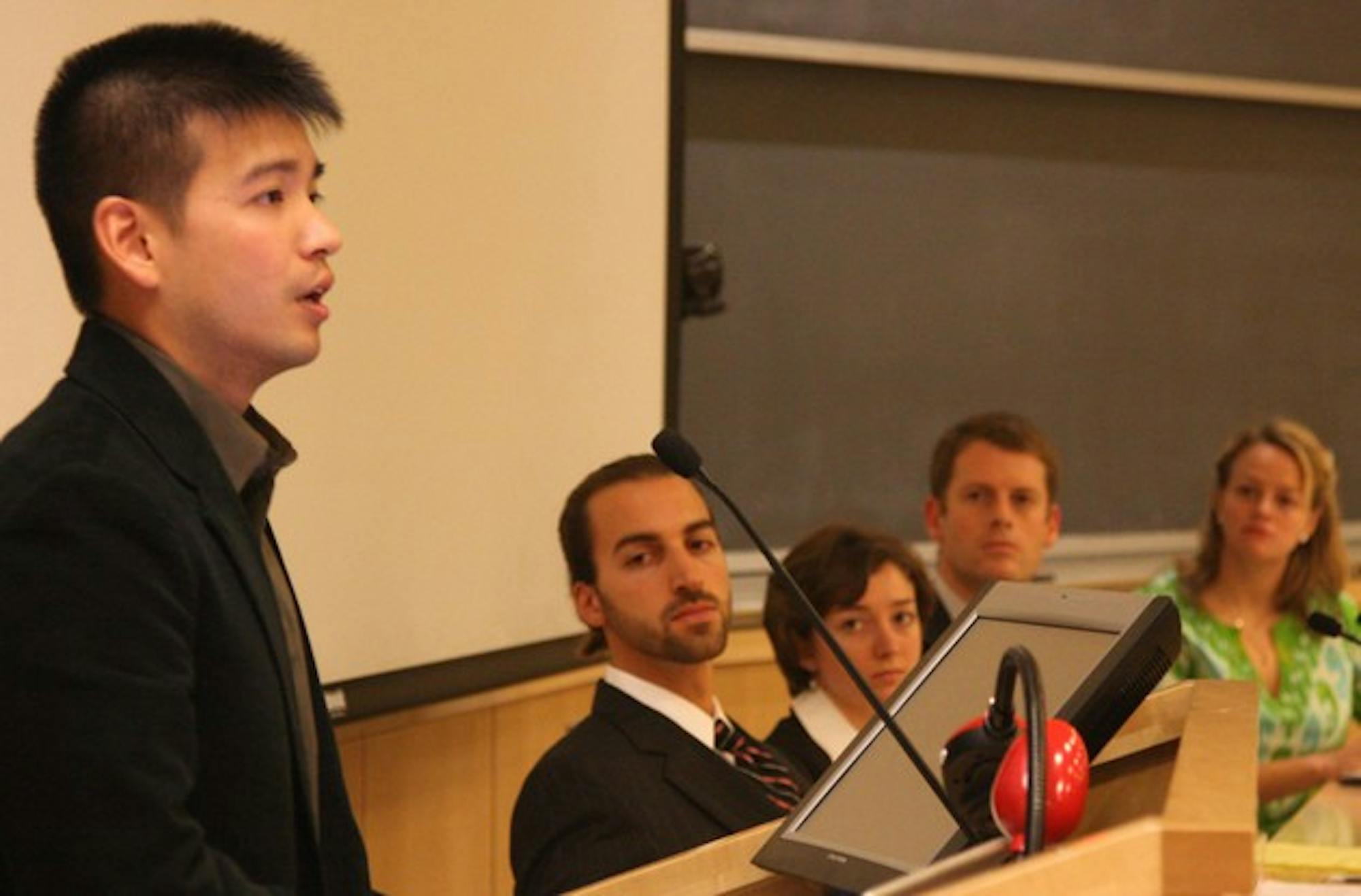
Though their career paths vary, the panelists agreed that the War and Peace program was critical to their development.
Meredith Wilson '07 is a political analyst with the Department of Defense who specializes in Iraq. She recently spent time in Iraq, researching Iraqi Kurdistan and briefing General David Patraeus and U.S. Ambassador Ryan Crocker. Wilson said that being in Iraq during the war has changed her perspective on life in the United States.
The base where she lived in Iraq -- nicknamed "Camp Cupcake" -- was relatively nice and safe, Wilson said, which giving her a different view of the country than people who live in more dangerous living accomodations. Still, she said that aspects of her daily life in Iraq required acclimation, such as becoming accustomed to the rich food in she ate upon her return to America.
"Coming back home [from Iraq] was an adjustment," she said.
Wilson's fiance, Army Capt. Welton Chang '05, spoke at the panel about his 15-month deployment in a remote part of Iraq.
Ellen Pfeiffer '01, who has worked at the National Security Agency, the Democratic National Convention and Amnesty International, said that students hoping to work in international affairs and the public sector need to be open to a wide range of opportunities.
"I urge you to be open-minded... when you think about international affairs in [Washington,] D.C.," she said.
There are significant opportunities in volunteer work, Pfeiffer added, saying that students should remember they can make an impact without being a paid employee, and that volunteer work can open doors to more permanent positions.
Alexios Monopolis '03, who is currently completing his fourth masters program and finishing his Ph.D, said that it is important to take advantage of opportunities at Dartmouth like the War and Peace Fellowship, adding that he encourages every student to apply to as many grants and scholarships as possible. Monopolis has masters degrees in photojournalism, environmental science and international relations.
Daryl Press, coordinator of the War and Peace fellows program and a government professor, moderated the panel.
The fellows program brings students together to plan events and discussions about international conflict and cooperation, according to the program's web site.
"The most important thing I want the panel to accomplish is to nurture connections between current students and alums, specifically in the War and Peace area," Press said in an interview with The Dartmouth. "One of the central objectives of the War and Peace program is making connections between alums and students."
The panelists were selected because they have been active in international affairs and public service since leaving Dartmouth, Press added. He hoped that Friday's event, which drew approximately 50 students, faculty and community members, introduced current students to the wide range of careers and opportunities that the War and Peace program could connect them to.


