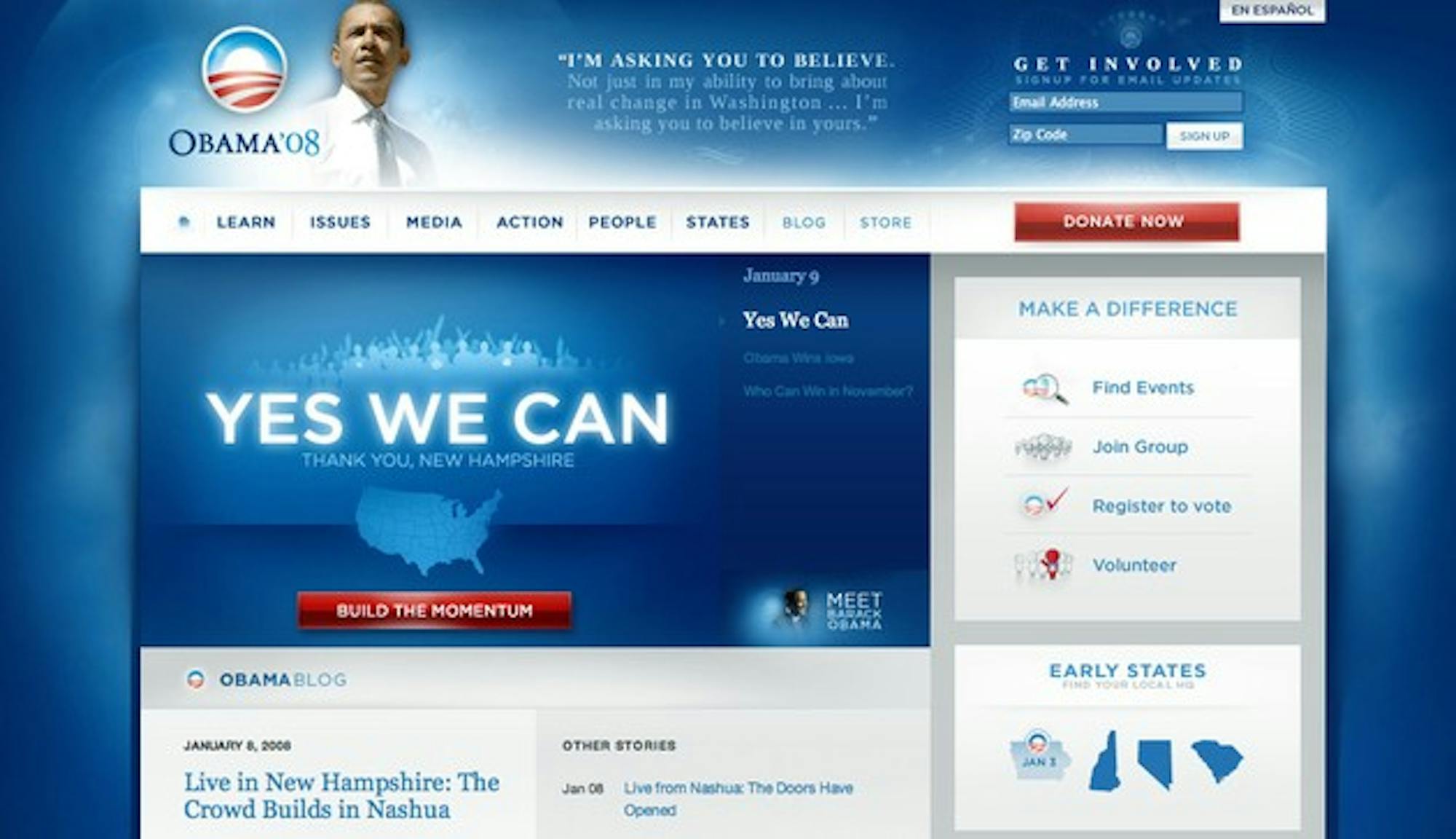
Emblazoned on everything from campaign signs to website banners, the candidate's logos have come to serve as not only placeholders in our minds but also as artistic tributes to each respective political personality.
Somewhere, some genius put a lot of time into designing Barack Obama's "O" emblem, with its field-like red and white stripes, its glistening blue sky and its vibrant white center rising like the sun. A rising sun of hope for tomorrow, I'm sure.
In addition, The "O" extends the assonance of Obama in Oh-eight into the realm of iconography.
Mitt Romney's red and white stripes are eagle-esque, while Hillary's just flutter lamely. I think Kennedy said something famous about that; something along the lines of, "ask not what your stripes can do for you, but what you can do for your stripes."
Meanwhile, the rebellious John Edwards eschewed the stripes for a shooting star with a green (!) tail. I can't quite put my finger on it, but I get the feeling he cares deeply about the environment.
In today's high-stakes political game, don't think that every single minute detail isn't intentional. Each of the candidate's websites, for example, is truly a marketing masterpiec.
Edwards' and Obama's pages both open with stunning black and white family portraits, while Hillary appears solo on her homepage, hand over her heart, wedding band clearly visible. I guess the giant rock on her finger is her nod to the family, hearth, home, Bill Clinton, etc.
Actually, the word "Clinton" only appears twice on the homepage -- in tiny print, at the bottom. If I didn't know better, I would think she was just "Hillary," sort of like, Madonna.
Obama's site is an elegant light blue and literally sparkles, while Romney's is a cold, steel-gray powerhouse.
In general it is uncanny how similar the websites are for all the candidates -- Clinton encourages you to join "Team Hillary," while Romney pushes "Team Mitt." I'm still Team Aniston, personally.
Like their voting records in the senate during their two years of overlap, Obama's and Clinton's websites are almost identical. The differences are subtle, but intriguing.
Obama's Spanish link in the top right hand corner of his page reads "En Espanol" while Hillary's is "Pagina Bilingue." You can't tell me no one thought twice about having the word "pagina" on her page, when "Clinton" is so marginalized.
Both sites include a row of similar drop-down menu titles like "Action" and "Issues," except for one strange contrast: Obama's site has one called "People," which features such categories as "Asian Americans and Pacific Islanders," "People of Faith" and "LGBT." Hillary has one called "Hillary" with categories like "Hillary's Story," "Growing up" and "Mother and Advocate." Huh.
But Romney tops them all with his creative combination of aesthetics and family life: his site features a "Five Brothers" blog, written by his brothers, who happen to be incredibly handsome. There are, of course, pictures. Lots of pictures.
It is, however, probably time to get back to discussing the real issues. I guess it doesn't really mean anything if our next president's website looks like a glistening Pottery Barn catalogue or a steel-grey battleship.
But picture your future: What do you want it to look like? The artists of campaign aesthetics think they know.