
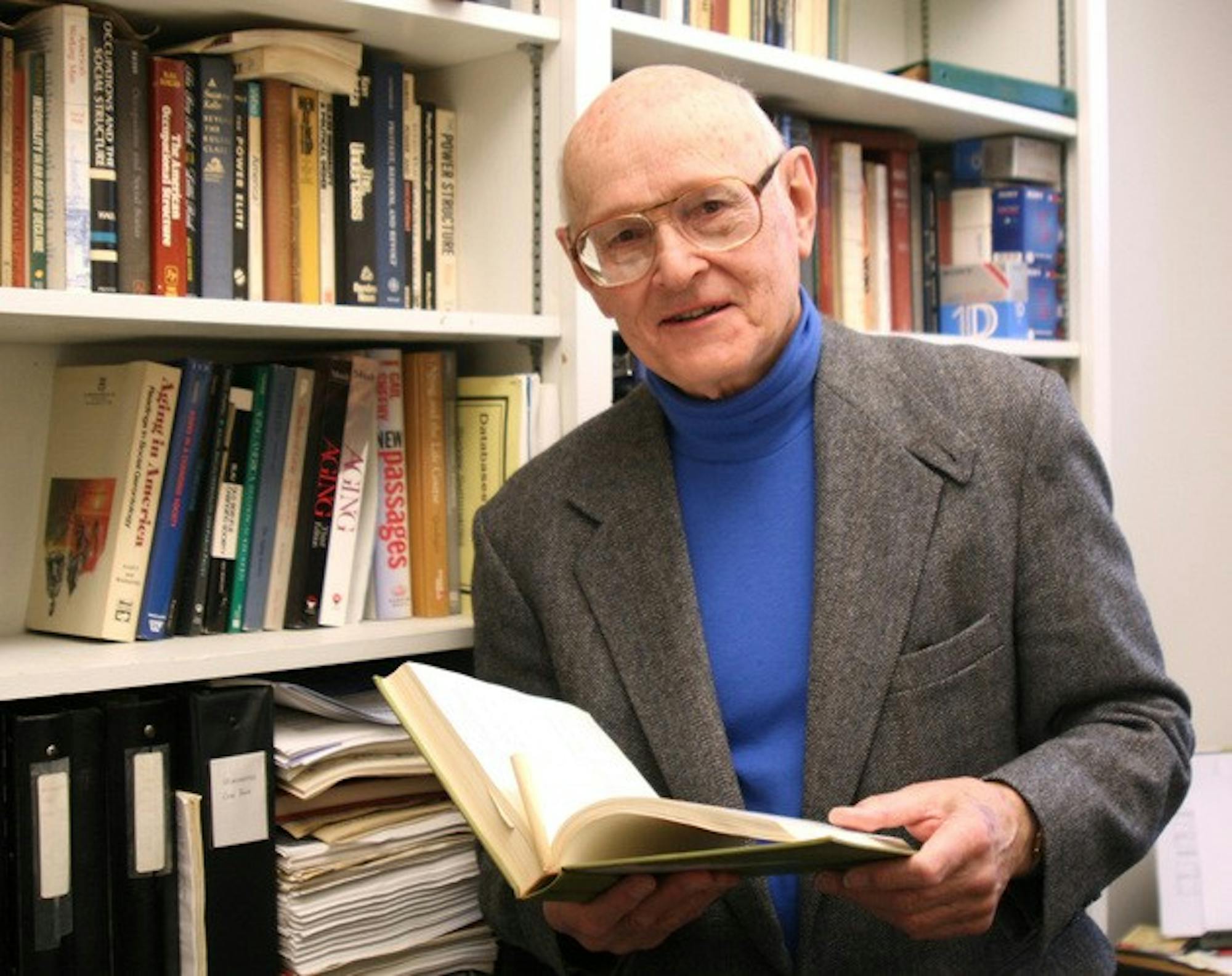
Although this is the first study administered since 2000, Sokol has been compiling information for over 50 years. He first began collecting his own data in 1982 and has since conducted five surveys. To find information about students that attended Dartmouth before he began his research, Sokol relies on alternate studies done by the sociology department since 1952.
"One of the difficulties I have come across in my studies is the fact that I had no control over the earlier questionnaires," Sokol said.
Another problem he faces is the high rate of "questionnaire mortality," or the percentage of pamphlets not returned or completed. Only 35 to 55 percent of students who receive the survey take the time to fill it out.
Sokol, who retired in 1996 and now focuses entirely on his research, considers himself a "social historian."
"I look at long term trends to see if there are any modifications in the political, social, and ethnic climates of Dartmouth and whether these things have any impact on attitudes towards the college," he said.
Though Sokol is currently working on determining overall trends from the data he has gathered so far, he maintained that "not much has changed from year to year."
"Since students applying to Dartmouth are self-selective, and the admissions department has its own set of criteria, this tends not to facilitate much change. Parents, students and admissions are all looking for the same things: smart, highly-involved kids."
Politically, Sokol pointed out that undergraduates' views "tend to be centralized."
"Many students hail from strong right- or left-wing families, and although some of them reflect these views, the trend seems to be a shift towards the middle," Sokol said. "I'm not sure whether this is a serious shift or an unwillingness to think about it."
Although Sokol said that fraternities were not his major topic of interest, he did stress that the majority of students were not opposed to Greek life.
"Previously, there has been a large core of objectors, although not the majority, but due to the increase in coed fraternities and affinity houses, the objection has lessened," he said.
Professor Sokol plans to release his book about the behaviors and perceptions of Dartmouth students sometime in 2007 or 2008.


