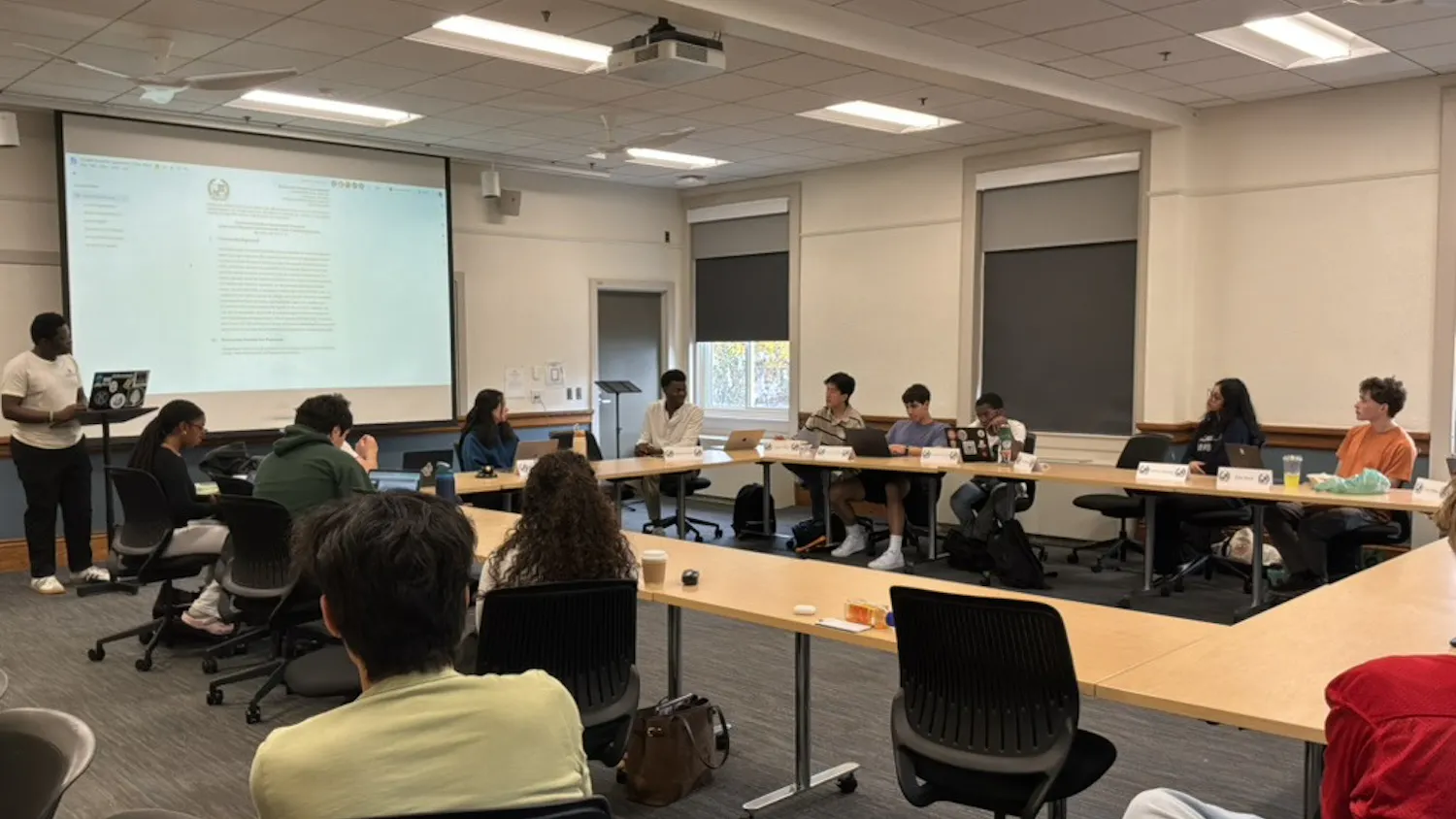
In a two-and-a-half hour open forum last night in Alumni Hall, the steering committee on student life announced they have now reached "decision-making mode" and revealed a possible recommendation on the future of residential and social life based around the theme of common houses.
Co-Chairs of the Committee Susan Dentzer '77 and Peter Fahey '68 -- who stated that the committee's report to the Board of Trustees would be submitted late Fall term -- revealed their progress thus far with a slide presentation and fielded numerous questions from the approximately 250 audience members.
Much of the presentation and subsequent discussion focused on the committee's stated proposal of the common house, which according to the Trustees would be non-residential facilities with abundant programming space to suit a variety of student uses.
In an interview with The Dartmouth following the forum, Fahey said the two most likely alternative options or replacements to the Greek System would be social organizations based on residence halls -- which might or might not include common houses -- or a common house system unrelated to residence halls.
At one point in the program, Dentzer entreated the audience to envision residential clusters associated with common houses.
"Close your eyes and imagine clusters with big common houses attached to them, where 300 people can get together and have a sushi night for the entire cluster," Dentzer said.
Common houses would be dedicated for large social events to foster identity and community and would be available for both cluster and campus use, Dentzer said.
Fahey alluded to prior feedback the committee received that consisted of various campus organizations desiring improved space on campus.
"Half of eligible students do not join CFSC houses and we need to address their needs and spaces for them so they can get together in small social groups," Dentzer said.
While common houses may be seen as a possible solution to exclusionary concerns of the Greek system, they might also be able to instill a greater sense of belonging in the residence halls.
"We want to beef up the residential component to make it more than a place where you hang your hat for 10 weeks," Dentzer said.
Fahey spoke several times on having the CFSC system in tune with the central academic mission of the College.
"The focus is not on suppressing the Greek System but on creating the best social and residential system we can," Fahey said.
While Fahey clarified the fate of the CFSC has not yet been determined, he said if the CFSC remains, it would be tailored to better suit the academic mission of the College.
"We strongly believe in choices, but we want those to be very structured kinds of choices," Dentzer said to much commotion in the audience.
Another important revelation of the committee was its approaching shift from "seeking and processing input to becoming more in a decision making mode" Fahey said.
The transition period will occur this October.
Although some students shared their apprehensions of a decision already established, Dentzer attempted to allay student's fears.
"The reason we are here tonight is because no decision has been made," she said.
The committee did announce that a report would be out by the end of Fall term.
Dentzer and Fahey clarified that the listening phase will not be terminated in spite of any decisions. Once recommendations are broached to the public, the Board will resume a listening role to gauge public feedback.
The winter of 2000 marks the subsequent phase where the community can comment on the decisions reached by the Trustees, Fahey said.
Yet opportunities to share original ideas with the Committee are fading.
"After tonight we're beginning our decision-making mode. We're still listening, but this is the last organized group session planned," Fahey said.
Among the clear goals the committee identified were a need to encourage students to live on-campus, to increase quality of life by decompressing dorms and to enhance graduate student facilities.
The committee did recognize the long-term implications for such changes to occur.
Dentzer said that any forthcoming changes could not be effected overnight, but rather by the time much of the audience would come back to Hanover for their fifth reunion.
"Any implementation of programs will [span] the next decade. A lot of hard work [is required] to turn those recommendations into reality," Fahey said.
The program's aim was for the committee to convey more information to the public about what is has been discussing, Fahey said.
"The goal is to weave together areas we have under our consideration to create a unified program to best meet the needs of the College and its students," Fahey said.
Dean of the College James Larimore moderated the discussion.
The steering committee is officially known as the Committee on the Student Life Initiative.