This article is featured in the 2026 Freshman Special Issue.
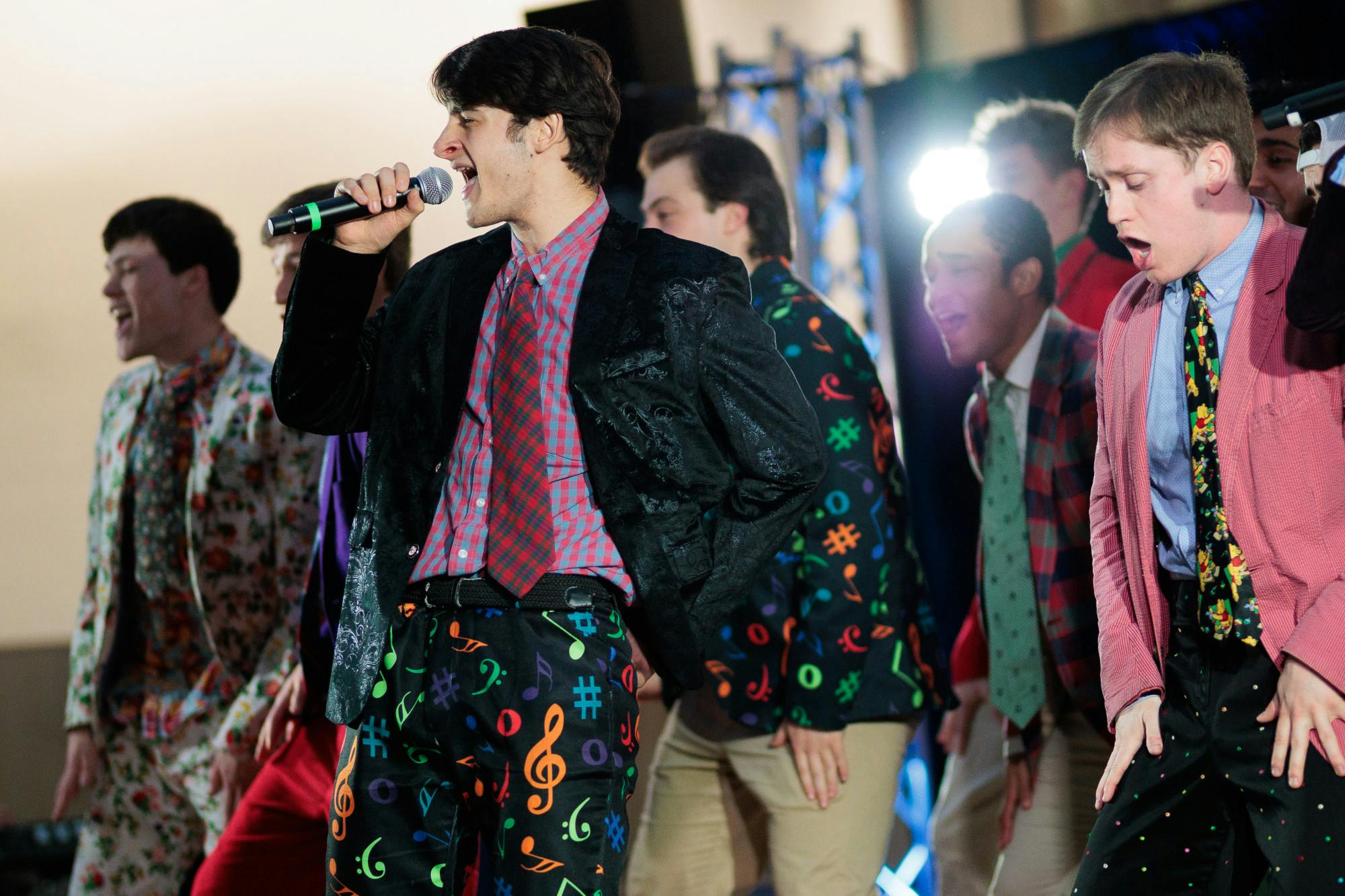
Throughout the term, there is no shortage of live a cappella performances hosted anywhere from Greek houses to Spaulding Auditorium. Today, Dartmouth’s a cappella scene includes eight groups: the Aires, the Brovertones and the Cords, which are all-male; the Decibelles, the Rockapellas and the Subtleties, which are all-female; and the Dodecaphonics and the Sings, which are mixed gender.
All groups have produced recorded albums, with the Aires, Brovertones and Dodecaphonics releasing records most recently in 2026.
The Dartmouth sat down with members of the Aires, the College’s oldest a cappella group, and the Dodecaphonics, a gender-inclusive group founded in 1984, to discuss the long process of producing albums as a college a cappella group.
“Self-Awaire” by The Dartmouth Aires (2026)
The Dartmouth Aires released their 13th cover album “Self-Awaire” on July 17. The album spans a wide range of genres, from country pieces such as “Tennessee Whiskey” by Chris Stapleton to alternative rock tracks like “Somewhere Only We Know” by Keane.
Aires music director and baritone vocalist Eli Fox ’27 — who oversees the logistical and technical process of producing the group’s recorded music — said each album is “three years in the making,” underscoring the amount of time it takes to fully record and produce “around 12 songs.” He added that there are six “generations” of Aires represented on the album.
“Each year we look back on our repertoire from that year [and] the new songs that we have arranged, and we vote on about four songs that we want included on the next album,” Fox said. “Then we record it at the end of the year.”
For their most recent album, the Aires partnered with Plaid Productions, a music recording and production company based in Sommerville, Mass., that specializes in “contemporary a cappella,” according to their LinkedIn.
Plaid Productions partner Alex Koutzoukis — who started his journey with a cappella at Tufts University as a bass and vocal percussionist for the Tufts Beelzebubs — has been working with the Aires for 12 years, primarily helping with the recording and editing phase of the production process.
Koutzoukis said he and business partner Alex Green have dedicated a weekend to spend in Hanover with the Aires for 12 years, typically “at the end of a school year,” to meet with the Aires music director and discuss every member’s vocal parts. The process helps formulate the vision for the album, since the music is not “malleable after you start recording,” he said.
“We’ll sit down music directors for a little while to listen through those songs [to] make sure that all the tempos match everything that they’re used to live,” Koutzoukis said. “Or if there’s anything that shifted, changed or that they want to add space for.”
The Aires record music at the BritTrax Recording Studio, located in the Hopkins Center for the Arts, Koutzoukis said. He added that while recording at other colleges can be “hit-or-miss” in terms of finding spaces that don’t suffer from being “noisy” or having “a lot of foot traffic,” BritTrax provides a unique contrast.
“Being able to go up [to Dartmouth] and pretty consistently be able to reserve BritTrax, the other rehearsal room next to it or a studio space means [finding a room] is at the bottom of our list of worries when we’re trying to plan out the weekend,” Koutzoukis said.
In an email statement to The Dartmouth, independent a cappella mixing engineer Ed Boyer — who was also a member of the Tufts Beelzebubs prior to Koutzoukis’s time at Tufts — wrote that he combines all the audio files “painstakingly recorded” by Koutzoukis and Green. Boyer’s job includes “balancing the volume levels, using [equalizer] and compression to control tone and dynamics, adding effects — reverb, delay, distortion — then printing it into one file.”
Fox said that, prior to Dartmouth, he didn’t “put much thought” into the process of making an album, but his time with the Aires has helped him understand the “end-to-end operation” of releasing recorded music. Fox added that he leaned on Aires alumni throughout the process, looping in a group chat of 10 different music directors from previous classes for advice on the mixing stage.
“When the ’26s were in the administration, they were doing the same, talking to past music directors,” Fox said. “[We incorporate] their notes and feedback and making adjustments, and then we pass it on to mastering, give it another final listen and then we get set to release [the] album.”
Aires alumni coordinator and tenor vocalist Andrew Sibila ’29 said “Self-Awaire” was his “first time recording professionally.” Despite the occasional difficulty of getting a “good take,” Sibila found the experience “rewarding.”
“[Recording] felt like a very uniting experience,” Sibila said. “For me personally, to be able to do what I love and be able to sing and record something for a global audience was great.”
Sibila added that his experience with the Aires has taught him to “lean into” Dartmouth’s culture.
“Don’t be afraid to be a little goofy on stage or really put yourself out there for auditions, even if you’re never sang before,” Sibila said. “I think that’s the most important thing you can do.”
“XII” by The Dartmouth Dodecaphonics (2026)
The Dodecaphonics released “XII,” also a cover album, on Sept. 1. The album spans a variety of pop songs, from “God is a Woman” by Ariana Grande to “Bleeding Love” by Leona Lewis.
Dodecaphonics music director and tenor vocalist Bennett Taubman ’28 described the album production as a “lengthy process,” adding that recording for “XII” began “a few years ago.” Five years of Dodecaphonics members sang on the album, spanning the Class of 2023 to the Class of 2027.
“We record about four to five songs at a time — this new album has considerably more than that,” Taubman said. “We record once a year because it’s hard to get everyone together.”
Taubman said another Dodecaphonics album is currently “in the works,” adding that the group has “three batches” of songs being prepared for the upcoming album, each at different stages of production.
The Dodecaphonics work with Northgate Studio, a music recording company based in Bedford, Mass., according to Taubman. One of Northgate’s strengths is their recording setup technology, which allows members of the group to sing together in one room, Taubman said. The group travels to Boston on select weekends to record and edit songs, he added.
“That’s one of the most important things when you’re recording an album,” Taubman said. “So much can be fixed in post [production], but what can’t be fixed is the performance and the energy that goes into it. We just perform a whole lot better when we are actually singing together.”
Dodecaphonics assistant music director and bass vocalist Ethan Park ’29 said while they did not have a “strong amount” of musical knowledge prior to joining the Dodecaphonics, singing with the group has always made them feel “supported and able to grow.”
Park added that working on the album has taught them that “listening to each other” is as important for recording as singing itself.
“I’m really excited to see how the sound of a cappella at Dartmouth changes — the new Aires album was great,” Park said. “Then you have all the other groups that are growing and changing. It’s always fun to see.”
Jared Gonzalez Arce '29 is a news reporter from California majoring in history. Out of The D, Jared is in surf club and loves music.