
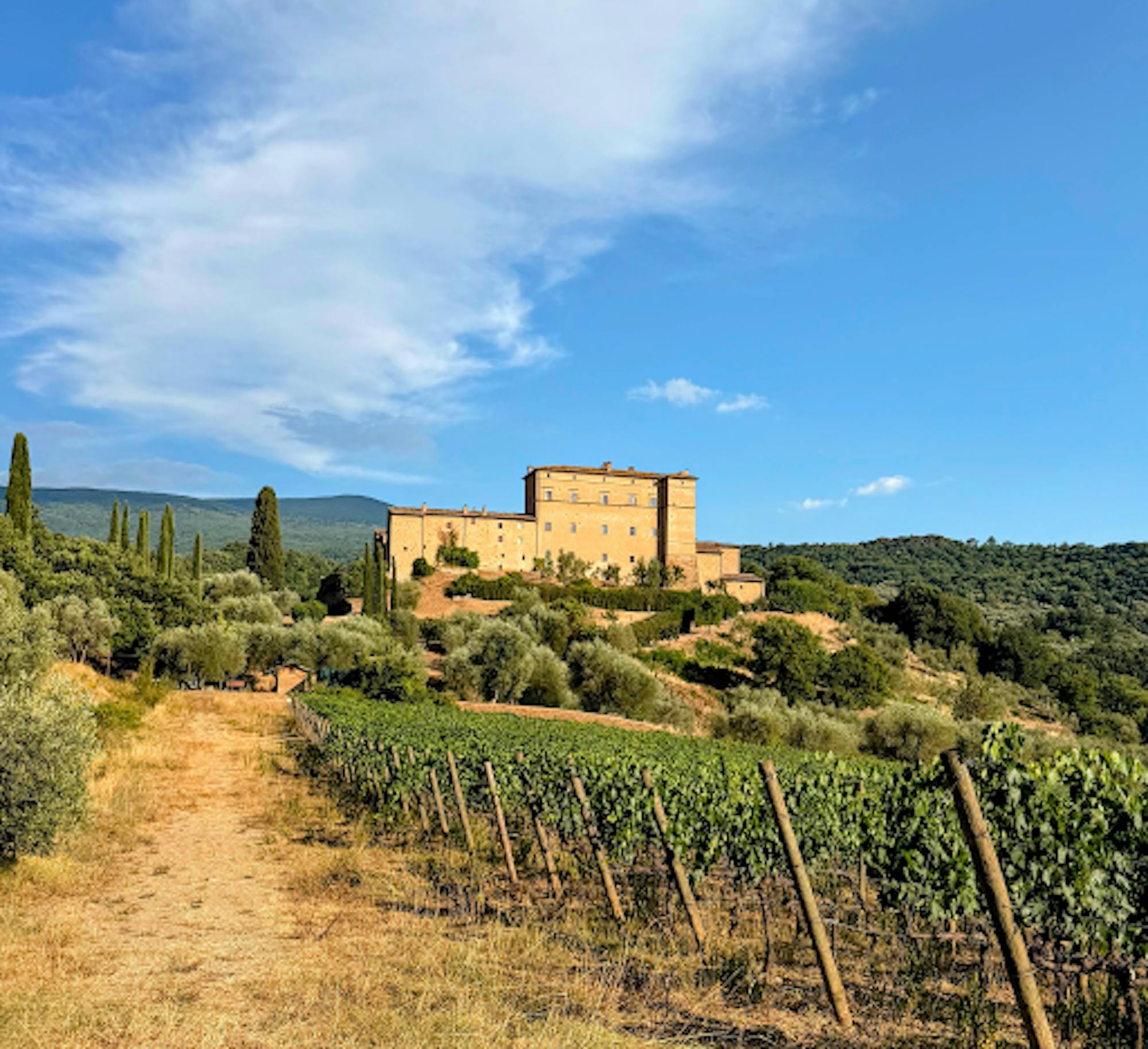
At 5:30 a.m. each morning, my roommate Kyra and I rolled out of bed about half an hour later than we had intended. It was still dark when our alarms first sounded, but by the time we were dressed, the sun was rising over the Tuscan hills and the cool air was already gone. This summer, that was how my days began: in a castle in southern Tuscany, heading each morning out of its gate toward a medieval convent that no longer had a roof.
By 6 a.m., the team gathered in the courtyard of the pale-yellow Castello di Potentino, set among its vineyards below Seggiano, a small hill town. The first known document mentioning Castello di Potentino dates to 1042. When Charlotte Horton and her family bought it in 2000, the castle had been abandoned and was falling in on itself. They began restoring it — bringing the vineyards and olive groves back into production, making wine and creating both a cultural center and the extraordinary home in which we lived this summer.
Dartmouth students have found their way to Potentino before: through an art history foreign study program, a trip organized by the Dartmouth Office of Sustainability or art history professor Nicola “Nick” Camerlenghi’s ongoing research in the Potentino Valley. This summer, I was there for the last of these, living at the castle while working with Nick and the rest of our team to investigate a special facet of the valley’s history: the remains of a medieval convent about a 10-minute drive away.

Each morning, we left the castle courtyard behind, piled into cars and drove down the road to Colombaio, an early center of the Franciscan Observance where St. Bernardino of Siena trained as a novice. Then, as Auggie Laster ’27, a fellow research assistant, liked to say, it was “time to play the game.” For the next six and a half hours, we excavated.
Much of our work centered on the convent church, where two walls remain, one remarkably intact, alongside a crumbled bell tower and the remains of a side altar. Simone, the lead archaeologist on the excavation, is a Franciscan friar who speaks little English. Somehow, this rarely presented much of a problem to those of us with very little Italian. We quickly learned how much could be communicated by pointing, demonstrating and, occasionally, simply handing someone a shovel.
We pruned and cleared the nave the first week, then began excavating beneath it, three inches at a time: pickax, shovel, clean. One pass could take an hour. By lunch, dust and mortar had worked into our hair, our mouths and the creases of our knuckles.
Kyra, a rising senior at Mount Holyoke College, and I worked in the nave from our first morning. We became attached enough to our little patch of ruin that we developed a name for the particular feeling produced by hours of excavating it in the midsummer heat: “nave rage.” Through all those hours of pickaxing, shoveling and cleaning, Sade’s greatest hits became our unofficial soundtrack.

Somewhere in all those mornings, something changed a couple of weeks in. The dirt stopped looking like dirt. When I first arrived, a stone was a stone. After enough time in the nave, I began recognizing pieces of tile almost instinctively. Subtle differences in texture and color began to stand out. The compact mortar layer Simone called “preparation” had its own look. When you spend hours looking closely at the same few square meters of earth, your eyes become trained to distinctions that would once have been invisible.
I had experienced that feeling before, in a very different place: reporting for this paper. Reporting also begins with learning how to look. You arrive at a story knowing very little, start asking questions and gradually learn which details matter. A document that once seemed bureaucratic suddenly contains an important sentence. Something that doesn’t fit the piece you thought you were reporting becomes the reason to keep reporting it. Archaeology works on a different timescale, but I began to recognize the same discipline at Colombaio: look carefully, document what is there and remain willing to change your understanding when the evidence changes.
At the beginning of our third week, my pickax caught a line of stones beneath the nave. As we worked around them, their arrangement took shape: a grave. About a foot down, a skull emerged from the earth. After weeks of watching the church reveal itself a few inches at a time, the discovery was thrilling. The next day, we uncovered another. Based on its size, Nick and Simone believed the first belonged to a child, though further analysis will be needed to know for certain.
But the graves also complicated what we thought we knew about the site. They appear to predate the church, Nick and Simone surmised, which may explain why they do not align with the nave constructed above them. In archaeology, new evidence seems to produce questions almost as quickly as answers. If the graves predate the church, what were they connected to? Why were these people buried here? The more we uncovered, the more there was to explain.
I felt the discovery first as a researcher-in-training: adrenaline, a running list of implications. Then something plainer took its place. These were real people. Someone had buried them here. Someone had known them, and someone had mourned them. Centuries later, I found myself looking at someone who had likely last been seen by the people who laid them there.
There was something moving about being entrusted with that. Architecture and objects can make the past tangible, but human remains make it personal. We were learning something new about Seggiano’s past while slowly becoming acquainted with the place in the present — the man at the hardware store smiling and saying “ciao,” the mayor sharing town gossip, an elderly woman with impossibly platinum-blonde hair remembering our individual pizza orders. I suppose that is what happens when you spend enough time digging in a small town in the middle of Italy. You begin by studying its history and end up, however briefly, becoming part of its present.
Our days developed their own rhythm: back to Potentino for lunch at 1 p.m.; afternoons of photogrammetry, flotation and field logs; free hours at the pool; dinner at 8 p.m. around the long wooden table in the courtyard, with Charlotte in her usual place at its head. One evening, we tried wine made in an Etruscan style, foot-pressed and unfiltered. On the best nights, Pasquale — the castle’s chef — brought out tiramisu, which was the best I have ever eaten. After dinner, we played cards in the granary or walked back to the pool, where the castle sat above us and the stars seemed impossibly bright, bats occasionally swooping just above the surface.
The repetition was part of what made the summer meaningful. I came to understand how much archaeological work depends on patience and attention. There was no skipping ahead to see what was underneath: Each layer had to be excavated evenly, cleaned and understood before we could move to the next. And sometimes, what we uncovered contradicted what we thought we knew, sending us back to the archives or forcing us to reconsider the history we had begun constructing.
I also came to understand how many people it takes to make archaeological research possible. Our project brought together archaeology, art history, architecture, engineering, archival research, heritage preservation, local government and a considerable amount of physical work. Nick deliberately encouraged us to move among different parts of the project rather than stay with one task. As Layal, another member of our team, put it, he wanted us not only to experience every part of the excavation but to feel some ownership over every discovery. Even when only a few people uncovered something, everyone had the chance to examine it, ask questions and understand why it mattered.
At Colombaio and Potentino, Nick was our professor, project director, art historian, tour guide and, often, the person at dinner still willing to answer the question that had occurred to you six hours after leaving the dig. An afternoon visit to a local church could become an impromptu lesson in medieval architecture; something uncovered that morning could send us into a conversation about an archival source that evening. Having that kind of access to a professor, not for an office hour or a class period, but while actually doing the work together, was one of the most distinctly Dartmouth parts of the experience — and one of the most rewarding.

That may be what I will remember most about undergraduate research at Dartmouth: we weren’t there simply to watch the process; we were part of it. In Tuscany, that meant picking up the tools, keeping the logs, cleaning the layers, sorting material, working around the remains and trying to understand what the evidence was telling us. The research was, quite literally, in our hands.
Each morning, we arrived at Colombaio and began again: pickax, shovel, clean. Three inches at a time, the ground became legible. I had spent the summer learning how to read what was beneath my feet, only to recognize in archaeology something I already knew from reporting: Sometimes, you have to dig a little deeper.
Isabel Menna ‘29 is a reporter from Leavenworth, Wash., is majoring in economics and is a member of the Dartmouth Ski Patrol.


