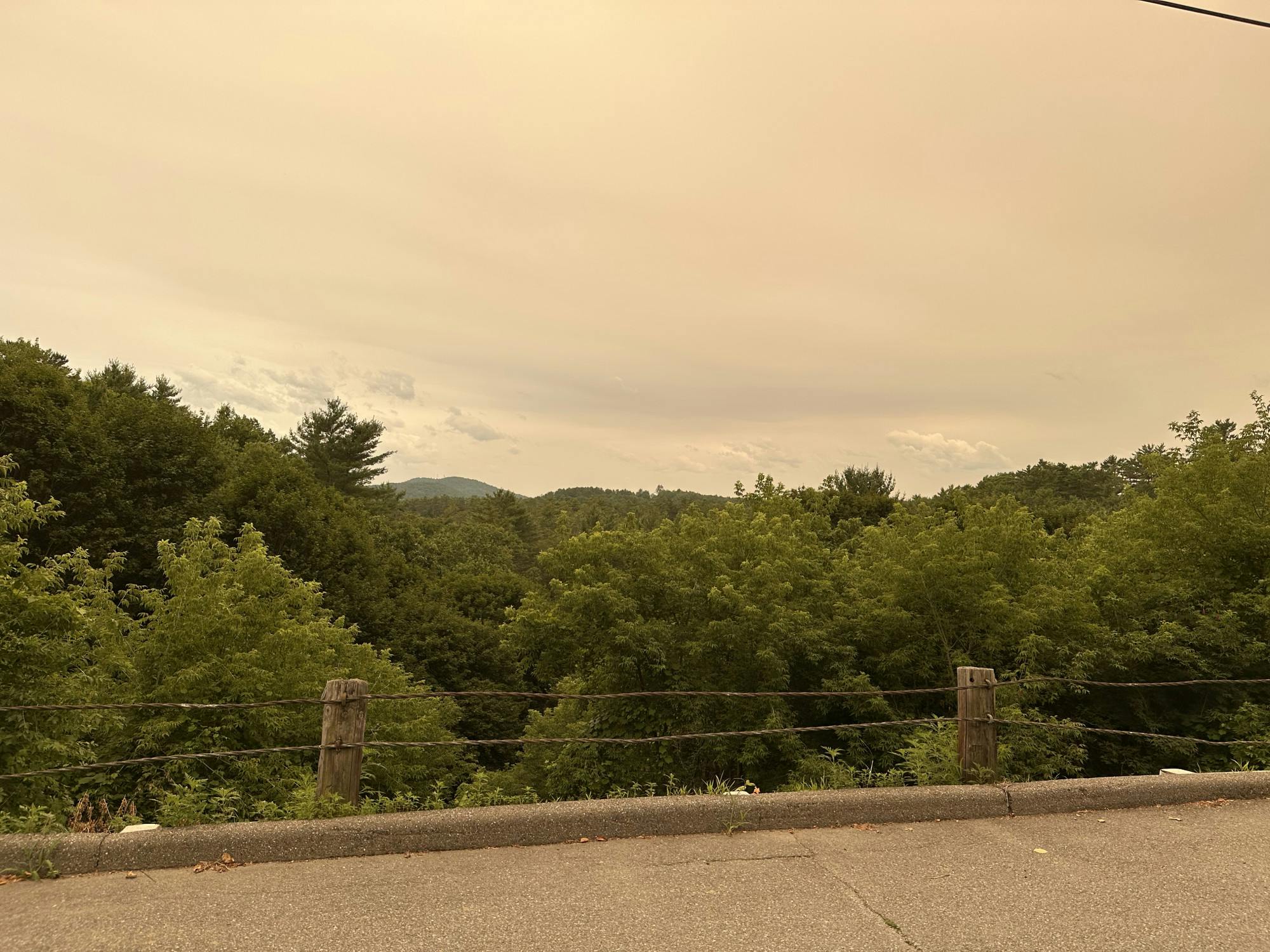
Starting on July 14, smoke from Canadian wildfires drifted into the Upper Valley and across much of the Eastern United States, turning the sky visibly yellow in Hanover on July 14 and 15. On July 16, the air smelled of smoke. Some students who exercise outdoors said the air quality worried them.
The air quality index in Hanover reached 85 out of 300 in the afternoon of July 16, with higher numbers representing more hazardous air. 85 represents a level which “may pose a moderate health risk” to a “very small number of” sensitive individuals, including the elderly, young children and people with lung conditions, according to the U.S. Environmental Protection Agency.
The New Hampshire Department of Environmental Services issued a statewide “code orange” air quality warning on July 16. According to the New Hampshire Department of Health and Human Services website, exposure to particle pollution can cause breathing problems, worsen asthma symptoms, decreased lung growth in children and increased emergency department visits and hospital stays for people with breathing and heart problems.
“Conditions are expected to improve on Friday afternoon but there is potential for the smoke plumes to persist,” a NHDES press release reads. “Symptoms of fine particle exposure may include chest pain, palpitations, shortness of breath and difficulty breathing.”
Dartmouth Athletics spokesperson Stephanie Albrycht said the department canceled “some” physical education classes this week “due to poor air quality.”
“Year-round we work closely with our sports medicine team to evaluate conditions, and whenever there is any concern, we move practices, classes and activities indoors wherever possible,” Albrycht wrote.
Ava Zander ’28 runs two to three times a week to “stay present.” She said she stopped running on July 14 when she noticed the sky was yellow.
“In general I’ve just been more prone to stay inside,” she said. “I love going to the [Connecticut] River, but it’s just not worth it with this air.”
Sydney Grogean ’28 is running a half marathon every Monday of sophomore summer with friends and classmates. She said she ran on July 14 without a problem, but her Wednesday rowing in the Connecticut River was “not pleasant.” Grogean added that the air quality makes her “nervous” for this upcoming “Half-marathon Monday.”
“I don’t want anyone to get sick,” she said.
Ciara McCrory ’28 said she went on a run on the morning of July 16. She planned to run three or four miles, but “had to stop” early because of difficulty breathing.
“[Running is] something I’m less inclined to do [now] just because it’s harder to breathe, that makes it less enjoyable,” she said. “I would rather run inside or just not run.”
Despite the air, Main Street was bustling with foot traffic on the afternoon of July 16. When asked, multiple people said the air did not concern them. Hanover resident Phyllis Fox, 83, said she had not noticed the air until someone pointed it out to her that day.
A Dartmouth Hitchcock Medical Center primary care physician, who was walking in town on July 16, said she noticed she has been sneezing “a whole lot more than normal” this week.
She said that last summer, when Canadian wildfires caused similar air quality dips, her patients with chronic lung conditions were “struggling more” than when air quality is at normal levels.
“I don’t think it’s as bad right now as it was last year,” the doctor said.
Iris WeaverBell ’28 is a reporter and editor. She is from Portland, Ore., and is majoring in economics and minoring in public policy.