As the United States celebrates the 250th anniversary of its founding, the Hood Museum of Art is using works from its permanent collection to invite visitors to consider not one story of America, but many.
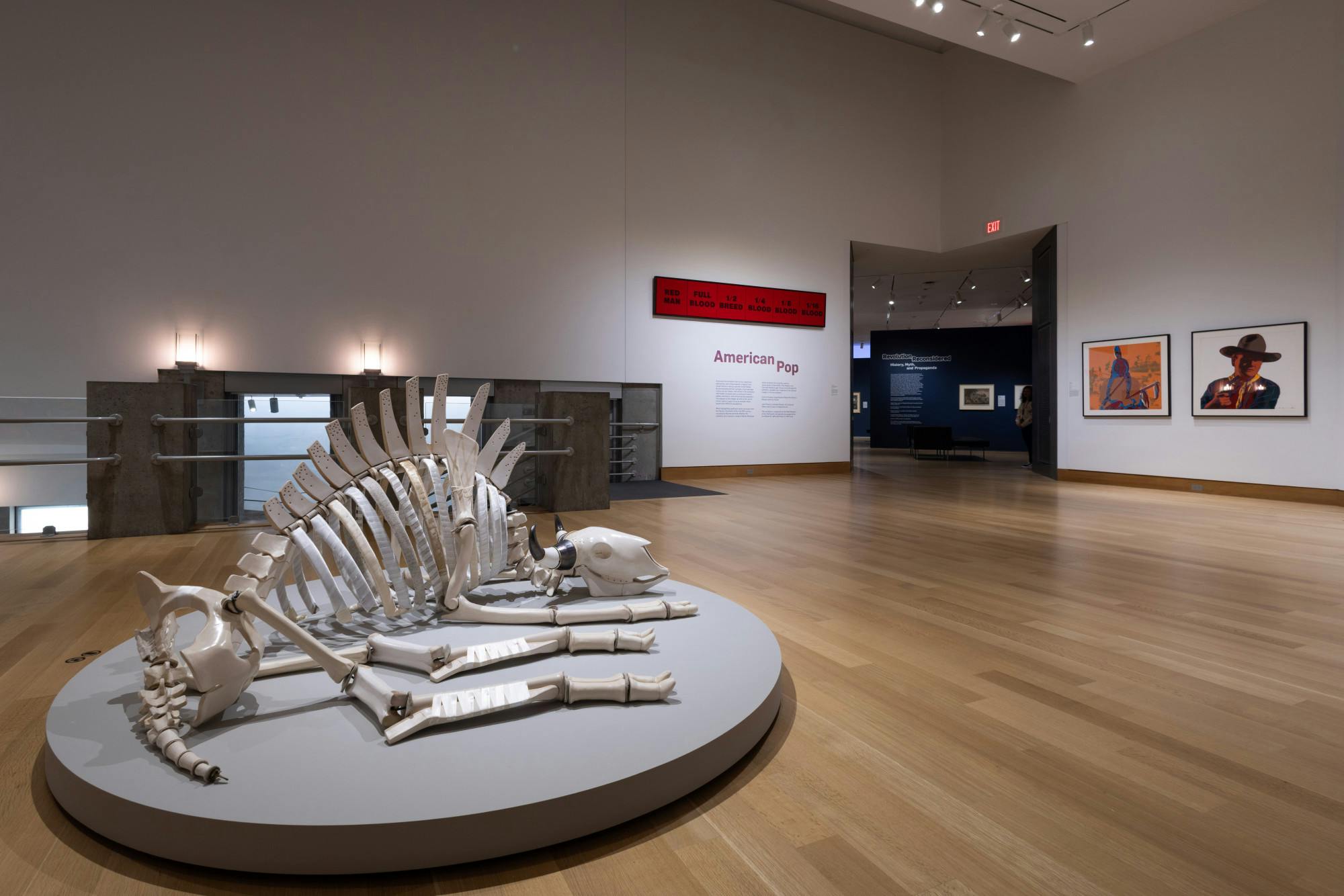
Throughout 2026, the museum has transformed its galleries into 12 interconnected exhibitions organized around themes including nationhood, the American Revolution, slavery and its legacies, labor and popular culture. Together, the exhibitions present multiple perspectives on the people, events and ideas that have shaped the United States.
While the exhibitions coincide with the nation’s semiquincentennial, they are not organized as a traditional commemoration. Instead, they use works from the Hood’s collection to examine how artists have defined, questioned and reinterpreted the American experience across generations.
Planning for the project began in 2022. As Hood Museum director John Stomberg wrote in an email statement to The Dartmouth, the team “quickly made two decisions.” Those decisions shaped an exhibition series that is built around multiple themes rather than a single, chronological interpretation of U.S. history.
The first was to pull from as many perspectives as possible.
“We chose to give voice to the many rather than the few as that seems appropriate to an examination of a democracy,” Stomberg wrote. “Too much has to be ignored to keep that kind of narrative strand moving.”
That philosophy also shaped how the exhibitions were created. Haeley Chang, the Hood Museum East Asian art associate curator, who contributed to “Nurturing Nationhood” and “Revolution Reconsidered” and was the lead curator of “Shared Ground,” wrote in an email statement that the exhibitions were “collectively curated by our museum team around the broad theme of revisiting the concept of America and American art from different perspectives.”
The second decision, Stomberg wrote, was to rely entirely on works from the Hood’s collection. Among the exhibitions currently on view, “Nurturing Nationhood” explores how artists helped construct ideas of American identity during the 19th and 20th centuries, while “Revolution Reconsidered” examines how visual representations of the American Revolution have been reinterpreted over time. Other exhibitions examine slavery, abstraction and popular culture, each offering a different perspective on the nation’s past.
Stomberg said the project reflects the distinctive role of a university museum.
“Academic art museums are uniquely prepared to take on this sort of project,” he wrote. “First, we have the incredible brain trust that is the college faculty. The interactions between our curators and professors from countless departments shape our storytelling and allow us to share a never-ending cascade of fresh ideas.”
Furthermore, because the Hood serves as Dartmouth’s teaching museum, it can prioritize scholarship over attendance.
“Museums such as the Hood are expected to be different than city museums and so we do not have to try and ‘sell’ our exhibitions to sell tickets; we just make sure that they are thoughtful and relevant.”
Dartmouth art history professor Elizabeth Kassler-Taub said museums offer a distinctive setting for examining the nation’s past because they encourage visitors to engage with competing interpretations of history.
“Like monuments, museums are vessels of collective and contested memory,” Kassler-Taub wrote in an email. “At their best, they encourage us to confront the issues and events that have shaped our shared past and our — often divergent — cultural and political identities.”
She said college museums extend those conversations beyond the classroom by encouraging students to engage directly with works of art.
“College museums like the Hood, which craft art historical narratives in service of a greater pedagogical mission, have the unique opportunity to treat images and objects as provocations,” Kassler-Taub wrote. “At major cultural and political inflection points like this, one of the most important things that we can offer our students is an opportunity for close looking and critical thinking in the company of objects that challenge their historical assumptions.”
Grace Neuwirth ’28, an art history major, said the exhibition series reflects the Hood’s broader mission of encouraging visitors to consider often overlooked historical perspectives.
“Art museums have a unique power to help people see alternative views of the country,” Neuwirth said.
Katharine Knuppel ’28, an art history major, said museums play an important role in helping people engage with the nation’s past through visual art.
“Through visual language, artists offer new perspectives, revive cultural traditions and challenge dominant historical narratives,” Knuppel said. “Museums uniquely contextualize this visual language and are dedicated to the preservation of art that investigates American history.”
Neuwirth encouraged students who may feel intimidated by museums to visit the exhibition.
“Art can be really intimidating, but you’ll be surprised by how much meaning you can find in looking,” she said.
Although the exhibitions span different historical periods, artistic movements and media, Stomberg said they share a common purpose: encouraging visitors to embrace the complexity of the American experience rather than reducing it to a single narrative.
“With the 12 shows the Hood will host across 2026, we hope to celebrate the complexity and rich diversity of American experience,” he wrote. “Some of these stories are fabulous, others are heartbreaking, but together they remind us of the myriad episodes that in aggregate shape the histories of the United States.”
For Stomberg, embracing that complexity is central to the museum’s approach.
“In historical periods, just as is the case today, opposing ideas can be simultaneously true,” he wrote. “This is a hard lesson to learn, but also crucial to move society forward and therefore something we hope our audiences wrestle with in a productive manner.”
Isabel Menna ‘29 is a reporter from Leavenworth, Wash., is majoring in economics and is a member of the Dartmouth Ski Patrol.