Dartmouth Dialogues, College President Sian Leah Beilock’s signature initiative, is getting new leadership.
On July 15, Kristi Clemens, the project’s inaugural executive director, transitioned into a new role as associate vice president of institutional case management and community support under the Office of Campus Life, in which she will oversee behavioral intervention and crisis management policies, according to her LinkedIn. She will continue to oversee Dartmouth Dialogues until the next executive director is selected.
Day-to-day operations on campus will be overseen by Stephanie Glaros, who previously worked with Dartmouth Dialogues as the facilitator of Story Corps One Small Step, a non-profit that organizes conversations across political differences.
In an interview with The Dartmouth last week, Clemens — who oversaw Title IX at the College prior to her role in Dartmouth Dialogues — said her executive director role was always supposed to be temporary. She has served as executive director since the project was launched on Jan. 10, 2024.
“I thought that this would be a great role for me to do for two to three years to build a strong foundation for a program because I know Dartmouth so well,” she said. “I was able to leverage my connections around the institution to find places on campus where this [dialogue] was happening and to try to build this strong and wide foundation for Dartmouth Dialogues, while knowing that someday we would be able to hire a national expert in this role.”
She added that the next executive director, who will “optimistically” begin serving by spring 2027, will be better equipped to take Dartmouth Dialogues’s “specialness” and “apply” it to a broader model that could work in other institutions and even high schools.
“We’re looking for somebody to be a national thought leader, to be somebody who has been doing this work across institutions, who’s been doing this work across different fields, and can take Dartmouth Dialogues, with their expertise and their national or international connections, to the next level,” she said.
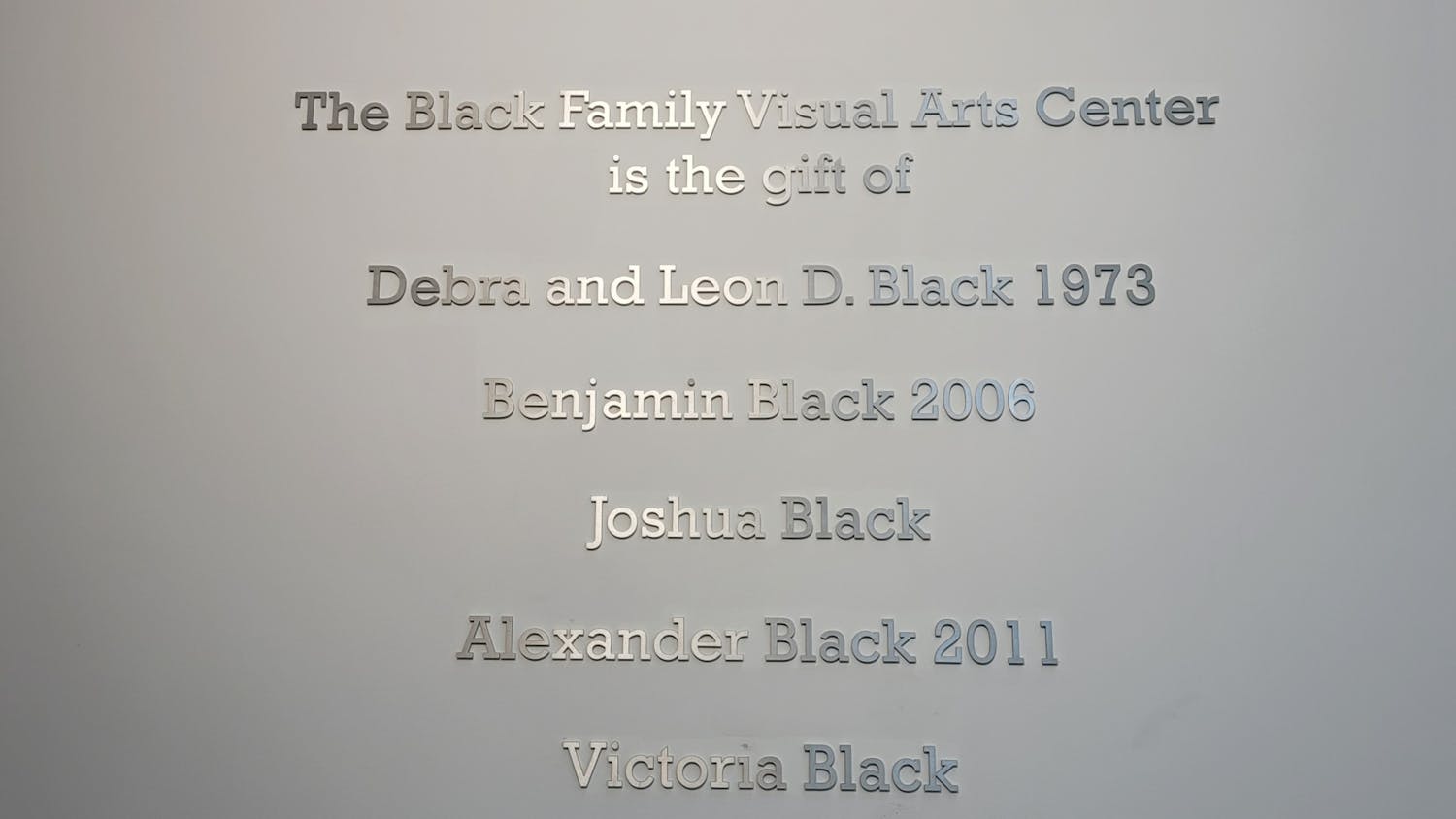
Clemens said Jim Frank ’65, Karen Frank and their son Daniel Frank ’92’s $25 million gift to the initiative — $10 million of which permanently endowed the executive director role — “allowed” the College to begin searching for a candidate with “national recognition” to fill the role. Their donation will not fund Glaros’s position, according to Clemens.
The search committee will be chaired by biology professor and former dean of faculty of Arts and Sciences Elizabeth Smith, who helped found Dartmouth Dialogues, and Clemens. It will consist of Temi Bailey ’28, government professor Jason Barabas ’93, senior director of principal gifts and campaign planning Michael Griesi, associate vice president for campus life and inclusive initiatives Tennille Haynes, psychology professor Melissa Herman, Guarini School of Graduate and Advanced Studies assistant dean of graduate student affairs Amy Keeler, associate vice president for communications Kathryn Kennedy, dean of undergraduate student affairs John McKnight, Jude Poirier ’28, Pari Sidana ’28 and government professor Sean Westwood.
Reflecting on her tenure, Clemens said she is proud of the initiative’s pre-Thanksgiving workshop, in which Clemens and Story Corps facilitators taught students how to handle political disagreements during holidays over Winterim. It also provided training for student leaders, including undergraduate advisors. Much of the Dartmouth Dialogues’ work is “embedded in other work that’s already happening on campus,” she said.
“I’m really proud of when they [students] set aside the cynicism, and they come to the table, and come to a workshop, come to a program, and say, ‘Oh, this is actually really helpful. I have a practical application for this,’” she said.
Dartmouth Dialogues was founded in January 2024 — a year before President Donald Trump began his second term, in which he has attempted to shape what he has called higher education’s “wokeness,” including ideological bias against conservatives and their ideas. Clemens said she “understands skepticism” of Dartmouth Dialogues “given the conditions under which it was created.” Still, the project aims to equip students with tools for conversations after they leave higher education.
“We have been graduating students who are not prepared to have tough conversations, period,” she said. “I’ve seen that in all the different capacities that I’ve worked in. And so, for me, that’s been a really important motivating factor in building Dartmouth Dialogues.”
Senior vice president of community and campus life Jennifer Rosales wrote in an email statement to The Dartmouth that Glaros’ “familiarity with our community and our mission makes her exactly the right person to help lead the next chapter” of Dartmouth Dialogues.
“As Dartmouth Dialogues grows to meet the extraordinary opportunity created by the Frank family's $25 million gift, we’re building out the team to match,” she wrote.
In a separate interview last week, Glaros said she is interested in creating opportunities for dialogue that are “enjoyable.”
“He [Dartmouth Dialogues program coordinator Trevor Fornara] and I are very, very interested in and eager to work with students and get student input to find out from students how can we create these experiences … to make sure that they're number one, relevant to students and number two, enjoyable,” she said.
She said she has made 10 to 12 visits to campus in the past two years for the Dartmouth Dialogue-Story Corps partnership, hosting events which have engaged over 1,000 students, faculty and staff members. Throughout these conversations, participants often struggled to “listen fully.”
“I think we are operating in a culture where reacting in the moment of what’s rewarded,” she added.
Barabas wrote in an email statement to The Dartmouth that “ideally,” the next executive director will “promote opportunities for cross-cutting intellectual exchanges at Dartmouth.”
Other search committee members declined or did not respond to a request for comment by time of publication.
Iris WeaverBell ’28 is a reporter and editor. She is from Portland, Ore., and is majoring in economics and minoring in public policy.