
This article is featured in the 2026 Commencement special issue.
Fifty-four years ago, athletic director Seaver Peters ’54 hired coach Agnes Bixler Kurtz to lead the creation of women’s athletic teams at Dartmouth. In a letter to the first female undergraduate degree candidates admitted to Dartmouth, Kurtz encouraged them to join the school’s first women’s athletics teams: “We have a chance to start some teams.”
“I want you to return this letter to me in person, so I know you know where the gym is, and I know you can walk,” she concluded.
Coeducation at Dartmouth, which began in the 1972–73 academic year, coincided with the enactment of Title IX of the Education Amendments of 1972, which prohibits sex-based discrimination in schools and other education programs that receive federal funding.
Today, Title IX is famously interpreted to require that federally-funded institutions provide female athletics programs with equal opportunities and funding as male ones. But when Kurtz first arrived in Hanover, “there was no job description” for her role as assistant director of physical education for women’s athletics
“It just said, ‘Start women’s athletics,’” she recalled.
Kurtz had previous experience with leading physical education programs and was a competitive college athlete herself, which helped her do the same with women’s sports at Dartmouth. She competed in intercollegiate squash and studied religion at Smith College before representing the United States in international competitions in England and Australia in 1968 and 1972, respectively.
In 1965, while teaching physical education at Vassar College, Kurtz founded the first national intercollegiate squash tournament; from 1968 to 1972, she helped start the women’s athletics program at the University of Delaware.
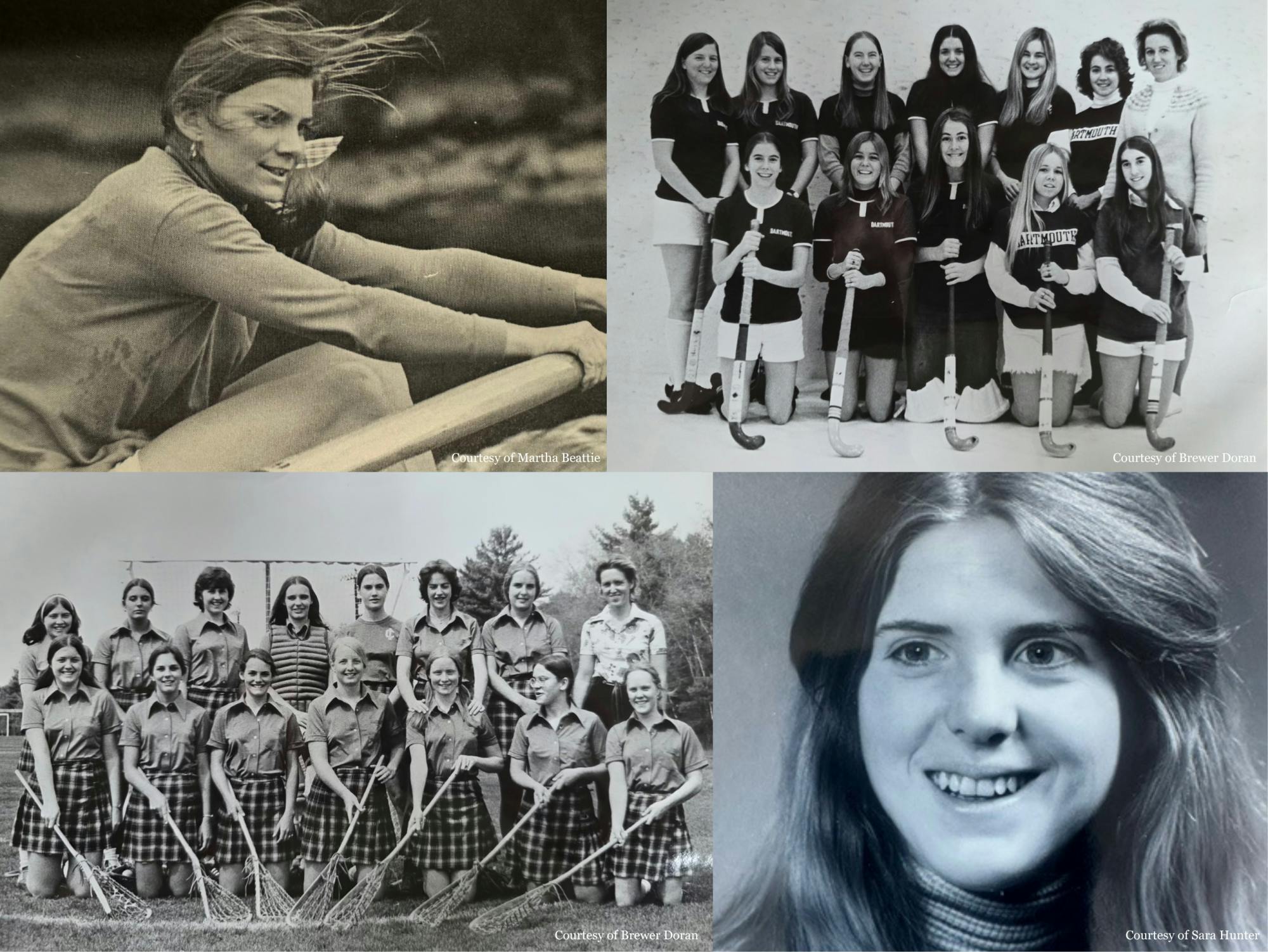
By the end of the 1972-73 academic year, Kurtz had recruited athletes for five women’s sports teams at Dartmouth: basketball, field hockey, lacrosse, skiing, squash and tennis. She personally coached the field hockey, squash and lacrosse teams. In 1973, 1975 and 1978 Dartmouth Athletics added women’s swimming and diving, rowing and ice hockey programs, respectively.
Some players — particularly those on the squash team— had never competed in their sports before attending the College, Kurtz told The Dartmouth. Despite this lack of experience, the women who joined the new teams were “fairly outgoing” and “fairly aggressive” in their respective sports, Kurtz said in a 1997 interview for an oral history project organized by the College.
During their first year, many of the women’s teams had such small budgets they were unable to afford uniforms.
Martha Beattie ’76, a member of the inaugural women’s rowing team, recalled going to the Dartmouth Coop and buying “just some t-shirts with a ‘D’ on it” for practice.

Men’s athletics teams also helped facilitate the transition. Heavyweight rowing coach Peter Gardner, for example, volunteered his time to coach the newly founded women’s rowing team with no additional pay.
“For the Head of the Charles race, Pete Gardner went into the storage closet somewhere and came up with some old lightweight men’s rowing trousers,” Beattie added.
Beattie said Gardner “decided that … if the men were on the water, the women should be on the water too.”
K. Brewer Doran ’76, the first captain of the women’s lacrosse team, said Dartmouth “did really well” integrating women in sports in their first year.
“They were looking for resiliency, and we were unafraid to ask for something,” Doran said.

While there were few women at Dartmouth in the 1970s and even fewer on athletic teams, Sara Hoagland Hunter ’76 said she remembers the close relationships between team members, especially with older female students who transferred after Dartmouth became coeducational.
“It just felt like a wonderful bonding experience … talking on the bus, going on trips to the other Ivies,” Hunter said. “There was camaraderie with the transfer students who were older than us … because they were real minorities in their classes.”
In her oral history project interview, Kurtz said the bus rides to athletic events were a time for the women to “get together and be themselves” and “the only chance that the women in the first year could ever sit together and be together” in the College’s male-dominated environment, helping them find their way on campus.
“That was their own sorority,” she said.
At the end of Sandy Helve ’76’s four years at the College, she became the first Dartmouth student to receive 11 varsity letters — one for every term she played at Dartmouth — as a member of the field hockey, lacrosse and squash teams. She credited away games with giving the teams “a chance to spend time with each other.” The men’s and women’s teams were “like brothers and sisters,” she explained.
“I remembered very vividly in the fall we’d practice field hockey and cheer on the men’s soccer team, and vice versa … and same in the spring for the lacrosse games,” Helve said. “It was a shared experience, and a lot of those guys were like our brothers.”
Former athletic communications director Rick Bender, who worked at the College from 2008 to 2014, attributed the expansion of women’s sports to early support from the administration for women’s sports programs.
“Dartmouth was very invested early on in women’s athletics in the ‘70s,” Bender said. “Other schools weren’t investing like Dartmouth was, so [Dartmouth was] ahead of the curve in that regard.”
Today, Dartmouth has 16 women’s varsity sports teams, several of which have produced Olympic athletes and gone on to successful professional careers.
Canadian national women’s hockey team player Gillian Apps ’07, a three-time Olympic gold medalist from the 2006, 2010 and 2014 Olympic Games, is a former professional hockey player in the Canadian Women’s Hockey League and served as an assistant coach for the Boston College women’s hockey program from 2016 to 2017.
By the time she arrived at Dartmouth in the fall of 2002, the Big Green women’s hockey team “was one of the best in the nation,” Apps said. The Big Green won five Ivy League titles between 1991 and 2001 and were the 2001 ECAC hockey champions. Because there were numerous national team players on the Dartmouth roster, the College accommodated App’s ambitions to leave campus for national team training camps.
“It was a great environment where I could sort of work toward both school and the national team,” Apps said. “At Dartmouth, we had a really talented team: It was like practicing against some of the best players in the world every day.”

Other notable female Olympians from Dartmouth include 1976 and 1984 Olympic rower Judy Geer ’75 Th ’83, skier and gold medalist Hannah Kearney ’15, women’s soccer gold medalist Kristen Luckenbill ’01, skier and silver medalist Elizabeth McIntyre ’87, women’s rugby player and bronze medalist Ariana Ramsey ’23 and women’s hockey silver medalist Laura Stacey ’16.
Dartmouth has also led the way in hiring female coaches, according to Bender. He pointed out the importance of providing women with opportunities to pursue leadership options in athletics.
“Opportunities are trickling in on the men’s side, but I think on the women’s side, more and more women are getting into those coaching positions, which is great to see,” Bender said.
Several female Dartmouth alumni have found success in coaching sports. In 2021, former varsity softball player Bianca Smith ’12 became the first Black woman to coach in a Major League Baseball organization when she was hired to coach a minor league affiliate of the Boston Red Sox. That same year, former Dartmouth football quality control coach Jennifer King became the first Black female coach in NFL history when she was promoted to offensive assistant for the Washington Commanders.
Reflecting on her experience as a rower, Beattie said she was confident that Dartmouth would become a place where women’s sports could thrive.
“We came in with some trepidation, but I was sure that Dartmouth was a place for women, and that it should be a place for women,” Beattie said.
Fifty years later, as women’s sports thrive at Dartmouth, Beattie’s convictions have become a reality.

