
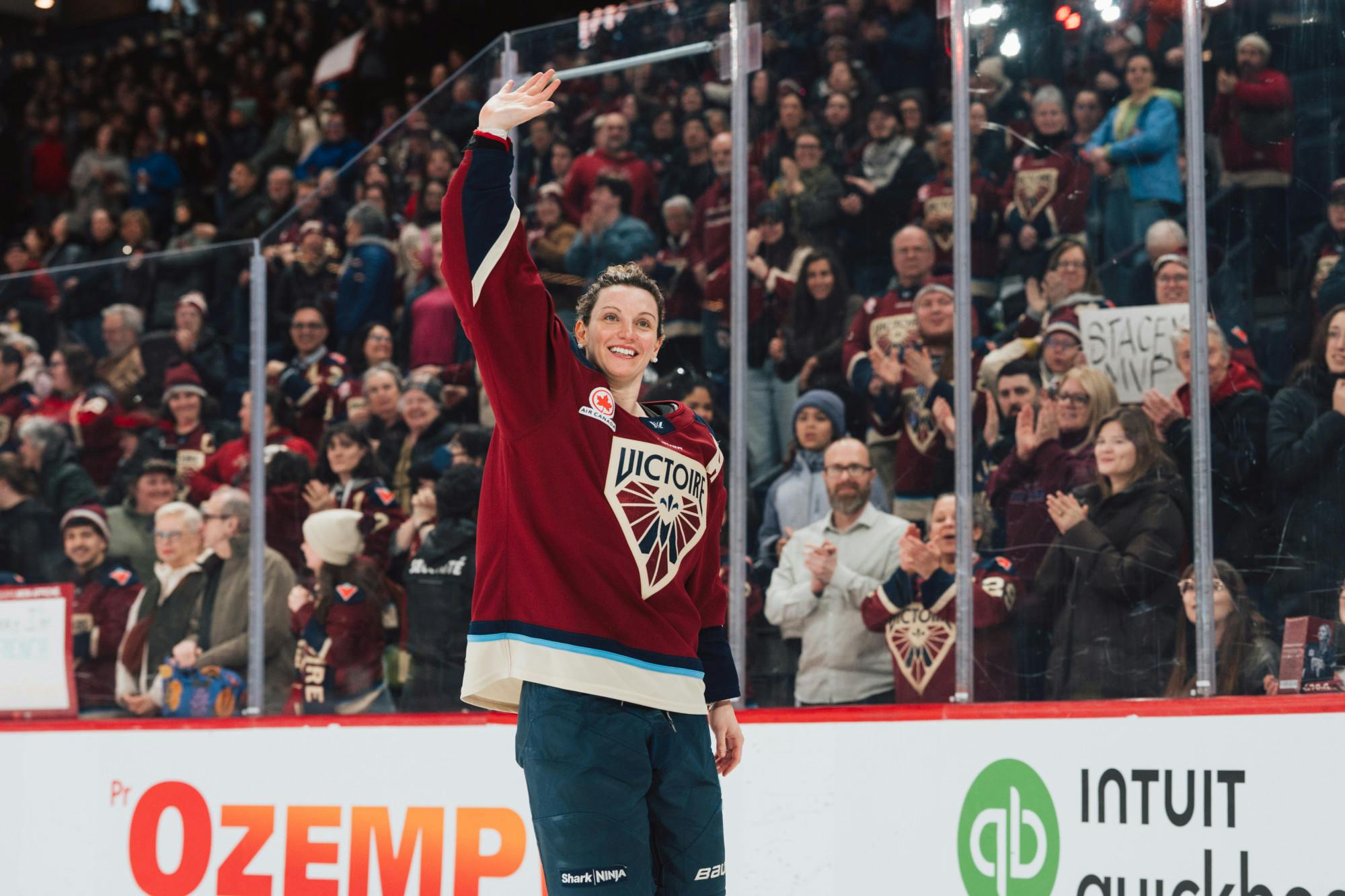
Laura Stacey ’16’s path to hockey stardom was anything but linear. From crying during figure skating lessons and longing to join hockey practice on the other side of the rink, to representing Canada on the Olympic stage and winning a gold and two silver medals for her country, Stacey’s journey has been defined by persistence, perspective and an ever-evolving love of the game.
At Dartmouth, Stacey was a standout forward, captaining the team her senior year and earning All-Ivy and Eastern College Athletic Conference honors. She then went on to compete at the highest level of women’s hockey, playing in three Olympics finals with Team Canada.
Stacey also helped pioneer the formation of the Professional Women’s Hockey League after the collapse of the Canadian Women’s Hockey League in 2019. She and several other players spent several years without a stable professional league before PWHL launched in 2023, backed by Billie Jean King Enterprises, a female-owned and led investment and consulting firm founded by Billie Jean King and Ilana Kloss. The league quickly became a turning point in women’s hockey, providing a professional platform for fans to watch high-level North American competition.
Now a forward for the Montréal Victoire — a team Stacey describes as “experienced, resilient and tough to play against that loves spending time with one another” — sat down with The Dartmouth to reflect on her journey from Ivy League hockey to the Olympic stage, the rise of professional women’s hockey and the lessons that have shaped her along the way.
How long have you been playing hockey? What first sparked your love for this sport?
LS: I’ve been playing hockey for a long time now. My parents put me into a “learning to skate” figure skating course when I was about three years old, and I hated it. I sat on the ice and cried because I saw all the boys going to the rink and getting to play hockey. Eventually, I convinced my parents to let me go and play hockey across the way, and I never really looked back. I think that’s where my love for the game started and, honestly, it’s just kept growing and I haven’t looked back.
What led you to choose Dartmouth?
LS: Coming from Canada, I feel like I was pretty overwhelmed with all of the amazing National College Athletic Association American schools and even the schools in Canada. I just wanted to do my due diligence and go and see the different options that I could be a part of. I got to go on five official visits, and Dartmouth was one of them. I spent time on campus with the team and the coaches, and, I know it sounds cliche, I just fell in love with it.
How was your overall experience as a student athlete?
LS: It was amazing. I think it teaches you a lot about yourself, and it teaches you a lot about how to prioritize what is important to you and how to go after those dreams. For me, it was a huge learning curve to balance all the things that come with college, like friends, school and athletics. I also thought the resources available to me were absolutely incredible. For me, Dartmouth was just the best of all of the world combined, and all I had to do was learn how to take advantage of it and prioritize what was important for me. My four years at Dartmouth had a significant impact on my hockey career, but more importantly, the person behind the hockey player that I’ve become.
At what point did you realize you wanted to pursue hockey at the Olympic level?
LS: Ever since I was a little kid, when I saw the 2002 Olympics on TV and watched Canada win gold, going to the Olympics was always in the back of my mind. I have this vivid image of Cassie Campbell-Pascall, who captained the 2002 Canadian team, receiving her gold medal and singing the Canadian national anthem on the blue line. I was on the Canadian development team for all of my Dartmouth career, but I never cracked the senior national team roster. So through my four years at Dartmouth, I was chasing that goal. It wasn’t until the year after I graduated from Dartmouth that I got to experience being on the senior national team. At that time, women’s professional hockey didn’t exist. It was a bit of a tough decision: Should I keep pushing and trying to play hockey, should I keep trying to pursue my childhood dream or should I use my degree and try to get a real job? I’m so glad that I did wait it out and chase that dream because of what we have today.
What’s it like to play in the Olympics?
LS: It’s amazing. I think it’s everything — everything and more than you could ever dream of. That first moment you step into the village wearing your Team Canada kits and you see all the other athletes from all the other countries is surreal. Honestly, there’s so many surreal moments that you literally dream about, and it’s really tough to put that feeling in that whole experience into words. It’s one of those ‘Wow, I actually made it’ moments. It’s even more so when you’re putting that Canadian national team jersey on and representing your country.
Early in your career, you were often working incredibly hard in practice while still waiting for a bigger role on the ice. What kept you motivated during these times when the payoff wasn’t immediate?
LS: For me, it was the reason I started playing in the first place: I simply love playing the game. In those tougher moments — the ones where you ask yourself, ‘Why do I keep doing this? Should I keep playing? Should I keep chasing these dreams that I don’t know if they’re going to come true?’ — I think about how much I love hockey and how much I love who I do it with. Getting to show up to the locker room, getting to go to a tough training session or a workout, surrounded by your teammates who have become some of your best friends, is a pretty amazing life and a pretty amazing career even on the tougher days. No matter how good or how bad that day is, I’m pretty lucky at the end of the day, and that keeps me motivated.
How do you think these early tests of patience and perseverance have shaped the way you approach high pressure situations now?
LS: They’ve completely shaped me, obviously in the high pressure situations, but more importantly, just as a person. Going through those moments, the experience of being a healthy scratch, of being on the third or fourth line, really gives you perspective of how much you want, how much you love it and what you’re willing to do to get there. It gives you a lot of experience and insight into what other people are feeling, because you’ve felt it too. For example, now when I see a fourth line forward and I get to talk to them, it’s so much easier to connect with them because I’ve been through it too, and I know how hard it is. Those moments of adversity might suck at the very moment, but your discipline and resilience helps make you into the person that you become, which makes the journey to whatever you want to achieve even sweeter.
What has been your favorite hockey memory?
LS: I would say my very best one is definitely winning gold at the 2022 Olympics in Beijing, China. That moment when you get a gold medal put around your neck on the blue line with your teammates representing Canada is indescribable. There’s certainly no better feeling in the whole world.
I would also say my first ever PWHL game that I got to play in was another wow moment. It was something special, and so much greater than just a hockey game. I was helping to leave a legacy of women’s sports and women’s empowerment that was here to stay. It was so much bigger than hockey.
What advice would you give to younger players who want to follow a similar path?
LS: I would say two things. The first one is to have fun because I don’t think it’s possible to chase your dreams, go through the ups and downs and make a career of it if you don’t love it. Even when it becomes serious, even when it becomes a career, even when it becomes your life, you still want to show up to the rink every day and have fun and enjoy it. My second piece of advice is to believe in yourself. There’s always going to be somebody who doesn’t believe in you and that’s okay. The more you can believe in yourself, the more you can keep getting back up after being pushed down, and, the better you’re going to be on the ice, but also a better human.
This interview has been edited for clarity and length
Gabriella Messina ’27 is a sports writer. She is from Rye, N.Y. and is majoring in Engineering and minoring in French. On campus, Gabriella is on the club lacrosse and taekwondo teams. She is also a member of the 2027 class council.


