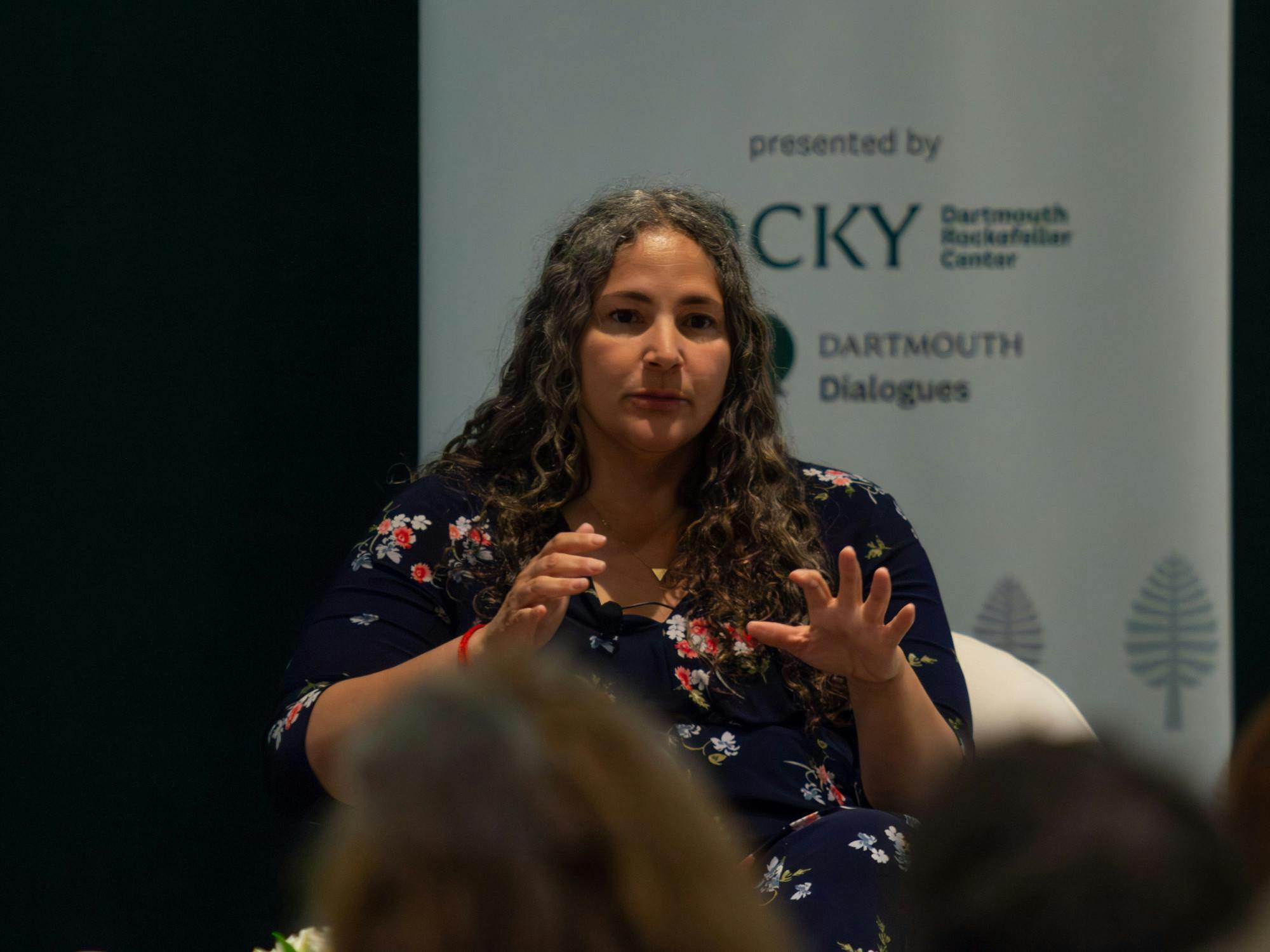
On May 12, Yale University psychology professor and podcast host Laurie Santos discussed the “student mental health crisis,” the impacts of artificial intelligence on mental health and the policy applications of happiness science at an event hosted by the Rockefeller Center for Public Policy.
The event — moderated by history professor Darrin McMahon — was part of the Rockefeller Center’s “Law and Democracy: The United States at 250” speaker series and its “Pursuit of Happiness” speaker mini-series. Approximately 170 people attended the event in Filene Auditorium, and another 175 streamed the event online, according to Rockefeller Center associate director for public programs and special events Dvora Greenberg Koelling.
Santos’s research focuses on the psychology of happiness and how people can “make wiser choices” and “live a life that’s happier,” according to her website. She hosts the “The Happiness Lab” podcast, which has amassed over 150 million downloads since 2019.
Santos began the event by noting the “staggering” mental health crisis she has observed among her students at Yale during her time as a professor.
“I was watching my students suffer from panic attacks, or worse,” Santos said. “That made me really question what my institution was doing in terms of mental health.”
Santos said that she created the course “Psychology and the Good Life” in 2018 to teach Yale students about strategies to improve their well-being. Around a quarter of the student body enrolled in her class in its inaugural year, making it Yale’s most popular course offering in over 300 years, according to Santos.
“I did not expect the only place to teach it on campus would be our concert hall,” she said.
Santos said “doing stuff for others,” such as by donating or volunteering, makes people happier. “Modern culture” gets happiness “so wrong,” she argued.
“If you go on TikTok, you will see somewhere something about self-care or treat-yourself or ’me, me, me,’” Santos said. “But if you look at the happiness research, that’s just not what predicts people’s happiness. Happiness is about being other-oriented.”
When McMahon asked her about the impacts that happiness science could have on public policy, Santos answered that the science is “super clear” about the “powerful” effects that universal basic income — programs that provide unconditional cash payments — could have on people’s well-being.
“If you give low-income people more money, it will necessarily make them happy,” Santos said. “If you have to tax higher income people to get that money, it’s going to have absolutely no effect on their happiness.”
Santos added that she believes four-day work weeks could also improve well-being because they would both improve productivity and allow for more leisure time.
“We forget the importance of time,” Santos said. “[Workers] get more of the bottom-line stuff done, and they also have time to rest and do other things.”
The moderated discussion was followed by an audience Q&A. One student asked Santos whether AI should be used for therapy considering recent incidents in which AI chatbots encouraged users to commit self-harm. Santos responded that the technology “isn’t so hot” at telling the difference between “good and bad” advice.
“I think these tools are getting better, especially as these awful incidents are coming out,” Santos said. “It’s dangerous … Many of us are feeling lonely, and … people are turning to these tools for friendship, advice, companionship.”
Another student asked about Santos’s thoughts on the “relationship between comparison and happiness.” Santos explained that the human brain interprets the world through comparison.
“We don’t think about anything in objective terms … including our grades, our beauty, our salary, our accomplishments,” Santos said. “We only think about them in relative terms.”
In an interview with The Dartmouth after the event, Santos criticized the competitiveness of the college admissions process, which she called an “arms race.”
“It’s making students more hustle-y and more stressed out,” Santos said. “It’s not actually making them perform or learn any better.”
Attendee Ines Charles ’29 said Santos’s comments about the competitive nature of college was “vital” for students to hear.
“Dartmouth, especially, is an amazing campus and it has a great community environment, but it has this hidden competitiveness,” Charles said.
First Generation Office director Jay Davis, who attended the event, said connecting first-generation students to Santos and her research was “really important.”
“For our students who have so many things off campus that can be challenges … their own wellness and happiness is such an important piece,” he said. “There were a lot of students that were thrilled to make that connection.”
In an interview with The Dartmouth after the event, McMahon praised Santos for her ability to connect with students.
“She has this incredible capacity to take a big, big subject like happiness and make it personal very quickly,” he said.
Kay Alvito ’29 is a news reporter from Rio de Janeiro, Brazil studying comparative literature and creative writing. On campus, she is very involved with the arts as a member of the Rude Mechanicals classical theatre company and the dance group Street Soul.