
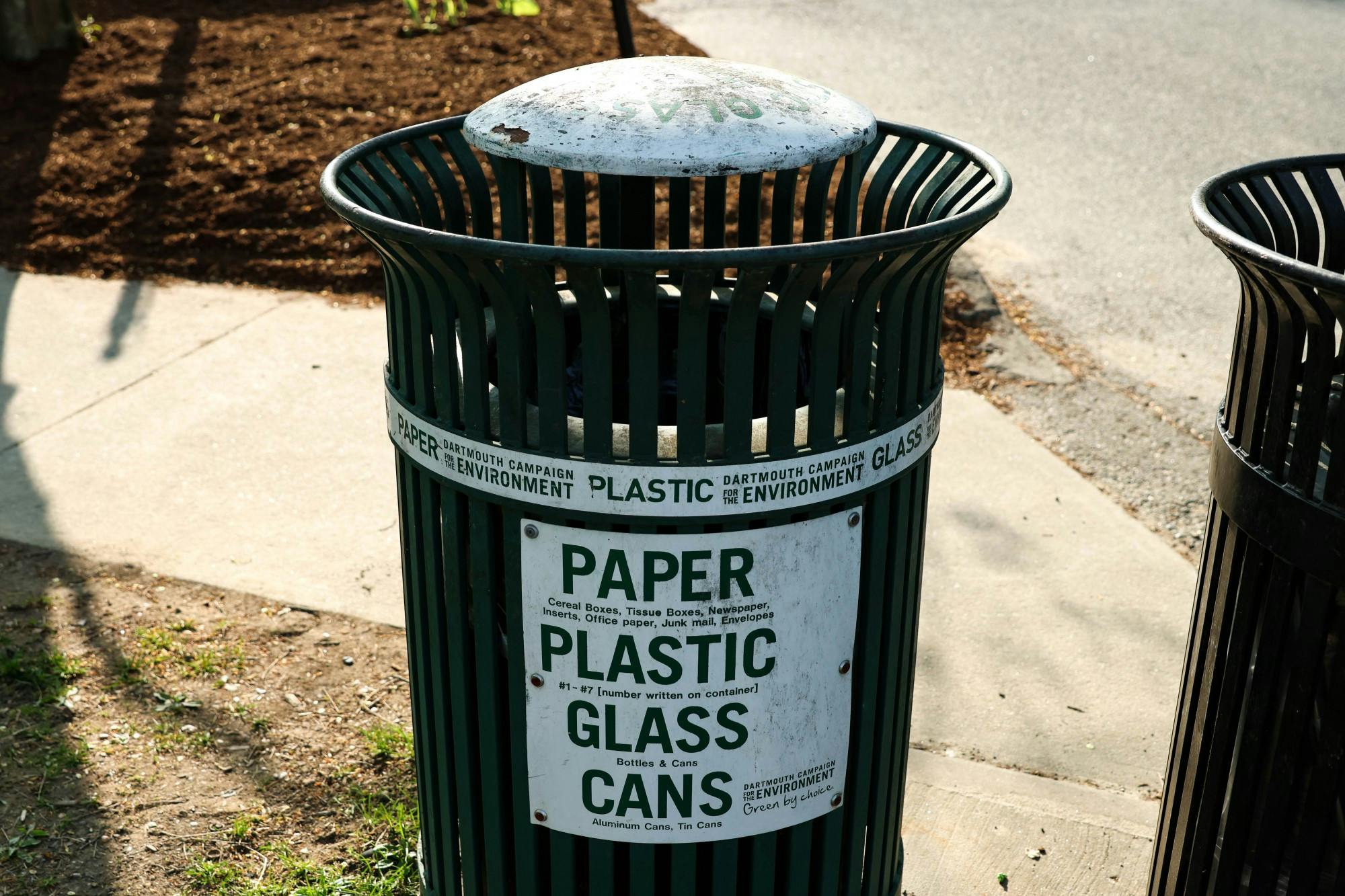
Walking across the Green on an unusually sunny day during an otherwise bleak Hanover spring, you’ll see armies of students playing spikeball and hacky sack, kicking soccer balls and throwing footballs and sitting on blankets with friends. You’ll also notice clusters of students eating from Collis paper bowls with plastic utensils and cups — containers that, by the end of the afternoon, are stuffed into or stacked precariously on top of overflowing trash cans.
Where does all of that waste actually go? What happens when a student tosses food into a recycling bin, and how much of Dartmouth’s waste is truly recycled?
In an email statement to The Dartmouth, campus services senior contract manager Susie Weider said Dartmouth disposed of 1,588 tons of waste from the start of fiscal year 2026 through March 31 this year. About 868 tons of that was “municipal solid waste,” or household garbage, paper, commercial refuse and yard waste. The remainder was a mix of cardboard, metals, food waste and building debris. Twenty-two tons of waste were recycled from bins around campus; however, a larger number was put into recycling bins before being taken out of the stream. Dartmouth’s diversion rate — the percentage of waste diverted away from landfills or incarceration — for the start of fiscal year 2026 through March 31 was 33.49%.
Recycling at Dartmouth is processed through a single-stream recycling system that operates through Zero-Sort, a single-stream waste management system managed through Casella Waste Systems, a waste management company, Weider wrote. Single-stream recycling allows individuals to place all their recyclables in a single recycling bin or cart. Dartmouth Sustainability operations associate director Marcus Welker said in a statement to The Dartmouth that campus services move waste from recycling bins across campus to a compacting dumpster, where it is then picked up by Casella and taken to a facility in White River Junction, Vt. From there, the recycled waste goes to Casella facilities in either Rutland, Vt., or outside of Boston.
According to Welker, the recyclables undergo various quality control checks along the way that detect contamination, which occurs when non-recyclable items are included with recycled items. Once found, contaminated recyclables are rerouted to the landfill.
“One of the challenges with single-faced recycling is that everybody who’s using that bin has to get it right in order for that material to be kept in the recycling stream,” Welker said. “Just one person making a mistake, like putting a cup of coffee or a greasy pizza box into a bag of recycling, can contaminate the entire bag and take it out of the recycling stream. The threshold is zero.”
In certain areas of campus, especially near dining locations, Welker said Dartmouth’s recycling is “nearly 100% contaminated.” He added that the best way to help decrease contamination rates is to “keep it simple” when sorting your waste.
“When in doubt, throw it out,” Welker said.
Welker mentioned one of the biggest obstacles to effective recycling is simple confusion, noting that many trash and recycling bins across campus look “nearly identical.”
“As a community, we are not sorting our materials well enough to allow for substantial quantities of it to be recycled,” said Welker.
On the other hand, some students argue that the College has not done enough to educate students about what can and cannot be recycled.
“Most people simply do not understand what things can or cannot be recycled,” Issa Allison ’29 said. “I think we can definitely do better education campaigns.”
Sebastian Rao ’28 added that the College’s continued reliance on single-use plastics contributes to careless waste habits.
“The College continues to sell a lot of food in single-use plastic containers, and it allows students to be careless with how they treat their waste, which means instead of recycling it properly, they end up throwing it away,” he said. “If instead the College were to use things that were biodegradable, it wouldn’t matter as much about the environmental impact of their food habits, or their eating habits.”
Environmental studies professor D.G. Webster said that recycling as a whole is not the right solution to waste.
“Frankly, recycling is like putting a Band-Aid on a gash,” Webster said. “It’s not a real solution.”
Like Rao, Webster said she believes that the College should focus on sourcing biodegradable products, adding that they are “a lot cheaper and more reliable” than in the past. In 2023, Dartmouth self-hauled almost 1,000 tons of its compost to Lebanon, which is only capable of disposing of food waste and cannot process other types of biodegradable materials. Instead, Webster argued, Dartmouth should work with waste-management operations in Norwich.
“It’s right across the river,” she said. “They can take all sorts of biodegradable materials for compost. So you have to think about the whole system.”
Webster noted that some incremental changes have been made since she began teaching at Dartmouth in 2009, including the addition of paper recycling bins in administration buildings and a temporary removal of trays in dining halls. She pointed to the latter as an example of past efforts to reduce waste at the source.
“There’s studies that show that food waste goes down if you don’t have trays,” he said. “...My guess is that there’s not a ton of options for other and better recycling.”
In an email statement, Dartmouth Dining director Jon Plodzik wrote that DDS is “deeply committed to sustainability.” For example, “approximately 99%” of single-use dining ware is compostable, while reusable container programs like Green-to-Go remove “500-700 containers out of the waste stream every day,” he wrote. Meanwhile, new software in the dining hall helps identify and reduce food waste. Any more info on this?
Other administrators also emphasized that recycling and waste reduction remain active priorities across campus. Weider wrote that students and employees receive recycling information during orientation, while campus buildings and collection containers feature signage with proper disposal practices. She also wrote that the Sustainability Office hosts periodic educational events — including programs with Casella — to promote correct recycling habits.
“There are people working really hard every day to make sure that as many materials as possible are being recycled,” Welker said. He also pointed to initiatives such as the campus thrift store and bike shop as part of Dartmouth’s broader effort “to minimize the waste that we’re producing” and “encourage reuse.”
For many students, recycling on campus is less a question of willingness than of knowing what actually belongs in the bin. Rao explained that improper disposal habits often undermine the system entirely:
“I’ve noticed that a lot of students prefer to use single-use plastics that they then either litter, or they don’t recycle,” Rao said. “When they use paper or metal, they don’t actually recycle them properly. They leave them with food in them, which means that they can’t recycle them, and if they attempt to recycle them, then the batch of recycling gets ruined and then it has to be thrown away and put in a landfill.”
Welker added that it is important for consumers to be “conscientious” of the materials they buy and how their food is packaged.
“We make a lot of choices as consumers and that is probably one of the critical places where we can make different or more recyclable decisions.”
From moving to biodegradable products to trashing a dirty coffee cup rather than recycling it, even small actions can collectively make a meaningful difference.
As a notable Dartmouth alumnus once said: “Unless someone like you cares a whole awful lot, nothing is going to get better. It’s not.” - Theodor Geisel, Class of 1925.
Jared Gonzalez Arce '29 is a news reporter from California majoring in history. Out of The D, Jared is in surf club and loves music.


