
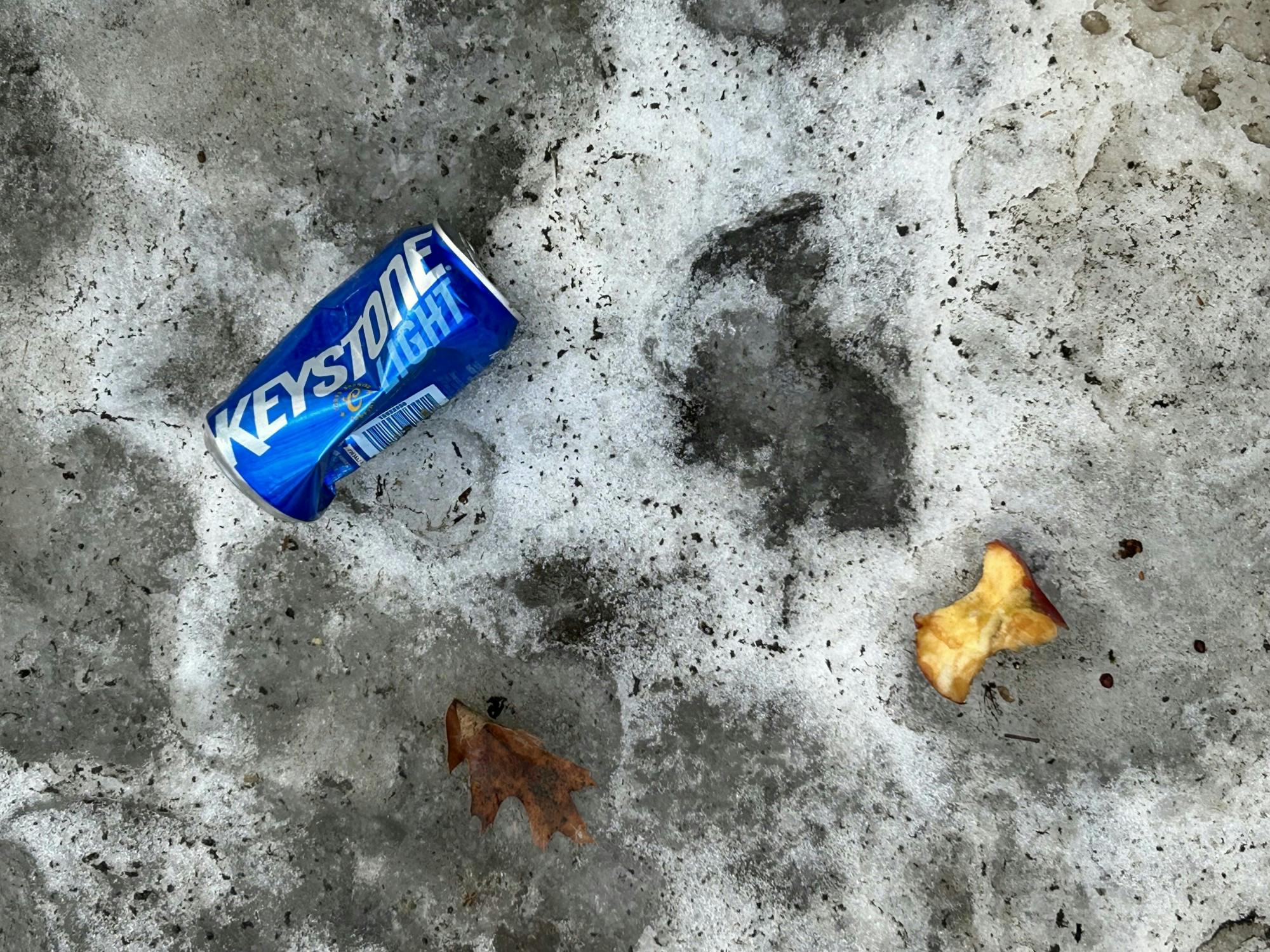
It’s midnight on a Wednesday, and someone wants to play a game of pong. They enter a basement that reeks of sweat and musk, where brothers are cracking open and sipping the amber runoff from an infamous blue can.
Every college has its signature beer. At Dartmouth, it’s Keystone Light. And if you didn’t know that before you got to campus, you found out quickly.
“I never heard of Keystone until Dartmouth,” Nelson Mendels ’27 said. “I think it’s kind of funny how we’re the only college that really drinks it.”
But how did a mid-tier light beer become Dartmouth’s drink of choice? The answer involves a vendor screw-up and one very consequential Green Key weekend.
According to Jack Stinson, owner of Stinson’s Village Store — the go-to alcohol store for Greek Life — for years, Dartmouth’s Greek scene ran on Milwaukee’s Best beer, “The Beast,” as everyone called it. It wasn’t always cans, either; The Beast came almost exclusively from kegs. On a big weekend like Green Key, Stinson’s would sell around 320 kegs over three days, and six per Greek house was standard. The Beast was so entrenched that visiting alumni would walk straight to the cooler and pour themselves a cup without a second thought.
In May 1991, the College banned kegs from fraternity basements, which forced houses to switch to cans, according to Stinson. Suddenly, the logistics of The Beast became complicated. When not in a keg, the beer was sold in structurally weak, 24-count cases. Stinson described it as a nightmare.
“Try to carry a case and it falls all over the place,” he said. “No one’s going to carry a loose 16-ounce, 24-pack of cans.”
Members of Greek Life needed something more easily transported and that came in larger quantities. But no brands had stepped up to fill that gap — not even the big names.
“Bud and Bud Light and all that, they didn’t even have 30-packs,” Stinson said. “No one was really geared towards 30-packs because kegs were so prevalent, so cheap.”
Then came the disaster. According to Stinson, at some point in the late 1980s or early 1990s, Seneca Beverages —The Beast’s local distributor — made a crucial mistake: They received out-of-date beer in New Hampshire and couldn’t legally ship it up to Hanover for Green Key.
“Everyone was so upset,” Stinson said. “We were saying, ‘just ship it, they’ll drink it.’” But legally, they couldn’t.
The emergency backup was Pabst Blue Ribbon. Capital Distributors, a competing beverage company owned by a Dartmouth alumnus, had enough PBR on hand to cover the weekend.
But the alumnus saw a larger opportunity. With kegs banned and students seeking larger packs of beer, he moved fast. He went through New Hampshire’s licensing process and became the first supplier to get Keystone’s 30-packs authorized for sale in the state, according to Stinson.
Suddenly, Keystone had what The Beast couldn’t offer in a post-keg world: A sturdy and stackable 30-pack.
Soon, Greek house social chairs started asking Stinson if they could get Keystone in kegs, not just 30-packs; the College’s policy had changed by then to require kegs to be registered with the College. Stinson made it happen. And just like that, the transition was complete.
As Stinson put it: “You never thought anyone could ever jump in and take Milwaukee’s Best. Everyone was always coming in asking for ‘The Beast.’ Now, everything’s changed.”
It’s important to note that Stinson’s story is not what The Dartmouth originally reported in 2004. According to that article, Keystone was introduced to Hanover in 2000 by two sororities: Kappa Delta Epsilon and Sigma Delta. The fraternities supposedly pushed back at first, but the rest of campus quickly adopted it. The article claimed that Keystone became the dominant beer in the winter term of 2001, partly because students preferred its taste to that of The Beast. Still, Stinson is adamant that the switch occurred before.
Regardless of how Keystone actually arrived, students today take its dominance for granted.
“I think it’s just now it’s like a thing — that’s what you do,” Lily Tuttle ’27 said. “I wouldn’t go play pong with a different beer. I feel like it would be wrong.”
That logic holds even for people who don’t enjoy the taste.
“I don’t know anyone that likes it,” Tuttle said. “I feel like a lot of people have conditioned themselves to like it.”
Tuttle has visited friends at Ohio State University and the University of Alabama — schools with their own Greek scenes — and everywhere, the reaction was the same: “You drink Keystone?” At those schools, bar culture fills the gap. At Dartmouth, there are few bars to speak of — hence, the prevalence of one type of booze. Now, Tuttle pointed out, Keystone has been thoroughly ingrained into Dartmouth’s culture.
“I think now it’s just culturally embedded,” she said. “I don’t know how it got that way, but I think now it’s to a point where we can’t change it. Would we even want to?”
Why does Keystone endure today? Besides the fact that it’s comfortably the cheapest beer available, one can only guess. I asked Stinson if the rumor’s really true that Dartmouth accounts for one percent of Keystone’s production, and he simply said that would be impossible, since only a quarter of the student population is legally allowed to drink alcohol.
“What are you really saying?” he asked.
I guess we’ll never know. Still, not bad for a beer that costs less than a dollar per can.
Molson Coors and Keystone did not respond to requests for comment.


