
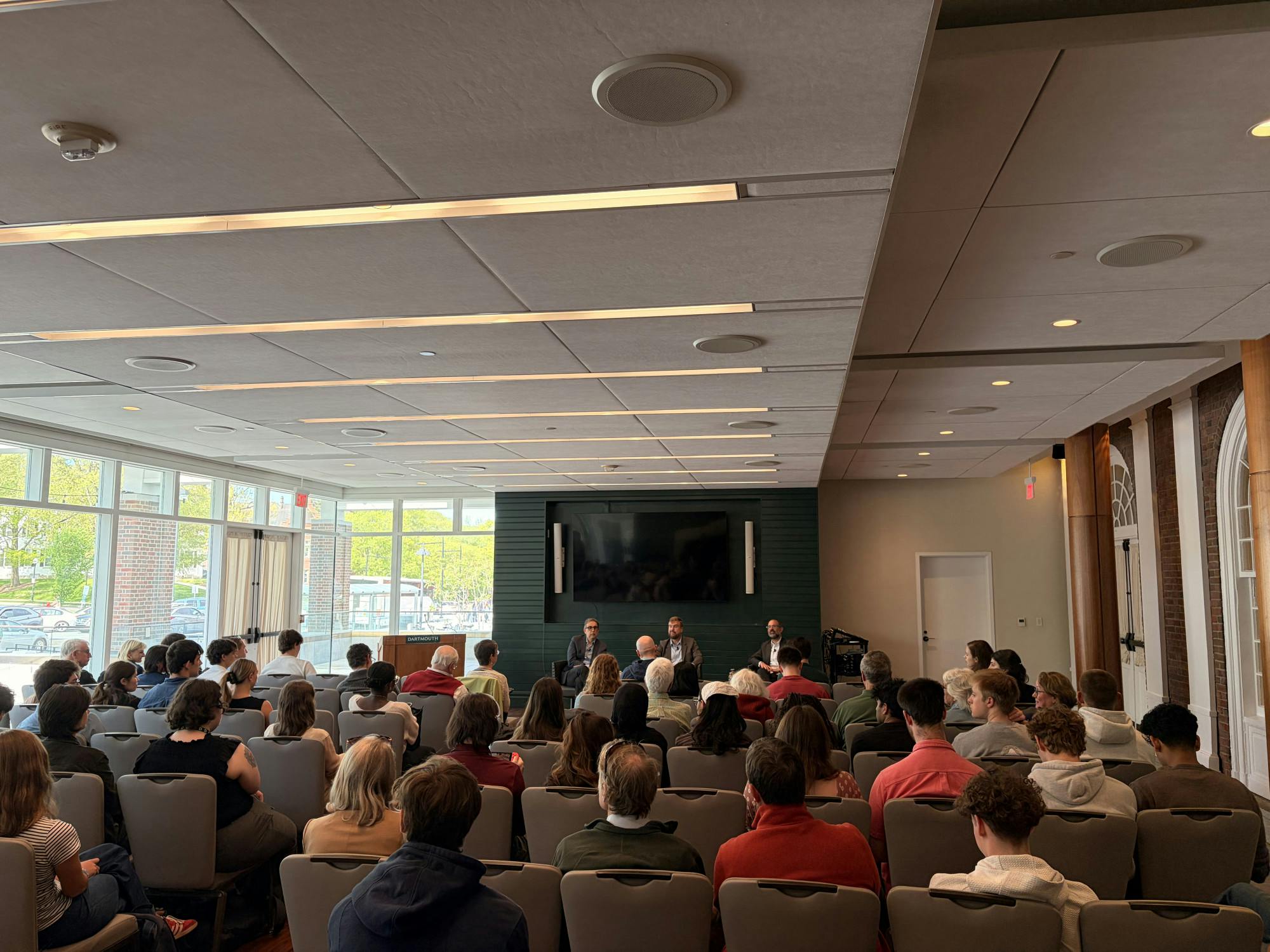
On May 21, the Foundation for Individual Rights and Expression president and chief executive officer Greg Lukianoff, who will receive an honorary Doctor of Laws degree at Commencement next month, condemned the state of freedom of speech in higher education at an event in the Hanover Inn.
FIRE is a prominent free-speech organization known for its rankings of colleges and universities for their speech climates. Last fall, FIRE ranked Dartmouth 35th out of 257 in the nation for freedom of expression, up from 224th out of 251 in the 2025 report. The College was the only Ivy League university to receive FIRE’s “green light” rating for its free expression policies in 2025.
The Dartmouth Dialogues event — which was co-moderated by distinguished fellow Ezzedine Fishere and Middle Eastern studies professor Jonathan Smolin — was attended by 80 people, according to School of Arts and Sciences event coordinator Tammi Klotz.
At the event, Lukianoff argued that higher education must take “seriously” points of view that many would “find deeply offensive” because “you only know what is true when you’re allowed to actually test it.”
“Unfortunately, I think way too many campuses have taken on this moral role where they actually think that, ‘because my norms find what you might want to say highly offensive, I am going to stop it,’” he said.
He criticized administrators in elite academic institutions who try to “rebalance” the unequal power they see in American society with “[their] judgement on what must and must not be allowed.”
“That kind of thinking is almost always motivated reasoning and … self-serving, and frankly, overwhelmingly represents the point of view of upper-class Americans,” Lukianoff said. “It ends up being a cultural imposition of the upper-class norms on everybody else.”
Lukianoff added that he believes higher education should demonstrate “radical open-mindedness” to ideas and play an “uncomfortable” role in advancing free speech. Responding to an audience question during the Q&A about whether a university should allow a hypothetical speaker on campus who believes Jewish people control the media, he said he thought the school should allow the speaker because it is important to hear “what people really think.”
Dartmouth has performed well in FIRE’s rankings in recent years because of its revision of its speech policies in 2024 “to align with First Amendment principles,” the adoption of an institutional restraint policy and its ideologically diverse student body, Lukianoff wrote in an email statement to The Dartmouth. He cancelled a previously-scheduled in-person interview.
“One difference between Dartmouth and its Ivy League counterparts, which may have something to do with its superior free speech climate, is that the Dartmouth student body is actually relatively politically diverse with a ratio of only 3.33:1 liberal to conservative students,” Lukianoff wrote, citing a self-reported statistic on FIRE’s Dartmouth webpage.
In FIRE student surveys, the share of students who believe it is “very” or “extremely” clear that the College “supports free speech on campus,” improved from 20% in 2025 to 27% in 2026, which also contributed to Dartmouth’s improvement in the rankings. The 2025 survey was conducted with a sample size of 162 students, according to FIRE’s website; sample size data for the 2026 survey was not publicly available.
Dartmouth’s 2026 scores on tolerance for both controversial liberal speakers and controversial conservative speakers were more than two standard deviations above the national average that FIRE found, Lukianoff added in his email statement. According to FIRE’s methodology page, tolerance scores are calculated through student surveys and measure how willing students are to allow liberal or conservative speakers on campus, even when they disagree with them.
The announcement of Lukianoff as an honorary degree recipient has been met with backlash. Some community members have questioned the close timing of the College’s improvement in FIRE rankings and the awarding of an honorary degree to Lukianoff. In the email statement, Lukianoff responded that FIRE’s research team uses a “rigorous methodology” to determine rankings and that he has “no input” in any school’s ranking.
Members of the Dartmouth LGBTQIA+ Alumni Association board of directors also wrote a May 19 guest column in The Dartmouth that encouraged audience members to turn their backs when Lukianoff is awarded his honorary degree at Commencement to protest his previous characterization of transgender activists as “totalitarian” and the focus of FIRE’s online guide to pronouns on why misgendering cannot legally constitute harassment.
Lukanioff wrote in a May 19 post on X that he would defend the rights of participating attendees to “peaceful, non-disruptive protest.”
“I would make no exception for protests against me personally,” he wrote in his email statement. “This is the post on X that I believe the authors of the op-ed were responding to. I stand by it.”
In the email statement, Lukianoff wrote that his primary concern regarding free speech on college campuses has shifted from — what he called — the “unholy alliance” between administrators and students who come to campus with “illiberal ideas and expectations of emotional safety” to the Trump administration’s “truly unprecedented targeting of higher ed[ucation].”
“Higher education absolutely needs reform, but any reform must comply with the First Amendment and academic freedom,” he wrote.
Lukianoff addressed the same free expression concern at Thursday’s event.
“We’re still seeing old school, as in 2020-style, cancel culture campaigns against students and professors who step out of line in some cases,” he said. “But we’re also seeing massive efforts from politicians on the right to go after professors and students who say things they don’t like.”
Because of these converging problems, the modern state of higher education is “a terrible mess” that features “the worst of both worlds,” Lukianoff argued.
A potential solution, he said, is to increase viewpoint diversity among faculty on campuses. Colleges, especially elite colleges, “have more self-proclaimed Marxists than [they] do conservatives,” Lukianoff said, citing national surveys. The Dartmouth could not independently verify this claim. In 2020, a Michigan State University survey of 1,141 social science professors at U.S. research institutions found that 84.7% identified with the Democratic party or leaned left and 3.6% identified with the Republican party or leaned right.
“This kind of group-think leads to less intellectual honesty and consequently less trust in higher education,” he said.
Lukianoff added that he supports hiring faculty members with the intention of increasing viewpoint diversity. He also “really likes” the idea of courses taught by two professors with opposing viewpoints, as the College has done with MES 12.18: “Difficult Conversations on the Middle East,” taught by Fishere and Smolin. Lukianoff said he also supported the concept of “counter departments” — academic departments that would counter “politically homogenous” sociology departments, for example — which he called “very sound thinking.”
“I do think that we [higher education] are spending a lot of time and a lot of energy working with assumptions that may not actually have any empirical basis in the first place,” he said.
Lukianoff concluded that a solution to problems he sees in higher education may have to come from outside of higher education because many faculty see themselves as in a “battle of good versus evil” and will fight efforts for viewpoint diversity amongst staff “tooth and nail.”
In an interview following the event, attendee Brenda Haynes, a former employee at the Dartmouth-Hitchcock Medical Center, agreed that tensions among university staff and faculty are hard to resolve but exist regardless of politics.
Tensions among staff are “in the nature of being human,” she said. “Maybe it’s not just all whether you fall along the left or right divide — there can be other issues.”
Dartmouth Political Union president Roger Friedlander ’27, who also attended the event, wrote in an email statement to The Dartmouth that Lukianoff’s message about litigating free expression cases in a “principled, consistent and nonpartisan” manner “resonated” with him.
“Together, free speech and diversity of viewpoint form one of the most powerful tools for universities in their pursuit of truth and the creation of knowledge, made possible only by uncomfortable and difficult but serious and intellectually rigorous conversations,” Friedlander wrote.
Will Sánchez '29 is a reporter from Portland, Ore., studying government and psychology.


