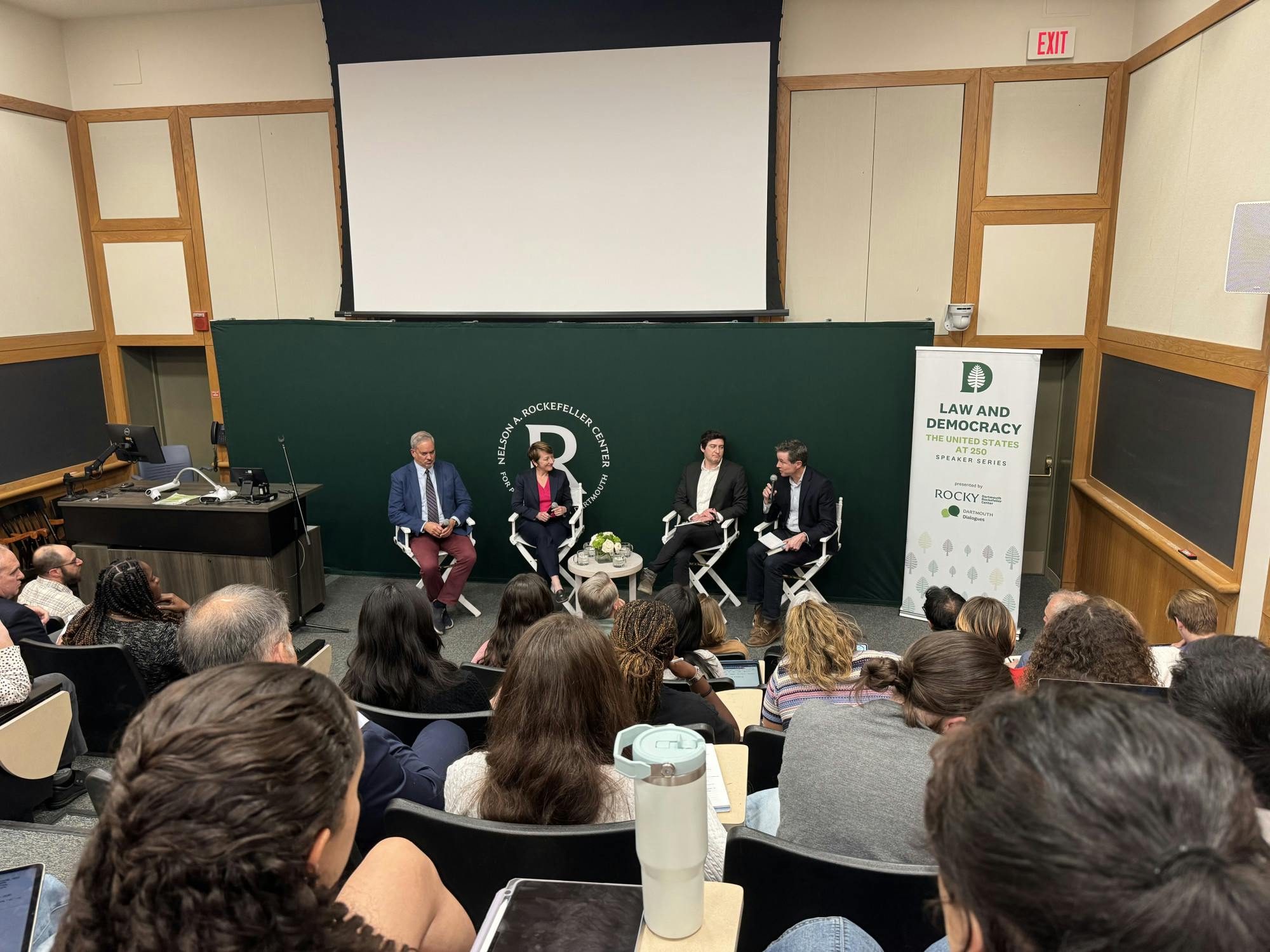
At a Rockefeller Center for Public Policy event on April 28, Princeton University political science professors Stephen Macedo and Frances Lee argued that COVID-19 pandemic lockdowns did not reduce disease spread and had negative consequences on education.
Approximately 120 people attended the event, with another 120 people livestreaming the program online, according to Rockefeller Center associate director of public programs and special events Dvora Greenberg Koelling. The event featured a 25-minute presentation from Lee and Macedo about their book, “In Covid’s Wake: How Our Politics Failed Us,” which was followed by a discussion moderated by government professors Herschel Nachlis and Brendan Nyhan.
The event was co-sponsored by The Dartmouth Institute, the Ethics Institute, the government department, Dartmouth Dialogues, the Office of the Dean of the Faculty of Arts and Sciences and the Office of the Associate Dean for the Social Sciences.
During the book presentation, Macedo said the book was about the “failure” of “truth-seeking institutions” during the COVID-19 pandemic and the “mishandling” of safety measures implemented.
“Science, journalism [and] universities … didn’t perform nearly as well as they should have during the COVID pandemic,” Macedo said. “We think that some loss of trust in elite institutions is understandable given these matters.”
Macedo said that prior to the outbreak of COVID-19, the World Health Organization and Johns Hopkins University released a systemic review about pandemic planning that “expressed uncertainty” about non-pharmaceutical interventions against pandemic spread.
“Contact tracing, quarantining, entry and exit screening and border closures … [were] not recommended in any circumstances, even in the worst pandemic,” Macedo said.
Macedo added that despite the review’s warnings, several non-pharmaceutical interventions, including contact tracing, border closures and quarantining were implemented during the COVID-19 pandemic.
Lee added that these measures, particularly school closures, negatively impacted education and future learning goals.
“The National Assessment of Educational Progress showed unprecedented drops in student learning in both reading and math, and there has not been any large-scale recovery since the pandemic,” Lee said.
Lee added that non-pharmaceutical COVID-19 interventions did not have any significant impact on mitigating the spread of the virus or reducing mortality rates.
“States that impose more stringent COVID restrictions … did not fare better than states that impose less stringent COVID restrictions,” Lee said. “[Those] that kept schools closed longer did not fare better than states that reopen them more quickly.”
Macedo said that while many European countries re-opened schools by April and May of 2020, several American states kept schools closed for over a year.
“European education ministers put out a statement on May 14, 2020, saying, our schools have been open for three or four weeks, we’re not seeing significant evidence of transmission,” Macedo said. “…The sustained inability [in the United States] to learn from experience of other places, to recalibrate and to change course … was extremely problematic.”
The Dartmouth was unable to independently verify Macedo’s claim.
In response to an audience question about what attendees should take away from the event for, Lee said the public response to COVID-19 offers a “cautionary tale” about refusing to hear dissenting voices.
“Policy extremism can result from a failure to engage with critics,” Lee said.
Another audience member asked whether pressure from teacher unions may have led to prolonged school closures in the United States.
Lee said that “organizational aspects of the story,” including teachers unions, may have been a factor in the prolonged school closures, but added that she thought that the partisan divide between Democrats and Republicans played a larger role.
“The partisanship of the jurisdiction remains the single best predictor of the length of school closures,” Lee said.
Marcella Arnesen ’28 said the event “was very informative.”
“It’s interesting that they pointed out that there has not been a lot of discourse after COVID-19 happened,” Arnesen said.
Ben Merrett ’28, who attended the event for his class PBPL 28: “Law, Courts and Judges,” said the speakers had “a refreshing take.”
“I thought it was good, whether or not I agreed with it 100%,” Merret said.
Madeline Kahn Ehrlich '29 is a reporter from upstate New York. She is considering studying English and Public Policy. She enjoys creative writing, art and reading historical fiction.