
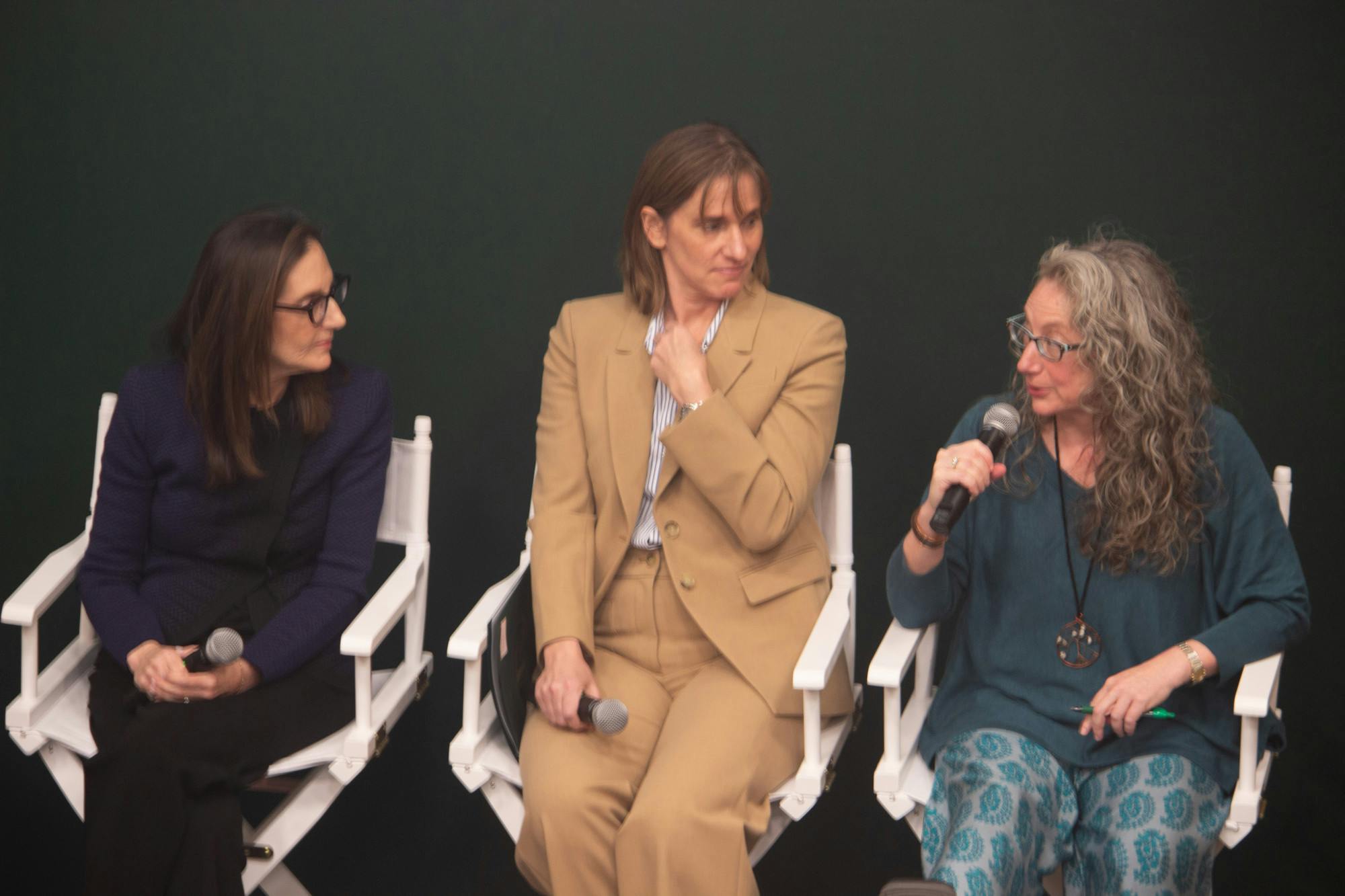
Americans should not “underestimate what a dangerous moment this is for women,” former U.S. attorney for the Northern District of Alabama and University of Alabama School of Law professor Joyce Vance told attendees at an April 27 event hosted by the Rockefeller Center for Public Policy. Vance pointed to legislation like the Safeguard American Voter Eligibility Act, which was passed by the U.S. House of Representatives on Feb. 11 and is now awaiting vote in the Senate. The SAVE Act would force women who have changed their last names to “jump through hoops” to vote, Vance argued.
MS NOW contributing analyst and Slate Magazine senior editor Dahlia Lithwick, former district attorney for Westchester County and Fordham School of Law professor Mimi Rocah and Vance spoke at the event, which was titled “Women, the Law and a Better American Democracy,” with Lithwick joining virtually on Zoom.
The event, moderated by government professors Julie Kalish and Anna Mahoney, was part of the Rockefeller Center’s “Law and Democracy: The United States at 250” speaker series. Approximately 120 people attended in the Rockefeller Center, while 150 people watched via livestream, according to Rockefeller Center associate director for public programs and special events Dvora Greenberg Koelling.
During the event, Vance argued that “civil rights issues” need to be thought of “as women’s issues.” She said she “took [her] civil rights obligation as the most important part of [her] job” when she served as U.S. Attorney, but “the priorities that surfaced” in an annual meeting with civil rights groups, attorneys and the civil rights division of the Department of Justice “never involved women.”
“Women, in many ways, have led the fight for democracy, and the pushback is strongly gendered against them,” she said. “[Voting] is a right, not a privilege, you should be able to exercise it.”
In an interview with The Dartmouth before the event, Rocah said she believes that returning to “a place where the goal is about our country and the American people, not the president” will look different depending on the political party in power.
“The President openly talks in terms of what he needs and wants, and his administration, including the Department of Justice, [goes] along with that and talk about it as if that is their primary goal,” Rocah said.
All three women spoke about books they are working on or have published about democracy and the law. Vance wrote her most recent book, “Giving Up Is Unforgivable: A Manual for Keeping a Democracy” after former Vice President Kamala Harris lost the 2024 presidential election. The book stemmed from a column of the same name on her Substack “Civil Discourse,” where she writes about the government and legal system.
After the 2024 election, Vance said she felt “deeply worried” when her friends told her they were “done” speaking up against President Donald Trump. “Public oppos[ition]” was a “guardrail” against the first Trump administration, Vance told attendees.
“I felt like going into this administration without public scrutiny could have been devastating for democracy,” Vance said during the event. “And it turns out, ultimately, … it’s the voters. We’re the last stand for democracy.”
Lithwick wrote her book, “Lady Justice: Women, the Law and the Battle to Save America” after the Supreme Court’s decision in Dobbs v. Jackson Women’s Health Organization was released in June 2022, overturning Roe v. Wade to allow states to regulate or prohibit abortion. In the book, Lithwick highlighted “unspoken heros” — the female lawyers who led cases during the first Trump administration.
“We can’t think that worshiping a hero saves democracy,” Lithwick said. “…We are the heroes. You really have to be the democracy warrior that you want to see in the world.”
Rocah is in the process of writing a book about Justice Department resignations during the beginning of the second Trump administration. Over 5,000 members of the Justice Department have been fired, retired or resigned since the beginning of the administration.
Rocah said she was driven by the approximately 1,600 rioters at the Jan. 6, 2021 Capitol insurrection who were “pardoned without any rhyme or reason” on the first day of the second Trump administration. Many of the pardons, and the order to drop the corruption charges against former New York City mayor Eric Adams, fell to the Southern District of New York, where Rocah was a prosecutor for 17 years. Rocah said the order to drop charges against Adams “in exchange for his cooperation with immigration enforcement” was “unethical” and “illegal,” motivating her to write the book.
“We were watching the Department of Justice be literally dismantled,” Rocah said at the event. “… I wanted to be there to capture what was happening.”
In an interview with The Dartmouth before the event, Vance said she thinks of American voters as a “frequently overlooked institution,” and that she hopes there will be large voter turnout during the 2026 midterm elections.
“Democracy is a contact sport, and we’re the players in it, and this is the time to get off the sidelines and play,” Vance said.
In an interview with The Dartmouth before the event, Rocah said that she often doubted herself and “thought that everyone else knew something” that she did not when she first started work at the U.S. Attorney’s office.
“We tend to think that other people have some secret sauce that we don’t have, whether it’s intellect, charm … but I think that’s just self doubt,” she said.
Attendee JJ Dega ’26 said that as “someone who’s interested in going into law,” he thought it was important to hear the speakers talk about how to “uphold” institutions, such as the Department of Justice and “law and democracy.”
“It will be the task of our generation to rebuild those norms and systems in a positive light, to make sure that the things that we’re seeing right now are not replicated in the future,” Dega said.
Attendee Sophie Scheible ’29 said she enjoyed that the speakers “emphasized how much their connections” to other women helped them in their careers.
“It’s very important at a time when it’s very easy to feel discouraged as a woman to hear from really powerful and successful people,” she said.
Eliza Dorton '29 is a reporter from Washington, D.C. and is studying English and public policy. Outside the classroom, she enjoys reading and going on walks.


