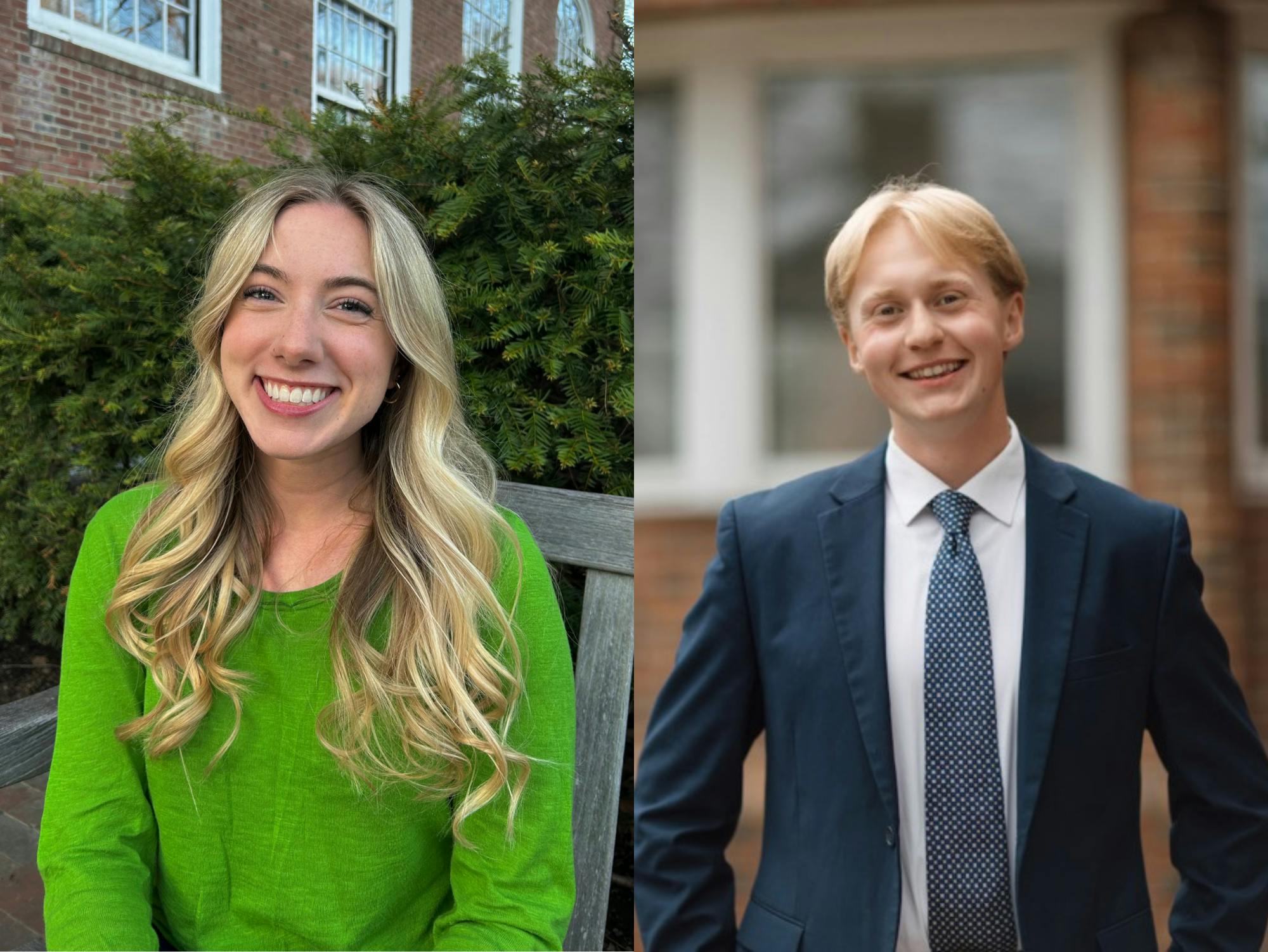
On April 17, Gracie Bartos ’27, Jackson DeConcini ’22 and Will Nelson ’27 were awarded the Harry S. Truman Scholarship, joining a cohort of 55 students selected from 761 candidates across 305 colleges and universities. The scholarship is awarded for “leadership potential, a commitment to a career in government or the nonprofit sector and academic excellence,” according to the Truman Foundation website.
The scholarship awards $30,000 to students from all 50 states and five U.S. territories. Awardees use the funds for graduate school and must commit to public service jobs for at least three years within five years after completing their education.
Bartos plans to obtain a J.D. and Master of Divinity joint degree with a focus on religion in public life. DeConcini will earn a J.D. and Master of International Policy joint degree with a focus on humanitarian aid. Nelson plans to obtain a J.D. with a concentration on antitrust enforcement.
The Dartmouth spoke with Bartos, DeConcini and Nelson about their backgrounds, areas of interests and future plans.
What was your initial reaction to winning the Truman Scholarship?
GB: Three days went by between us getting the first word that students at Bowdoin College and the University of North Carolina at Chapel Hill had won and when we got an email from College President Sian Leah Beilock saying that we had won. The email mentioned that this is the first time Dartmouth has had three winners in one cycle, which felt really special.
JD: Excitement. They emailed us a few days before we got the most exciting bit, which was the phone call from President Beilock, in which she called me to let me know that I had won the scholarship, that she had read my application and that she was very impressed with the work that I had done.
WN: I was really surprised and excited. I had never really considered that I would get it or even be a finalist. We had to wait a few extra days, so I kind of told myself that I didn’t get it. Then I got an email from President Beilock, and we were like, “Oh my God, we got it.” Gracie texted me, and it was kind of cool because we’re very close friends. So, we’re going to get to explore this together.
What did the application process look like for you ?
GB: The interesting thing about their application is they require you to submit what they call a policy proposal. Essentially, you pick a policy that you would change, and you get space at the end of the application to write a letter to the ranking member of whatever subcommittee would be in charge of passing that legislation. I chose school vouchers, which are used at private institutions to subsidize financial aid for tuition.
JD: I think there were 17 questions. Some were very short, such as the top three classes that you’ve taken at Dartmouth, but some were much longer essays. It took multiple revisions, working with our fellowship office, and also just thinking about how I wanted to frame my narrative before I actually had something that I felt good about submitting.
WN: Dartmouth nominates three people every year, so we had to submit an application to the Office of Fellowships and Scholars Programs in mid-December. It’s kind of existential because you have to think about what your life is going to be like and then argue for it. The thing that I’m most honored by is that it’s a taxpayer-funded scholarship. It’s the American people putting their trust in you to give back to them.
What drew you to your particular area of interest?
GB: I graduated from a public high school in suburban Phoenix, in a town called Peoria, and what I saw in my school represented a lot of issues with the public school system right now — not just being grossly underfunded, but also a lack of separation between church and state. I saw the encroachment of religion on public education very clearly. In my opinion, grossest instances of church-state combination happen in the school voucher system. You can apply for a voucher that can be used at a private institution, but that money is taxpayer funded, so in certain instances, taxpayer dollars fund religious education and disproportionately fund Christian religious education. I wrote my application on how the voucher system is in violation of the First Amendment.
JD: My focus is on humanitarian negotiations. I worked with an emergency medical team in Gaza and Lebanon during recent wars, primarily doing negotiations between armed actors on the ground. I also did coordination of medical supplies and medical programming for the organization, but most of my work was communication with external parties. This is something that I had the very good fortune of not only doing on the ground, but studying and learning more about here at Dartmouth. I took an excellent class in the fall with professor Jason Lyall on the nature of humanitarian aid under fire, which was an excellent way to take all of that work and put it into an academic lens.
WN: I mentioned this in my application, but I’m one of a handful of people at Dartmouth from North Dakota. I’m from a very rural town called Jamestown. It’s the size of Hanover, but the next closest town of any size is an hour-and-a-half in either direction. It’s an area that hasn’t grown in size in 90 years. I love it very much, but it’s kind of been left behind by the people in Washington and even the people in Bismarck, our state capital. After growing up in Jamestown, I really wanted to make people believe that when they go to vote, it matters, and who they vote for will impact their lives. That’s guided my time at Dartmouth and all my interests in understanding how to make people believe in politics again.
What are your plans and goals for after graduation?
GB: I've always known that I would be pursuing a Master’s of Divinity degree. From the time that I was 14, I knew that I wanted to do that, but I’m combining it with a JD because these conversations of religion and law need to be taken seriously, both on the religious side and on the legal side. You need someone who understands the ins and outs of religion from a theological perspective and also understands the ins and outs of constitutional litigation to be able to litigate these cases and even adjudicate them in a way that upholds First Amendment religious freedom while also taking religion seriously.
JD: I’m planning to go to graduate school. The premise of the scholarship is that they not only fund this but support students in choosing which schools they want to go to and what would be the best program for them. I’m looking at a few different options. I think some sort of master’s in public policy in international relations may be quite valuable. But I also feel very drawn to law school. Even in the field of humanitarian negotiations, you deal with a lot of legal questions, and having that background and expertise would be incredibly valuable.
WN: I come from modest means, so this scholarship will materially help me pay for law school. But I also think the alumni network will be really helpful in gaining experience as I go through grad school. I’m just excited to be a part of 54 other people in 2026 that are really ferociously wanting to tackle these issues, and I think that this program does a really good job of finding people who have a burning desire to change things. By virtue of the program, you can’t sell out after you graduate. You have to go and work for the American people because the American people took a chance on you.
How has Dartmouth shaped your interest in public service?
GB: As a young person, I picked up books about religion by Randall Balmer, who works on American Christianity, and by Susan Ackerman, who works on women and religion and issues of women in the Bible. They both taught at a place called Dartmouth. And I was like, “What’s that?” So I told my college counselor I was applying, and she said, “You can’t get in, you can’t afford it, you can’t even pronounce it.” No one from my high school had ever gone.
When I got in, it was for the sole purpose of studying under these authors who changed my life at a young age and were working on things I really cared about. I now research for Randall Balmer, and Susan Ackerman is coming out of retirement to advise my thesis. In many ways, it’s really full circle to have these authors who changed my life now be my colleagues and people that I get to work with on these topics.
JD: Dartmouth has had an incredible impact in shaping my perspective on humanitarian negotiations. Public service was something I had interest in coming into Dartmouth, but I think here, I was exposed to many upperclassmen who had that kind of central drive and sense of purpose that made it very compelling to them.
As for my specific interest, it was a class I had taken with Professor Ezzedine Fishere on Israel and Palestine that kind of opened up my world to the amount of in-depth negotiations that happen, not only in emergency and crisis, but also generally in state building, in peace building and state creation that I really wanted to get into.
WN: I picked Dartmouth because of the availability of engaging with politics. It’s in New Hampshire, which is a swing state, and it’s first in the nation for the presidential primaries. It’s a state where votes really matter. I’ve also been so overwhelmingly surprised and grateful with how many chances you have to, on a random Tuesday, go meet the governor of North Carolina for lunch. Where else can you do that? That is one of the coolest parts of the school for me. I can also take these classes where professors challenge me.
This interview has been edited for clarity and length.
Correction Appended (May 4, 3:02 p.m.): A previous version of this article erroneously said that this was the first year that Dartmouth nominated three students for the award.